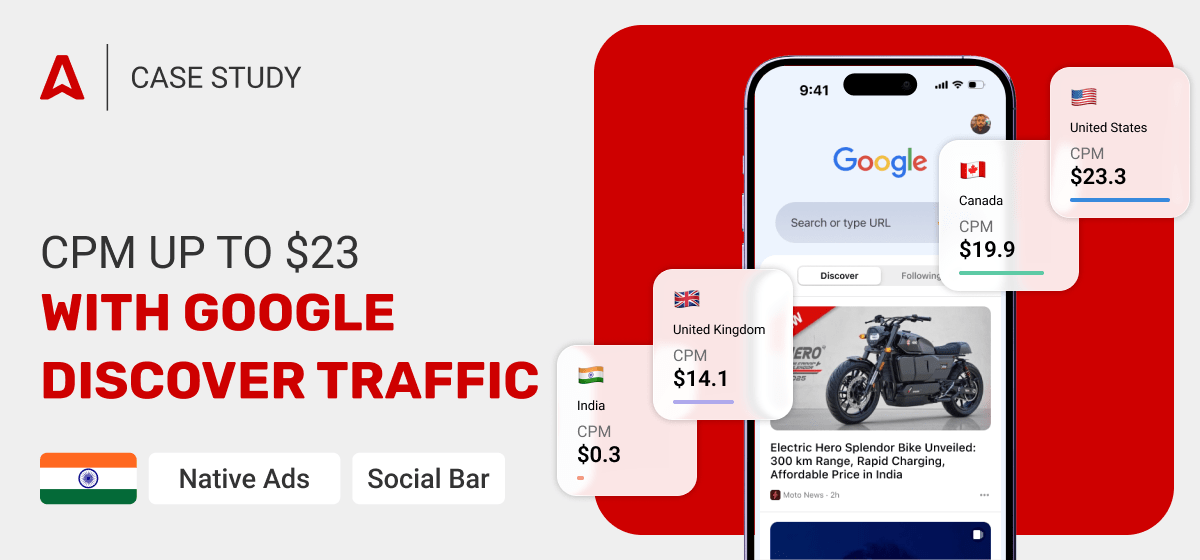
Speed, emotional relevance, and timing. That’s how Karan from India capitalizes on trending news using the power of Google Discover and display ads. His secret formula for generating almost $7,000 in revenue is far more intricate than simply watching trends and posting viral content. And he’s got the whole topic covered right here, right now.
“I’m continuously monitoring Google Trends, focusing on breakout topics with steep upward curves. I cross-reference this with what’s surging on social media, especially threads and posts generating rapid engagement. But let me explain the whole strategy, so you can reuse it for your blog’s monetization goals.”
Karan, news platform owner, SEO expert
My results with Google Discover and CPM ads
Results first. I now drive revenues from CPM ads and organic traffic coming from Google Discover and search platforms. My traffic breakdown:
| Category | World News and Facts |
| Google Discover Traffic | ~95% |
| Google Search Traffic | ~5% |
| Mobile Traffic | ~85% |
| Desktop Traffic | ~12% |
| Tablet Traffic | ~3% |
| Top GEOs (by revenue) | India (highest volume), Canada, United States, United Kingdom, Mexico |
| Publishing Frequency | 4–7 articles/day |
| Language(s) | English |
Detailed ad revenue breakdown by country:
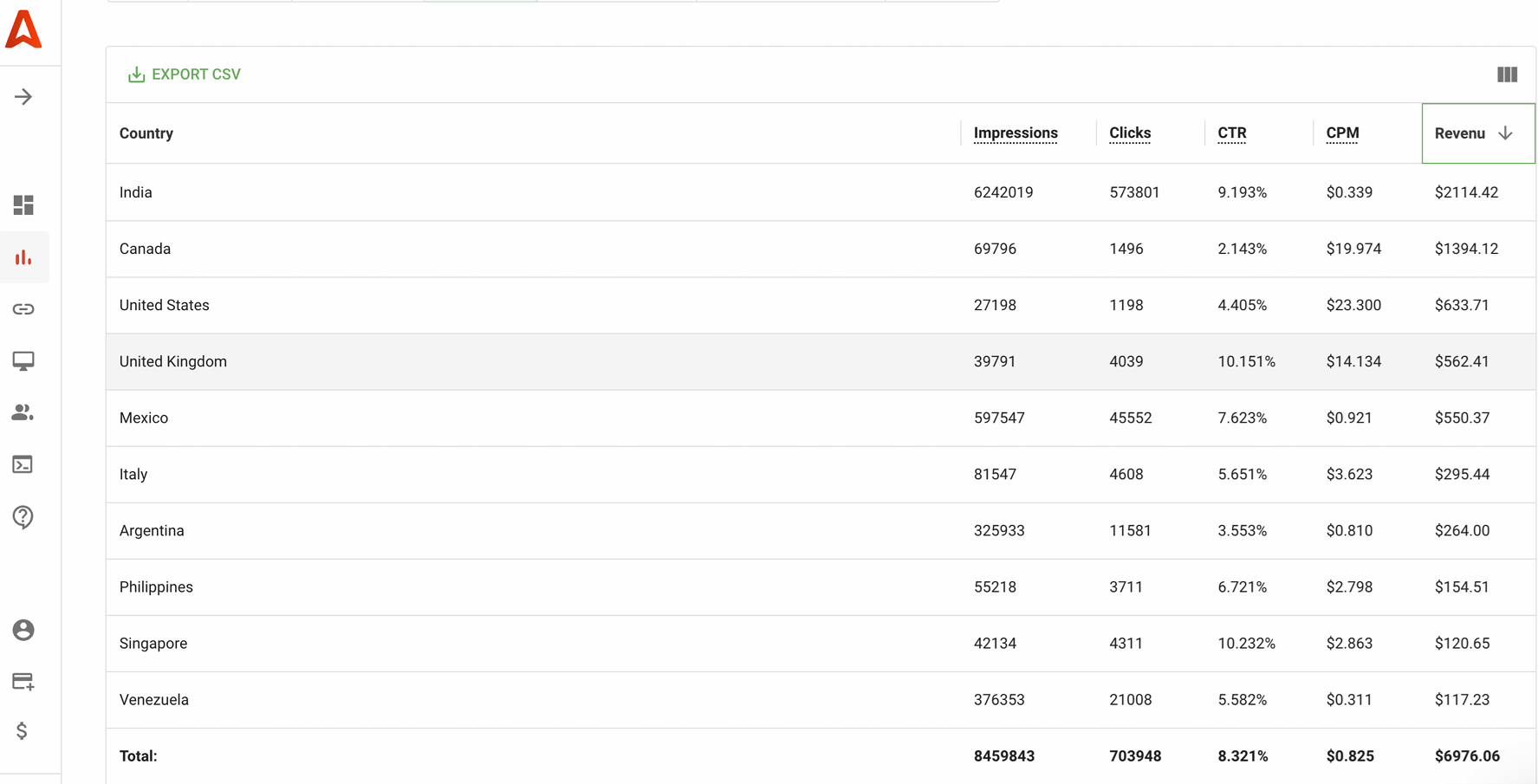
| Country | Impressions | Clicks | CTR | CPM | Revenue |
| India | 6,242,019 | 573,801 | 9.19% | $0.339 | $2,114.42 |
| Canada | 69,796 | 1,496 | 2.14% | $19.97 | $1,394.12 |
| United States | 27,198 | 1,198 | 4.40% | $23.30 | $633.71 |
| United Kingdom | 39,791 | 4,039 | 10.15% | $14.13 | $562.41 |
| Mexico | 597,547 | 45,552 | 7.62% | $0.921 | $550.37 |
| Italy | 81,547 | 4,608 | 5.65% | $3.623 | $295.44 |
| Argentina | 325,933 | 11,581 | 3.55% | $0.810 | $264.00 |
| Philippines | 55,218 | 3,711 | 6.72% | $2.798 | $154.51 |
| Singapore | 42,134 | 4,311 | 10.23% | $2.863 | $120.65 |
| Venezuela | 376,353 | 21,008 | 5.58% | $0.311 | $117.23 |
| TOTAL | 8,459,843 | 703,948 | 8.32% | $0.825 | $6,976.06 |
Here’s how I capitalize on trending news. In the table above, you see a detailed revenue breakdown by countries. Noticeably, India sends massive traffic and returns the highest profit. While its CPM is good, the US and Canada (Tier 1) are paid much higher.
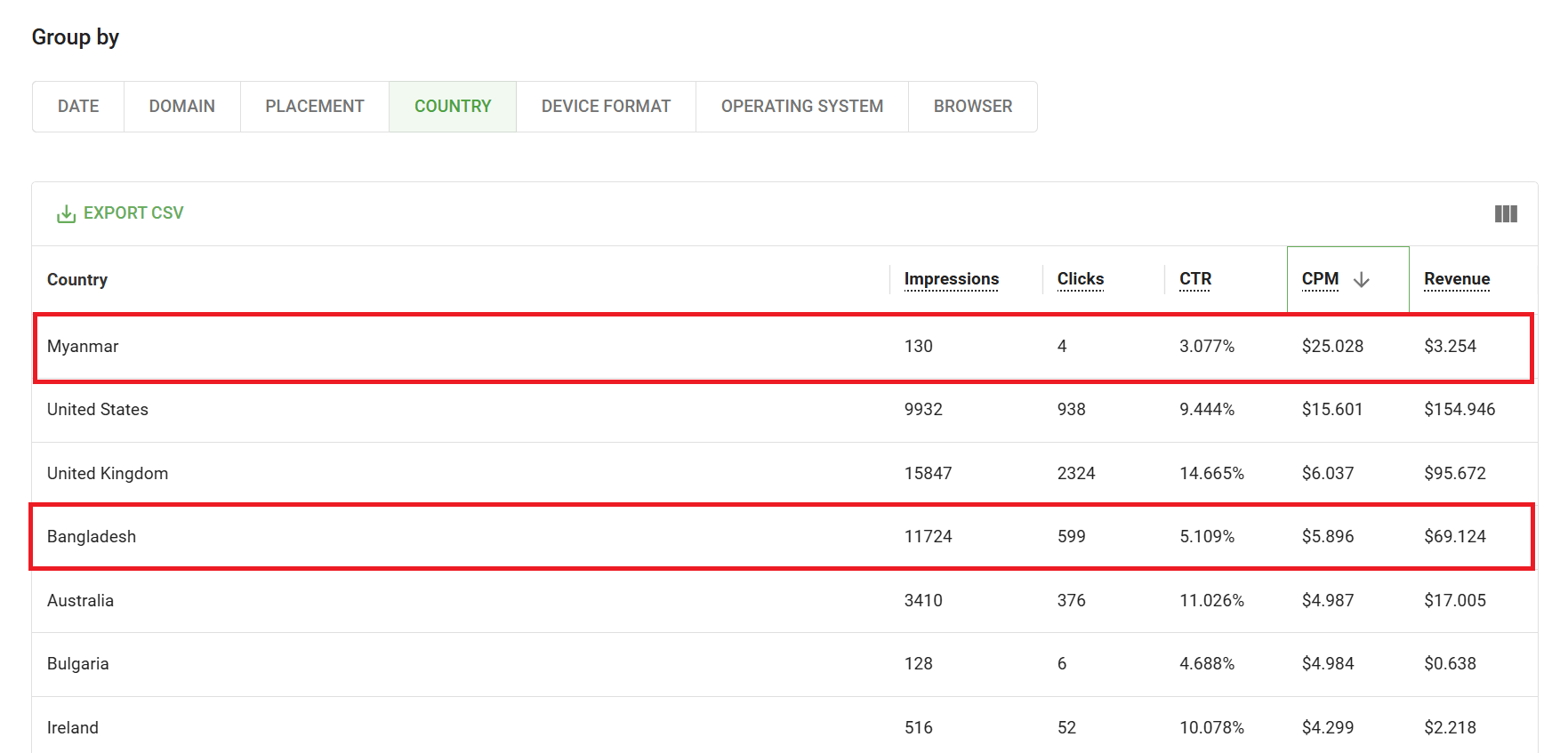
You may think that Tier-1 GEOs are the only driving powers. But it’s not true. If audiences you drive are loyal, stay long enough, click ads, and sign up for advertisements, Tier-2 and 3 GEOs also get top CPMs. You can hardly expect CPM $25 for Myanmar, but Adsterra has paid exactly this amount.
What do you need to start capitalizing on trends?
I’m now going to break down the necessary criteria to develop a website/blog for news content. The first part will uncover the tech stack, and the second one will reveal important on-site and reputational factors.
Tech stack: what a news site needs to drive Discover traffic
For a news website that focuses on trends, embracing multiple countries, I recommend focusing on the following:
- Fast-managed hosting with CDN. Free or shared hosting introduces latency that tanks mobile performance scores.
- Mobile-first design. The entire site is built and tested for mobile. Discover is all about mobile traffic (~85–90%).
- Minimal, clean theme. Heavy CSS/JS bloat kills Core Web Vitals.
- Correct Open Graph tags. Every article needs og:title, og:image (1200px+ wide), and og:description for proper Discover card display.
- NewsArticle schema markup. This one helps Google recognize content type and freshness signals.
- HTTPS on all pages. Any mixed content warnings hurt trust signals.
- No intrusive pop-ups blocking content. Such are penalized by Google because they destroy the reading experience.
- WordPress with Rank Math SEO + Ad Inserter. My current tech stack, and it’s not obligatory. The main principle is keeping your inventory lightweight, fast, and controllable in terms of SEO, schema markup, and ad placement. Want more recommendations? This guide for Google Discover optimization is a must-read.
Site reputation and content quality factors
Technologies make a foundation, but you can’t ignore vital reputational factors and quality content signs that Google approves.
- Site authority. Domain authority matters for fast indexing and initial Discover trust. I never tried breaking into Discover with a DR lower than 40–45.
- Core Web Vitals. High page loading speed on mobiles is critical. I advise monitoring LCP, CLS, and INP scores daily.
- No heavy or numerous JS: keep front-end JavaScript minimal to avoid render blocking.
- Seasonal and cultural alignment partially matters. Timely content gets a boost, but it must also be genuinely interesting to the audience.
- Presence of Publisher entity in Knowledge Graph. Though it’s not an obligatory factor, this contributes to E-E-A-T signals Google uses.
- Adding articles to Google Publisher Center. I use this as part of my standard publishing process.
- Large, high-quality featured images (1200px+ wide) are essential. Discover is visual-first, and the image often determines whether someone clicks.
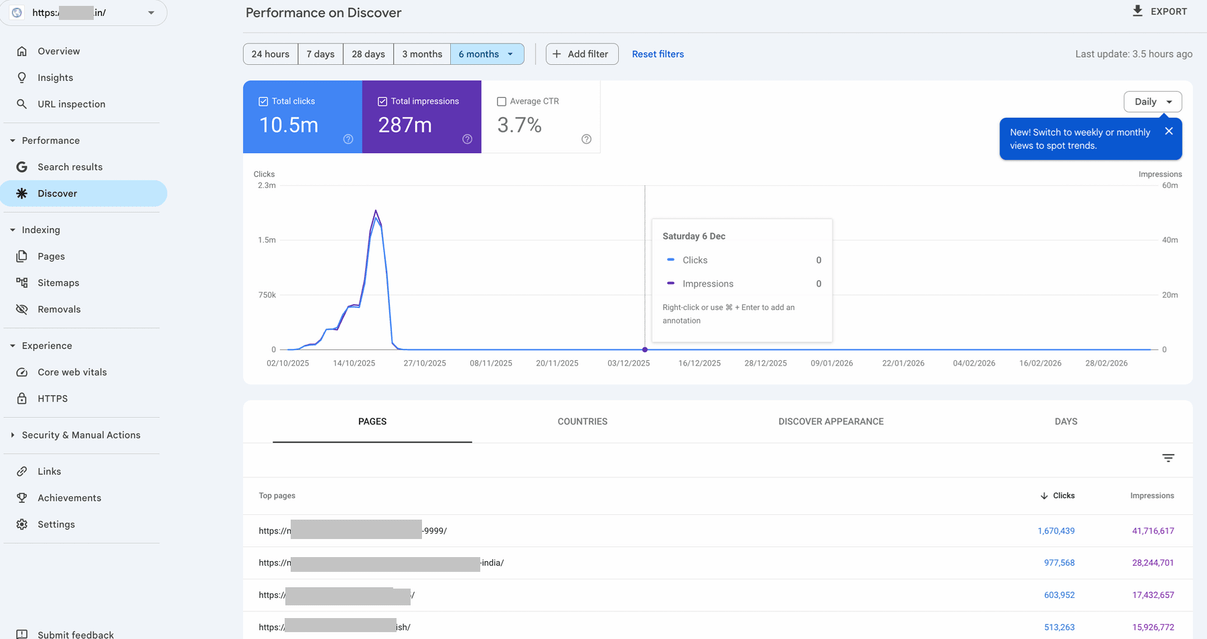
- Past success in Google Discover (2024–2025). For me, this is a significant factor. My GSC data shows a major Discover spike around October 2025, reaching over 2 million daily clicks. That success opened the door for sustained future traffic.
This chart reflects the Google Search Console and Discover performance over 6 months for one site only: 10.5M total clicks, 287M impressions, 3.7% average CTR. Notable spike in late October 2025, reaching ~2M+ daily clicks.
A workable flow for capitalizing on trending news
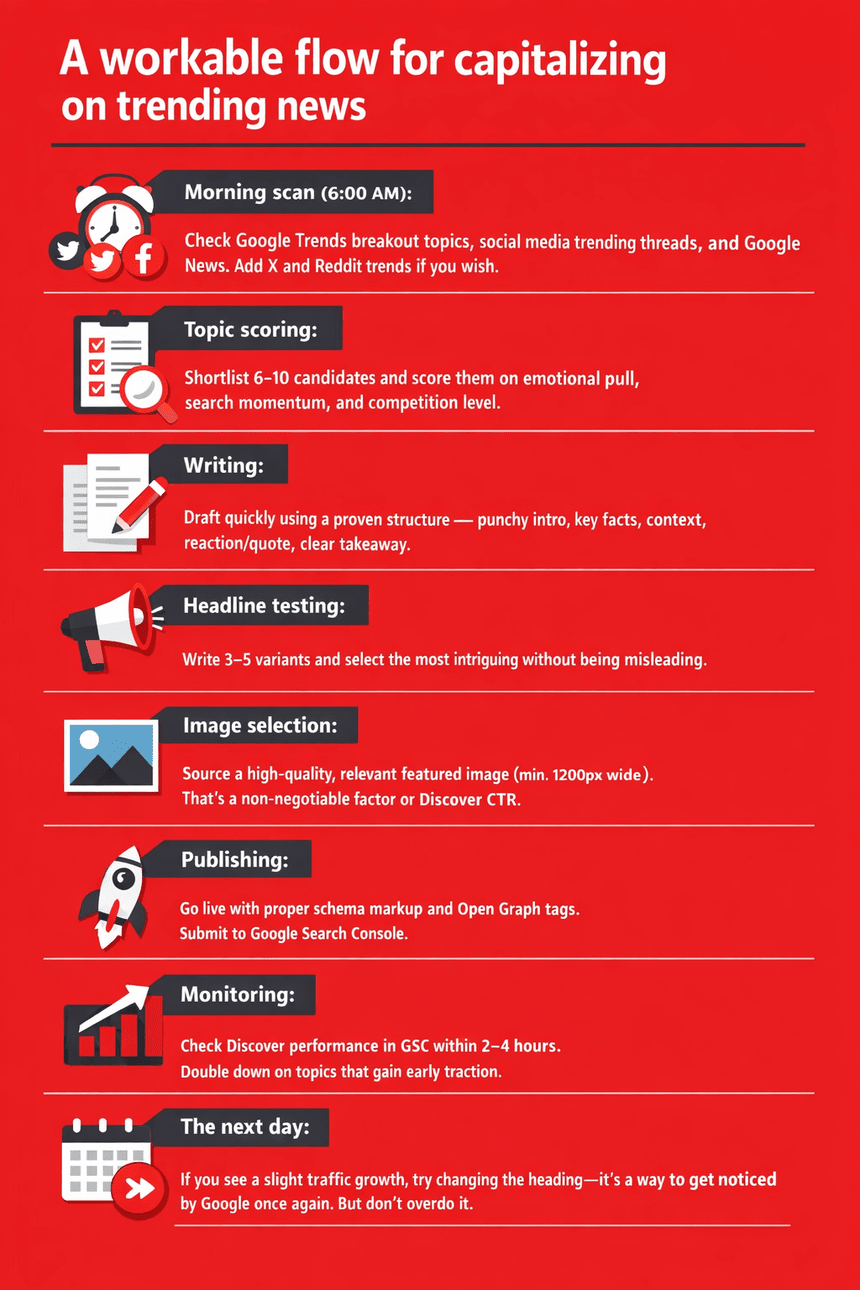
If you’re a checklist-addicted scheduling fan, this part is for you. I share my own and proven daily workflow that allows me to grow revenues from posting trending news.
- Morning scan (6:00 AM): Check Google Trends breakout topics, social media trending threads, and Google News. Add X and Reddit trends if you wish.
- Topic scoring: Shortlist 6–10 candidates and score them on emotional pull, search momentum, and competition level.
- Writing: Draft quickly using a proven structure — punchy intro, key facts, context, reaction/quote, clear takeaway. My target is under 45 minutes per article.
- Headline testing: Write 3–5 variants and select the most intriguing without being misleading.
- Image selection: Source a high-quality, relevant featured image (min. 1200px wide). That’s a non-negotiable factor for Discover CTR.
- Publishing: Go live with proper schema markup and Open Graph tags. Submit to Google Search Console.
- Monitoring: Check Discover performance in GSC within 2–4 hours. Double down on topics that gain early traction.
- The next day: If you see a slight traffic growth, try changing the heading–it’s a way to get noticed by Google once again. But don’t overuse this trick; it’s only a supportive measure.
The sweet spot is content with a strong emotional hook — surprise, controversy, inspiration — because those signals drive the clicks and dwell time that Discover rewards.
Toolkit I use
- Google Trends. Primary signal for real-time topic discovery. The ‘breakout’ filter is invaluable for catching stories early before competition ramps up.
- Social media monitoring (X/Twitter, Reddit). Social media platforms often surface viral stories 1–2 hours before they appear in Google Trends, giving a meaningful early-mover advantage.
- Google Search Console (Discover section). This report is essential for tracking impressions, CTR, and identifying which content types perform.
- Adsterra Statistics or another ad network’s dashboard. I use real-time CPM monitoring by country, format, and device. Traffic from mobile devices is specifically profitable.
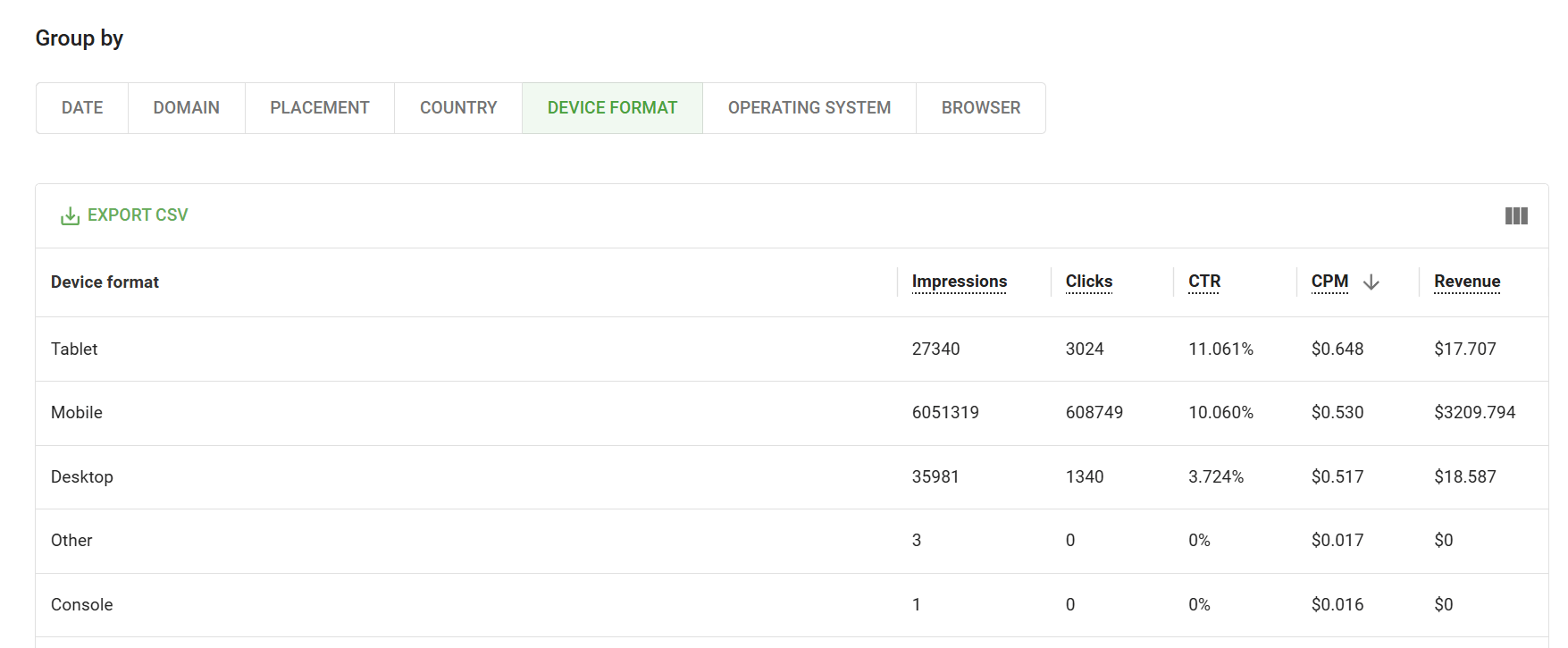
The country breakdown is especially useful: my US CPM ($23.30) is 68x higher than India ($0.339), which can shift your content targeting strategy.
- Rank Math SEO + Ad Inserter. These WordPress plugins are best for schema markup, Open Graph optimization, and strategic ad placement without slowing the site.
Facts about monetizing traffic spikes
If you want to capitalize on trending content, you need to learn to harness traffic spikes and CPM spikes. User and algorithm behavior varies drastically from classic search traffic.
- CPM rates: Discover CPMs can spike higher during viral moments. My Adsterra data shows an average CPM of $0.825 overall, but US traffic alone hits $23.30 CPM. If the topic you observe gains the audience’s traction, even Tier 3 GEOs will boost your revenue (my result for Myanmar, $25)
- Traffic behavior: Discover visitors are browsing, not searching. They consume content quickly and don’t always convert for intent-based products, but they’re excellent for display ad CPMs due to volume. Conversions matter, too, as they lift your payouts (CPM/CPA combination).
- Traffic volume: One Discover hit can send hundreds of thousands of sessions in 24–48 hours, which is nearly impossible with organic search unless you rank first for a high-volume keyword.
- Sustainability: Search traffic is stable day-to-day; Discover traffic comes in unpredictable spikes. Here’s when you gain the greatest profit.
My secret is to target ‘second-wave’ topics, as well: stories that broke 12–24 hours earlier but haven’t peaked in search interest yet. Competition is lower, the audience’s appetite is still growing, and you can still be ‘early.’ From topic identification to a published article typically takes me under 45 minutes.
How to use ad network’s statistics to capitalize on trends?
Any data can be forced to talk. But in my case, there’s no need for effort. Everything is already available in the analytics of my advertising network. If you want to seriously monetize trending news, I recommend using these filters:
Country filter
This is my favorite filter. The CPM gap between countries is enormous: US at $23.30 CPM vs India at $0.339 CPM. Understanding this breakdown shapes what topics I prioritize and which GEOs I try to attract.
Date range / daily view
Essential for correlating Discover traffic spikes with revenue spikes. When a story goes viral, I monitor hourly to see how quickly CPM and revenue peak.
CTR filter
My overall CTR is 8.32% across all countries. Monitoring CTR by country and ad format helps optimize placement.
Revenue sorted by country
Sorting by revenue (as shown in my screenshot) immediately shows where to focus. Canada generates $1,394 from just 69k impressions vs India’s $2,114 from 6.2M impressions. As you can see, the efficiency difference is stark.
What to avoid when posting news
Click-through rates matter, and the more users click your news, the better. Google is aware of this and has become especially intolerant to clockbait. These are the fastest ways to lose Discover traffic, learned from experience:
- Publishing headlines that don’t match the article content. High bounce rates suppress future distribution immediately.
- Publishing thin or duplicate content, trying to repurpose a hyped topic (rewritten stories with nothing original added rarely get featured).
- Inconsistent publishing schedules. Long activity gaps signal to Discover that the site isn’t authoritative or timely.
- Using low-quality or irrelevant featured images. Discover is a visual feed — the thumbnail is the first impression. Blurry or generic stock photos kill CTR.
- Keyword stuffing headlines. Discover rewards natural, readable, emotionally engaging titles — not SEO-jammed ones.
| Negative Practice | Impact on Google Discover |
| Publishing headlines that don’t match the article content. | High bounce rates suppress future distribution immediately. |
| Publishing thin or duplicate content, trying to repurpose a hyped topic. | Rewritten wire stories with nothing original added rarely get featured. |
| Inconsistent publishing schedules. | Long activity gaps signal that the site isn’t authoritative or timely. |
| Using low-quality or irrelevant featured images. | Blurry or generic stock photos kill CTR (Discover is a visual-first feed). |
| Keyword stuffing headlines. | Discover rewards natural, readable, emotionally engaging titles — not SEO-jammed ones. |
My rule is the ‘promise-and-deliver’ test: if a reader clicks the headline and feels satisfied — not deceived — after reading the article, the headline works. Google’s Discover algorithms are highly sensitive to the gap between headline promise and content delivery. High early bounce rates suppress an article’s Discover distribution almost immediately.
Practically, I avoid vague hyperbole (‘You won’t believe…’) in favor of specific intrigue: ‘The detail everyone missed in…’ or ‘What actually happened after…’. Numbers, names, and clear conflict drive CTR naturally. The goal is to make someone genuinely curious, not manipulate them into clicking something misleading.
How to adapt to Google Discover updates?
The updates usually increase the weight on genuine content quality and user experience. For my model — which relies on Discover-driven CPM revenue via Adsterra — this means I need to ensure ads don’t degrade the reading experience to the point of increasing bounce rates, which would suppress future Discover distribution.
My adaptation: reducing intrusive ad placements on mobile, investing more in original angles rather than rewritten stories, and building deeper topical authority in specific verticals.
My current reports already show that Tier 1 countries like Canada ($19.97 CPM) and the US ($23.30 CPM) deliver significantly higher revenue per impression, so I’m increasingly targeting content that resonates with English-speaking Tier 1 audiences.
Best ad platforms to generate revenue from trends
Have I tried monetizing with other ad networks? Sure. I’ve tested Google AdSense and other networks. Here’s why Adsterra has been my primary choice:
- Reliable payouts. Consistent disbursement on my traffic volume, no surprise holds, hidden charges, or payment delays.
- Strong CPM rates for non-Tier-1 traffic. India is my largest traffic source (6.2M impressions). While CPM is lower ($0.339), the volume makes it significant ($2,114 total). Adsterra monetizes this traffic better than the alternatives I tested.
- Tier 1 CPM quality. Canada at $19.97 and the US at $23.30 CPM are strong rates for display advertising on news content.
- User-friendly and brand-safe ads. I use Social Bar and Native Banner formats, and they perform well on mobile without disrupting the reading experience, which keeps bounce rates healthy for Discover.
- Dashboard transparency. The country-level breakdown with impressions, clicks, CTR, CPM, and revenue in one view makes optimization straightforward. No guesswork on where revenue is actually coming from.
Now that you have the workflow, what’s next? And what if you’re just starting out with a news platform? Check my tips in the final part!
Final part. How to jump into a running Google Discover car?
Not everyone has a well-established web platform or past success in Discover. Here are my primary tips for you, if you’re just getting started:
- Pick one tight niche and own it. Don’t spread content across too many topics but build topical authority in one vertical first (e.g., automotive news, celebrity news, local sports).
- Target ‘second-wave’ stories. Stop chasing the top breaking story where established sites dominate. Find the story that’s 12–24 hours old, still trending, but undercovered.
- Get Core Web Vitals green before publishing aggressively; a slow site won’t get traction, no matter how good the content is.
- Publish consistently, about 4–7 articles a day in your niche. Discover needs to build a performance history on your domain before it starts surfacing your content regularly.
- Invest in outstanding featured images from day one (one of the most underrated factors for new sites).
- Expect 3–6 months of consistent publishing before Discover starts picking you up regularly. The first Discover win is the hardest, and after that, the algorithm has data to work with.
- Think of seasonal content you can boost profits on. Find popular holidays in your location and ensure they get traction regularly.
It’s never too early to start capitalizing on your news site. With Adsterra, you have: a team of committed pros ready to help, a bunch of profitable ad formats, and a transparent payout flow.