Does it sometimes spin in your head… ? Have I done it all for my website SEO? Will my AI SEO strategy really move the needle? Breathe in, breathe out. Let’s pause for a minute. Today, we’ll dig into another algorithm from Google, that is Google Discover.
Optimizing for Google Discover SEO is not particularly new. Experienced publishers, as well as new publishers and creators, say that Discover provides an amazing opportunity to get enormous traffic and engagement quickly.
Shall we chase it on top of the AI SEO strategy we’re already stressing out about? Or is it a high-hanging fruit?
Without extra words, read our new explainer with fresh angles and real-life cases on the Google Discover optimization.
Let’s see if we’ll get into Google Discover together. 🙂
How to optimize for Google Discover? TL;DR
After reading this article, you’ll walk away with:
- How to approach Google Discover algorithm in regards to your website.
- Real-life cases to look into and get insights.
- The list of Google Discover first-party guides to dive deeper.
- Understanding of how Google Discover relates to social media and Google Search Engine.
- Recommendations for relevant technical enhancements for Google Discover.
- Understanding whether you want to take up your Google Discover strategy as a supplement to your SEO or as a full-fledged undertaking.
With traffic from Google Discover or with a growing audience from organic search, you can start monetizing in just a few steps. Adsterra lets publishers place free ad codes on their websites and get 100% ad fill rate. You can get your site approved in minutes and access 15,000+ reliable advertisers that will compete to show ads on your site.
Understanding Google Discover basics
What is Google Discover (feed)?
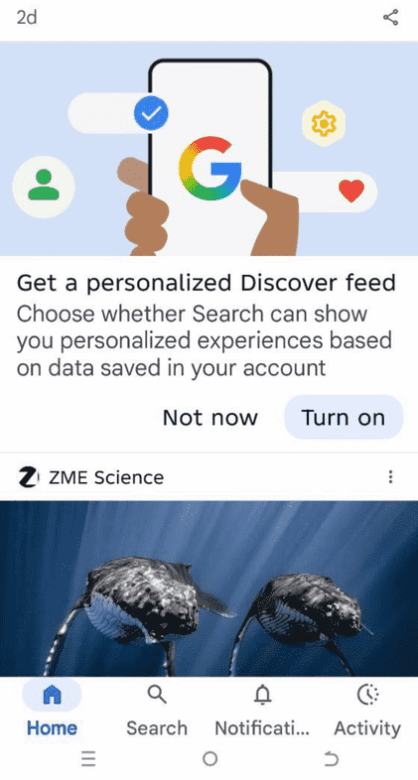
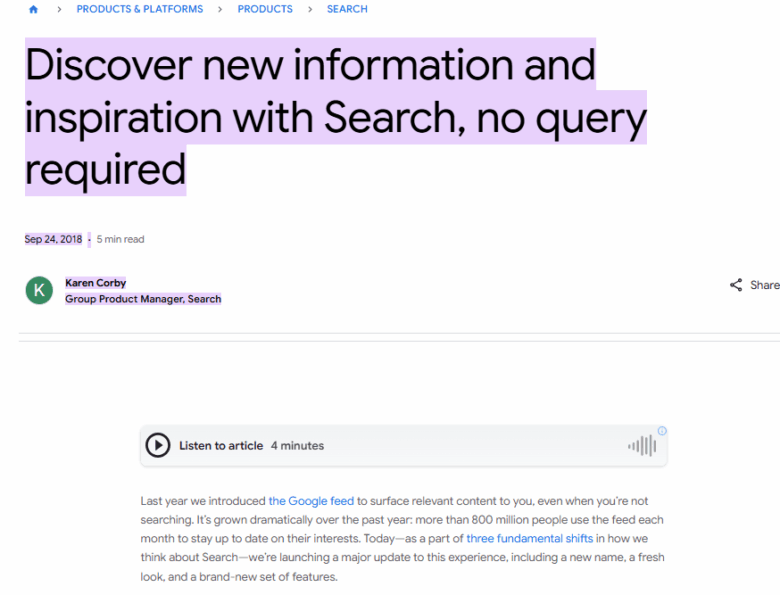
It all started in 2018. Google introduced Google Discover, which has become a new source of organic traffic for publishers. Being similar to the Facebook feed, Google Discover is a content recommendation system or, in other words, a personalized content feed, which is designed to provide relevant, engaging content to mobile users before they actively search for it.
Unlike the Google search engine algorithms, where visibility depends on keyword intent, Google Discover relies on the thematic connection between topics. Using machine learning, it analyzes users’ browsing search history, app activity, and location signals. Delivering a personalized feed, it focuses on predictive relevance. Simply said, it anticipates what users may want to read next.
So, what does that mean for you as a publisher? This represents an additional opportunity to get tons of free traffic that is no longer driven only by rankings. Content quality, freshness, and engagement potential are your real forces here.
There just need to be a few prerequisites. And we’ll get to that in the next few paragraphs.
Where Google Discover traffic comes from
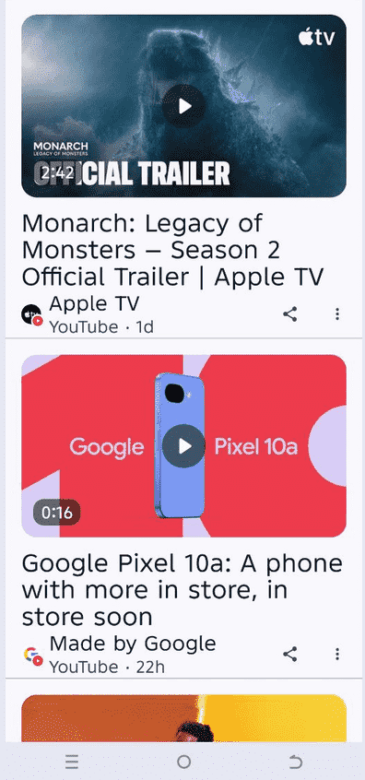
Primarily, you can spot it on mobile. Google Discover traffic is honed for mobile devices to provide swipe-based news and personalized interests.
Google Discover is available on Android home screens via the Google app, Google Chrome’s mobile homepage, or via the swipe-left gesture on iOS via the Google app.
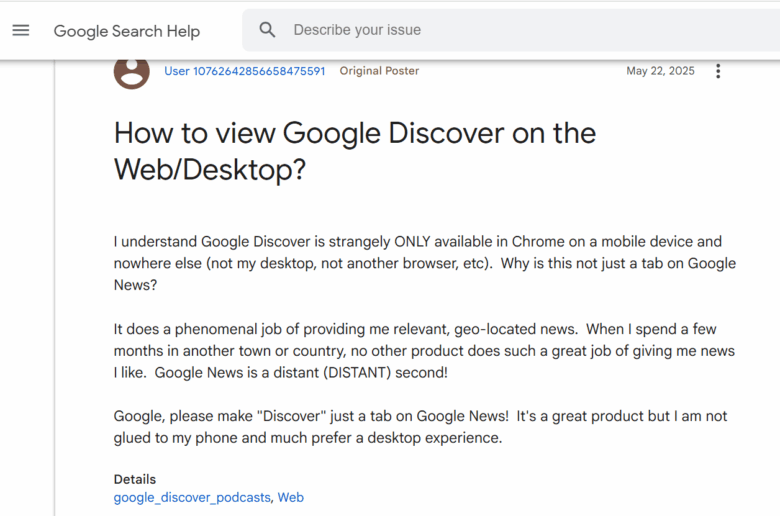
As you can see in the example post above, some users are actively expressing their demand for a desktop version of Google Discover. There have been some announcements about testing out Google Discover desktop in New Zealand and Australia, and we’re waiting for more news.
Google Discover traffic personalization
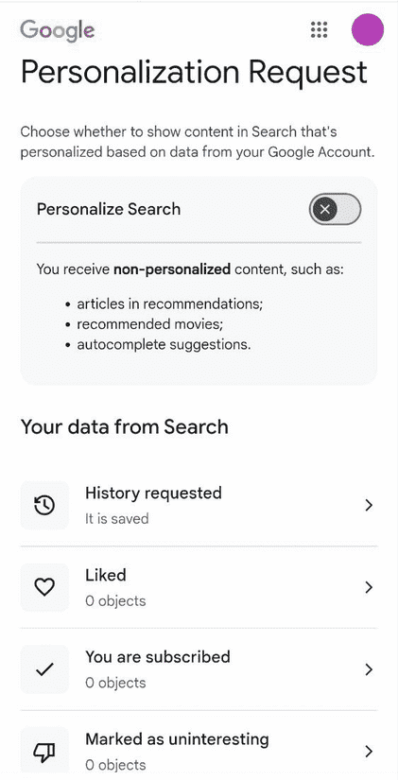
Mobile users can send a personalization request from their account in order to reflect their preferences in the Google Discover feed. The Google app settings allow users to manage interests, customize their personalized content feed and turn the feature on or off.
What does Google Discover display?

Google Discover algorithm showcases all kinds of content types tailored to the user’s interests and online behavior and conveys it all in the user’s preferred language settings.
Here is a list of content types that are likely to appear in Google Discover.
- News articles,
- Timely guides,
- Evergreen explainers with fresh angles,
- Trending topics,
- Captivating video content (mostly YouTube and YouTube Shorts),
- Weather updates,
- Local news stories,
- Web stories about current events,
- Catchy images and infographics,
- Product recommendations (mostly tech, fashion, and home),
- Evergreen blog posts and fresh articles (mostly for lifestyle, technology, travel, and health).
Ok, now, are your content types and blog topics similar to these? Can you show up in the Google Discover feed?
Let’s proceed and explore a few more interesting facts.
How Google Discover differs from search and social feeds

Google Discover differs significantly from both classic SEO search results and social media feeds.
Google search results are intent-driven. A user types a query, and Google search engine responds with the most relevant indexed pages. Rankings are competitive and keyword-focused. Relatively stable, as we know. 🙂
Social feeds, on the other hand, are driven by social graphs (meaning the “who you know” model vs “what you like”). Algorithms prioritize interactions, your network, and platform-specific engagement signals.
Google Discover sits comfy between the two. It is:
- Query-less (no search required),
- Interest-based rather than keyword-based,
- Highly personalized content feed,
- Volatile but potentially massive in reach.
Unlike social platforms, Google Discover does not require followers. Even if you are a small publisher, you have all the chances to outperform large brands. If your content aligns well with user interests and engagement signals, and Google treats you as a reputable source.
If you long thought of monetizing your website traffic, go through quick onboarding with Adsterra without bottlenecks or dismissals, unlike with other large global ad networks. Choose one of the high-paying ad formats and copy and paste the ad code to your site. Adsterra provides convenient payment methods, Partner Care Approach for every partner, and the Anti-AdBlock feature to increase revenue up to 35%.
Google Discover algorithm essentials: interests, engagement and signals
Google Discover relies heavily on artificial intelligence and machine learning algorithms that evaluate three main areas: user interests, content signals, and engagement behavior. These metrics are dynamic and constantly updated. What does that mean?
- User interests. Google builds interest profiles based on:
- Google search history,
- App usage,
- YouTube activity,
- Location patterns,
- Topic interactions: follows, likes, dismissals (“not interested” sessions).
- Content signals. Discover evaluates:
- Topic relevance,
- Freshness and timeliness,
- Authority and trust signals,
- Media richness (especially, high-quality images),
- Headlines appeal.
- Engagement signals. Once your high-quality content is shown, Discover measures:
- Click-through rate (CTR),
- Dwell time,
- Scroll depth,
- Dismissals,
- Saves and shares.
- Engagement and discover amplification (growth)
Strong engagement can cause exponential distribution, while poor Discover performance limits reach quickly. User trust is vital, since repeated dismissals can reduce future exposure.
Here, you should avoid any misleading headlines that cause bounces. Focus on increasing engagement. It comes from original, engaging content based on thoughtful questions and answers that encourage saves and shares.
Traffic impact and true publisher successes
The key point for us to draw is that Google Discover traffic is still volatile.
Publishers frequently report:
- Sudden traffic spikes of 5x–50x,
- Millions of impressions from a single post,
- Short-term virality combined with long-tail lasting traffic.
Even though publishers, who are lucky to adopt this Discover traffic as one of the top traffic sources within their strategy, that sometimes outperforms organic search, they cannot make it as stable and comparatively permanent as organic or paid traffic.
Here are a few real-life stories.
Real-life story 1
E-nautilia.gr is a dedicated maritime news portal and community, sharing insights and news for the merchant marine industry. It serves local audiences in Greece, Cyprus, and Sweden. They kindly shared their experience of optimizing for Google Discover and enjoying traffic for years, when it suddenly stopped last year.
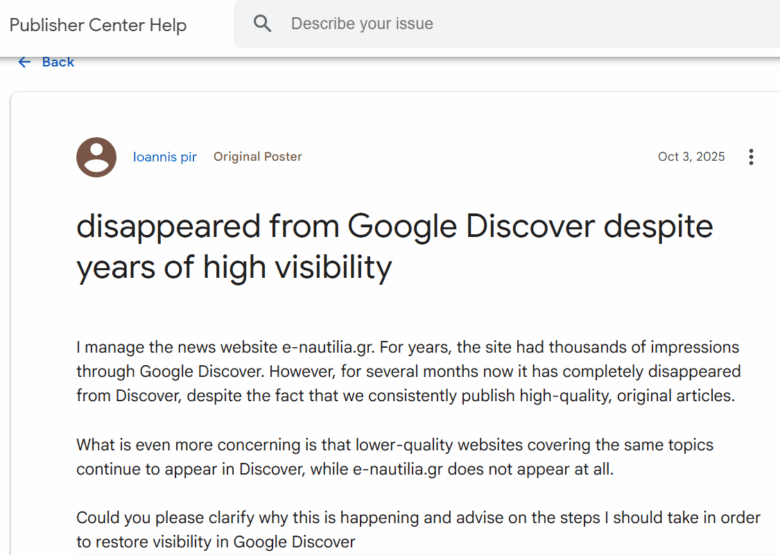
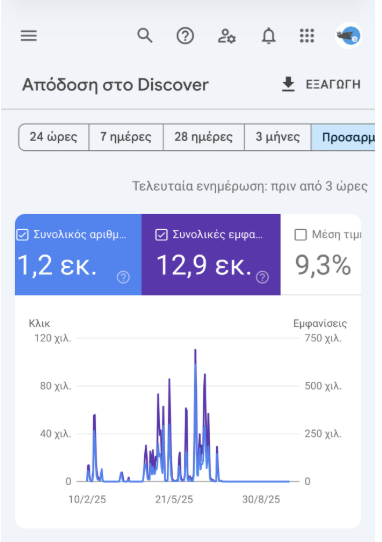
Many publishers share the same observations, trying to figure out how to rank in Google Discover. Impressions and clicks can surge overnight and drop just as fast. The fair question comes to mind: shall SEO traffic from Google Discover be best treated as a growth accelerator, rather than a sole traffic source?
Real-life story 2
Here is another true story and a case study from Adsterra news publishers Zaeem Insha and Ramzan Jani from Pakistan. They share on how they make $1,000 a week with Google Discover and a news website. They have built their own Google Discover system to apply to the algorithm with no false workarounds, just a news site and perseverance that has worked.
Expert tip by Zaeem Insha and Ramzan Jani
“On average, we publish 20+ articles per day. That’s a pace that’s not for everyone, but for Discover, consistency beats perfection.”
Their strategy has been based on monitoring Google Discover feeds and competitors’ pages. They track keywords with SEO tools and Google Search suggestions, closely watching the speed and intensity at which a topic is spreading and growing.
Read the full story How to Make $1,000 a Week With Google Discover (News Site Case Study) on our blog.
Real-life story 3
One more case study from Adsterra publishers Hamza Ali and Mutee Ur Rehman from Pakistan. “Most of our traffic came from Google Discover. Even during the short period, we were able to make hundreds of dollars from just one website, thanks to Adsterra’s fast monetization system.”
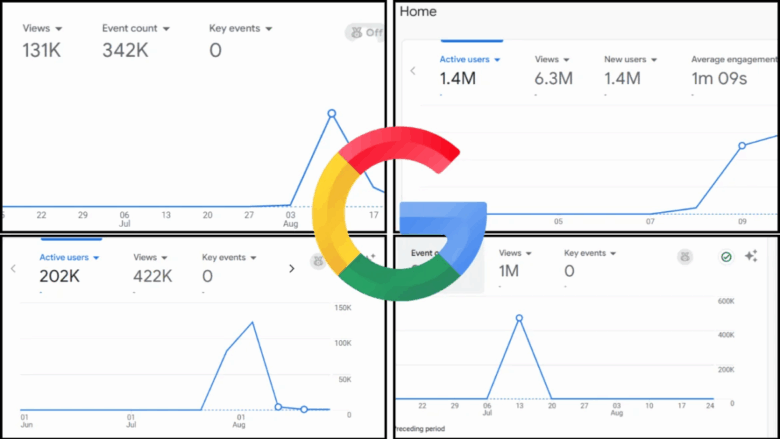
Read the full case study How to Make Money with Adsterra: Two Friends Made $2,700 Per Month.
Why optimize for Google Discover? Key advantages
Optimizing for Google Discover boosts online presence and offers publishers and creators several strategic benefits. These are:
- Massive reach without rankings. You don’t need to rank #1 to win traffic.
- Exposure to new audiences. Discover introduces your content to users who’ve never heard of your brand.
- Faster traffic velocity. Content can gain traction within hours of publishing.
- High engagement potential. Discover users are in a browsing mindset, often leading to longer sessions.
- Brand authority growth. Repeated Discover appearances build recognition and trust.
How to optimize for Google Discover algorithm? Publisher’s guide
If you think Google Discover is something that can complement your SEO strategy or you want to take it up as a long-term project, let’s dive into what we can do right this moment for success. Remember, we are not trying to outplay the system. It’s all about aligning with how the system works.
How to get Google Discover traffic? Best practices
At a high level, you need to follow these simple guidelines to get into Google Discover’s good books and obtain traffic to your website:
- Build trust and authority.
- Focus on topics people care about now.
- Publish compelling, visually rich content.
- Optimize for engagement, not just clicks.
In the following sections, we’ll break this down step by step.
1. Prepare your website for Google Discover visibility and eligibility for Google News
To make it to the top with Google Discover optimization, pay attention to the Google News Policy. It will beneficially impact your chances to meet requirements for Google Discover traffic to be pouring to your website.
Table 1. Google Discover visibility and Google’s News Policy
| Policy area | Why it’s important |
|---|---|
| General content standards | Ensures content is safe and appropriate for wider audiences. |
| Ads and sponsored content | Keeps user trust by preventing misleading monetization. |
| Misleading content | Prevents clickbait and misrepresentation. |
| Transparency | Helps readers judge credibility and context. |
Expert tip by Google Support
“When we find content or behavior that violates these policies, we may remove the content from our news surfaces.” If your traffic is down, be sure to double-check your Google Search Console account under “Security & Manual actions” for manual actions against your site.
2. Content strategy for Discover success
Content is the primary driver of Discover visibility and among the best practices of how to optimize content for Google Discover. Here are the core guidelines to observe.
1. Focus on topics, not keywords
Discover favors when topics resonate with wider audience. Topic authority prevails over exact keyword targeting. Build clusters around most popular Google Discover themes, such as:
- Industry trends,
- Emerging technologies,
- Lifestyle,
- Home,
- Travel,
- Health.
2. Balance evergreen and fresh content
While Discover supports freshness, evergreen content can spike when interest arises. Updating older posts with new insights, dates, current events, and visuals can trigger re-discovery.
3. Strong E-E-A-T Signals
Experience, Expertise, Authoritativeness, and Trust are also evergreen and crucial to rank in Google Discover. As you would, observing the SEO strategy, ensure you include:
- Author bios,
- Clear editorial standards,
- References and sources,
- Transparent ownership,
- Contact info and overall transparency.
As with long-term SEO stability, trust and credibility are critical for Discover. When Google identifies a domain as a reputable source, your Discover visibility can get traction again and again.
Expert tip by Google Help
“We don’t allow preview content that misleads users to engage with it by promising a topic or story that isn’t reflected in the underlying content”.
4. Effective, catchy headlines

If you got shown in Google Discover, it is only half the battle. Click-through rate determines whether distribution expands. The best approach is to skip clickbait, but embrace intrigue and emotions. Come up with powerful headlines that spark sincere interest:
- Promise value,
- Highlight novelty,
- Trigger emotion or curiosity,
- Make it clear, not vague,
- A/B test your headings.
Expert tip by John Shehata, Google Discover Analytics Guru
“Titles are the most important thing in Google Discover. And Google is telling you, oh, don’t do clicky, baity headlines, but this is official Google guidelines. But the reality, they do work. Okay. These are the most popular headlines and trafficked articles in Google Discover. But you cannot be outrageous. You cannot promise something that you will not deliver.”
5. Compelling visuals
High-quality images are critical and more likely to generate visits from Discover. Take care of:
- Unique visuals (not stock),
- High resolution images (at least 1200px wide),
- Proper image previews enabled via meta tags,
- Site logo absence.
6. Clean, readable formatting
In its turn, short paragraphs and scannable layouts of your website improve dwell time and engagement.
4. Technical enhancements: schema and feeds
Technical SEO aspects can enhance your brand visibility and performance and contribute to Google Discover optimization. Here are some key strategies to consider.
1) Discover schema
While there is no dedicated “Discover schema,” structured data helps Google better understand what your content is about. Schema testing tools like Schema Markup Validator (Schema.org) or Schema Checker (SchemaValidator.org) can help you follow your markup.
Recommended schema types are:
- Article,
- NewsArticle,
- BlogPosting,
- VideoObject,
- Author,
- Organization.
2) RSS feeds (XML-based format to update web content). RSS feeds are not required, but they will allow users and applications to access updates on your website in a standardized, computer-readable format. Meaning it’ll help Google discover your new content faster.
Correct publication dates, accurate author markup, and valid structured data with no errors prevent trust issues and eligibility problems.
5. Ensure key website prerequisites
Before content strategy comes into play, your website must meet baseline requirements:
1. Mobile-device-friendly design
Since Google Discover is still purely a mobile device phenomenon, remember about your mobile users when generating content types or doing technical or off-page SEO. A responsive website design is a must.
2. HTTPS enabled
Secure protocol is something you should consider with or without Google Discovery in mind.
3. No intrusive interstitials
Any intrusive pop ups that violate Google policies and SEO best practices should be eliminated.
Adsterra ad network offers publishers industry-advanced ad formats with up to 35X higher CTRs than web push ads. You can use more intuitive ad formats that comply with policies and technical requirements, like customizable Social Bar ads or In-Page Push.
4. Take care of site speed and UX optimization.
Ensure your Core Web Vitals are in good shape.
- Reduce INP (Interaction to Next Paint): minimize JavaScript and non-critical, third-party scripts.
- Fix CLS (Cumulative Layout Shift): set image and video dimensions, avoid layout-shifting ads, preload key resources.
- Improve LCP (Largest Contentful Paint): optimize and compress images properly, use responsive images and apply fast hosting. Lazy-load below-the-fold media. Serve WebP/AVIF.
- Review code and assets: remove unused CSS/JS.
- Test page speed: monitor load speed and page speed with tools like Page Speed Insights and Lighthouse.
Sites with poor usability or aggressive ads are unlikely to perform well in Discover, regardless of content quality.
6. Tracking and improving performance and analytics
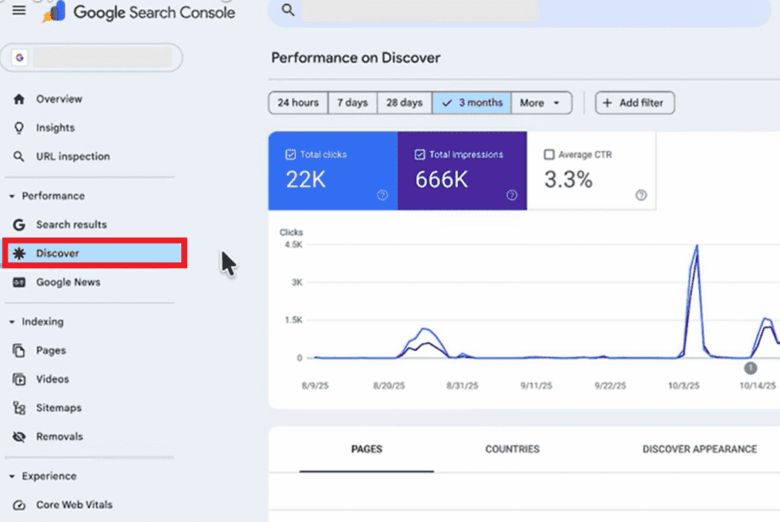
Here are a few approaches to see if your website appearing in Google Discover traffic.
1. Leveraging Google Search Console (GSC). Use Google Search Console, the same free tool you apply for tracking your organic traffic and SEO pages. Find a Discover performance report in the dashboard on the left and monitor the relevant pages. You can utilize the data to identify winning content formats within Discover feed, refine headlines and visuals and strengthen high-performing topics.
Watch the video from Google Search Central to master GSC data analysis, including for Discover traffic.
2. Understanding Google Analytics reports. Google Discover traffic isn’t natively labeled in Google Analytics (GA4), and publishers can overlook it as direct traffic, referral, etc.
3. Analyzing metrics. Pay close attention to key metrics, like impressions, clicks, CTR, and average performance by pages, particular topics, content types, and formats.
4. Relying on patterns and insights. Track trends, recurring fluctuations, and seasonal patterns.
5. Applying adjustments. Refine your approach and provide more relevant material.
Adsterra works in different niches, including those that are favored by Google Discover like News, Technology, Lifestyle, and others. You can go through quick registration and website approval and start earning immediately.
Advanced Google Discover tips for 2026
As Google’s AI systems evolve, Discover optimization is becoming more nuanced. We’ve put together more advanced tips to optimize existing content for Google Discover and to display news stories and new articles ready to pop up in Discovery.
Check if you have got these bullet points in your strategy that will complement both SEO and Discover SEO.
Table 2. How to optimize for Google Discover visibility: Discover and SEO
| Strategy area | What to do | Why it works for SEO + Discover |
|---|---|---|
| Topical authority | Create content clusters around themes together with keywords. Interlink pillar pages with supporting articles. | Discover prefers topic authority over exact keyword matching. SEO benefits from stronger internal linking and relevance. |
| Opinionated, experience-driven content, E-E-A-T | Publish first-hand insights, expert opinions, and original analysis instead of generic summaries. | Aligns with SEO‘s E-E-A-T and Discover’s preference for unique perspectives, improves engagement signals. |
| Leverage first-party data | Use surveys, user behavior, analytics, or internal data to create insights-driven content, tailored to your audience. | Original data differentiates content from competitors, attracts both Discover visibility and backlinks within off-page SEO. |
| Headline testing | Refresh headlines and preview images based on CTR and engagement trends. | Discover heavily weights headlines and visuals, SEO benefits from improved CTR. |
| Seasonal and cultural alignment | Tie content to trends, events, and recurring interest spikes (holidays, news cycles, behaviors). | Discover surfaces content based on current user interest, not queries. |
| Google Publisher Center | Not an official Google requirement to add a publication to the Google Publisher Center. However, some publishers notice positive results in doing so. | Google states that the systems automatically identify and rank eligible content per relevance, prominence, authoritativeness, freshness, location, and language. |
Final thoughts
We have proved again that quality content creation still opens all doors, including Google Discover. It rewards publishers who understand audiences, create value-driven content, and prioritize engagement over manipulation.
While still highly unpredictable, the Discover Algorithm traffic can become your powerful channel when approached strategically. Shall you invest all your time and effort into it? It depends on your niche and the formats that your audience loves. What you can surely do is consistently publish people-first content that readers genuinely want to consume and follow best practices suited to traditional SEO and Google Discover SEO.
How to get Google Discover traffic? FAQ
Is Google Discover worth it?
Yes, Google Discover is worth optimizing for if you publish evergreen or trending content with strong visual appeal. It can drive large spikes in traffic without relying on search queries that users type into the browser. However, traffic is less predictable than publishers are used to with traditional SEO, so it works best as a complement to search optimization, not a replacement.
Is Google Discover personalized?
Yes, Google Discover is personalized. It builds a custom feed using users’ past searches, browsing behavior, location, and app activity to provide articles and videos it thinks users will like. Users can fine-tune the algorithm by following topics, giving feedback, or removing interests they don’t enjoy.
How to get picked up by Google Discover?
To get picked up and start appearing in Google Discover, publish high-quality, original content that is acute. Pay attention to engagement, including clear, compelling headlines and attractive, large images. Optimize for mobile devices, follow Google News content policies, and avoid misleading clickbait. You can also use an SEO plugin for publishers to support your overall SEO strategy. Strong E-E-A-T signals (experience, expertise, authority, trust) are also best practices of how to optimize for Google Discover.