One can never imagine the scale of creative fancy and tech skills publishers possess. This business idea won’t leave you speechless, but will ramp up the ideation. The programmatic SEO website monetization case study is laid out by our partner from Indonesia. He’s running a global image-search website and now makes on average $4,000 per month from displaying Banners.
Setiawan from Indonesia owns a non-traditional “content website.” It is a visual search + long-tail image aggregation engine. The website is optimized for:
- Google Images
- Pinterest referral loops (relevant Pins – we’ll explain later)
- Long-tail keyword SEO
- Programmatic SEO page production (legit ways, no spam)
- High-paid display ads
- Viral image discovery behavior
Disclaimer:
The story was translated by the Adsterra Content team. We had to depersonalize web screenshots and remove sensitive data to protect the publisher’s privacy. We tried to keep the copy authentic, but we may have misinterpreted local naming or slang. Please be tolerant of this 😉
Business model of an image-search website
Setiawan describes his core business model and product pipeline like this:
- Aggregate millions of searchable images/pages
- Rank for a large number of long-tail image keywords
- Get traffic from:
- Google Images
- Social shares
- Low-competition long-tail searches
The programmatic SEO website monetization includes:
Placing Adsterra banners on all pages, getting paid for views and conversions primarily, and not depending on clicks!
Normally, banners are a click-based format. It means you get paid for ad clicks, and the higher the CTR (click-through rate) is, the more impressive your earnings are. Setiawan knew his audience came for image discovery and quick search, and wouldn’t click ads massively. But they would visit many pages per visit and are more likely to convert from these views and rare clicks.
He asked Adsterra to optimize ads for CPA/CPM campaigns 70%/30%. And that proved to be a wise decision, because even a few clicks turning into conversions generate stable revenues, on average $4,000–5,000 in 30 days.
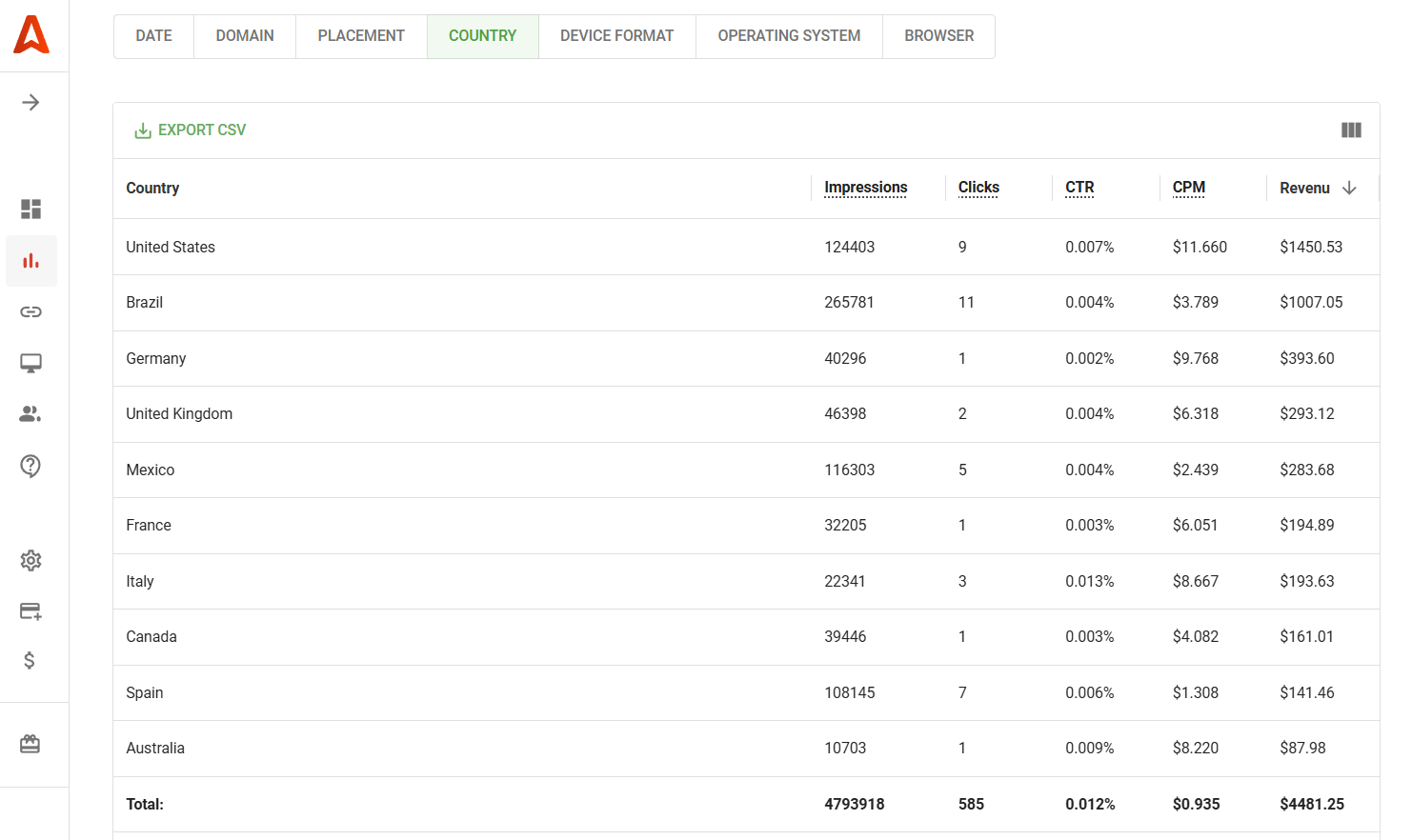
It’s a risk-free monetization idea for this kind of website that can perform at $11–12 CPM for US traffic, even with a banner CTR of 0.07%! 10,703 views and one Australian-based click returned the CPM of $8.2 and $87.9 monthly revenue. The second secret (no secrets!) is ad optimization: Adsterra sends advertising offers with the highest potential to engage website visitors and drive further conversions: browser games, sports, entertainment, app utilities, etc.
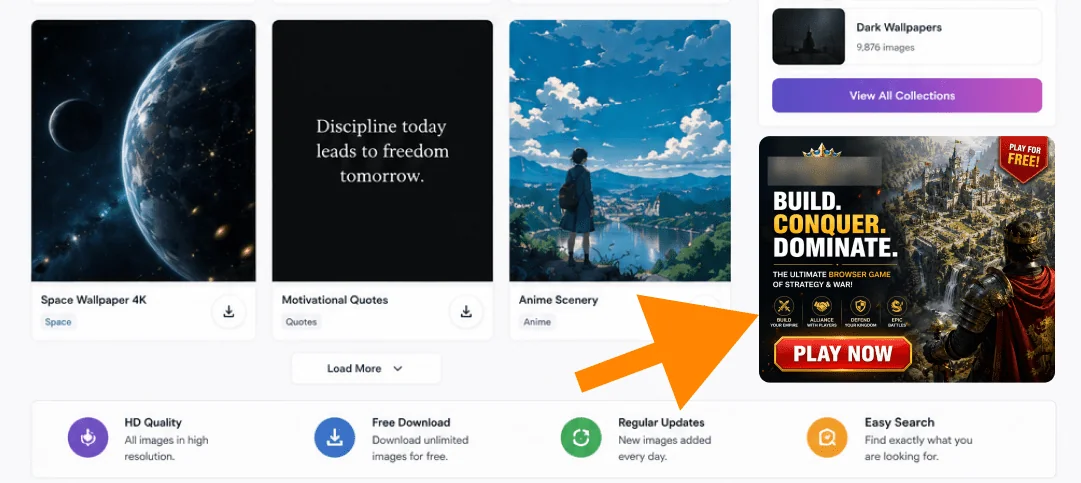
So what lies behind this strategy, and how exactly does the site generate traffic? We’re about to unfold this.
Traffic growth strategy
Traffic estimates vary between ~500k and ~1MM monthly visits.
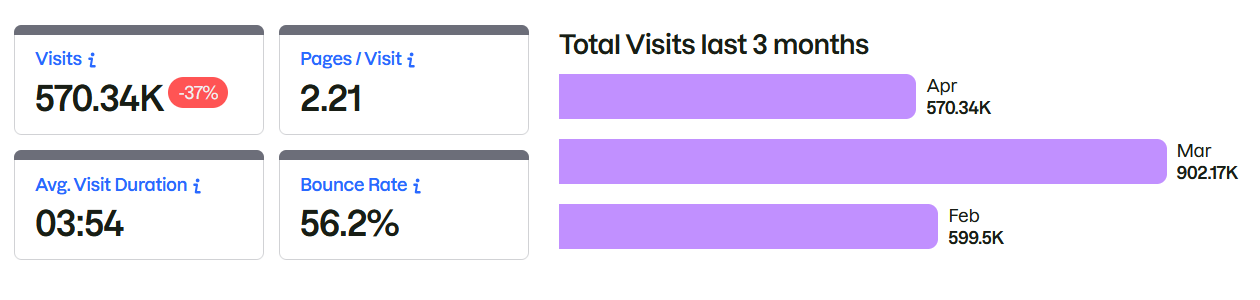
Starting from 2025, organic growth has slowed down, and many informational long-tail queries started dropping out of the search results. This is nothing but AI-driven Google traffic volatility. In this situation, adding more traffic sources apart from classic search is critical.
The biggest growth drivers are:
- Bing Images
- Google Image Search
- Pinterest referrals
- Programmatic image indexing in Google
- Direct traffic from repeat users.
SEO approach overview
Setiawan insists that Programmatic SEO is not about generating thousands of thin pages and stuffing search engines with low-quality content. This is a weak strategy that leads to Google bans for thin content (thanks to Google Helpful Content Updates).
Setiawan uses programmatic SEO to automate production of hyper-focused web pages, optimized for long-tail keywords.
Programmatic SEO + long-tail dominance
This is the foundation of the traffic growth strategy. A programmatic approach facilitates the generation of thousands of indexable URLs, each targeting micro-keywords.
Examples:
- “anime wallpaper dark”
- “girl dp aesthetic”
- “tattoo ideas men arm”
- “small kitchen ideas”
- “AI anime art”
Setiawan sticks to these rules of producing content: every page must be image-heavy, keyword-focused, and internally linked.
Important: Every page must provide valuable content, at least 400 words, non-generic copy, helpful image descriptions, and additional information. You need genuine utility like resolution info, download options, file type, usage rights, mobile-friendly zoom, print dimensions, styling tips, etc.
Why this matters
Automation creates massive keyword coverage in an extremely high search surface area. In addition, doing white-hat programmatic SEO entails minimal risks for being flagged by Google.
Instead of targeting high-volume and high-competition keywords (e.g., “wallpaper”), Setiawan created micro-keyword pages: anime dark wallpaper iphone, cute wallpaper pink, aesthetic, lockscreen anime wallpaper 4k, etc.
This matters because the competition is lower, user intent is stronger (higher CTR), and it’s easier to get ranked.
Image SEO or visual SEO principles
Their real SEO advantage is image indexing. Many publishers still ignore this lucrative optimization option. Setiawan has made image SEO a competitive advantage. He optimizes:
- image filenames
- alt text
- title tags
- surrounding keywords
- lazy-loading image structures
- internal image relevance
Infinite internal linking
Internal linking has always been one of the core SEO tactics. For an image-search site, it’s a must. Every page created links to:
- Related searches
- Related images
- Adjacent keywords
- Categories / hubs
Internal linking helps distribute PageRank within the site and increases crawl depth for search bots. It also improves indexing, as Google and Bing get clear signals on content clusters, semantic similarity, and the overall context. But there’s one more advantage: internal linking boosts session depth, and therefore, the number of ad impressions.
Fast content production
Again, programmatic SEO website monetization is not about posting tons of litter-like pages. It’s about optimizing your time and resources for good-quality content delivery.
What’s possible to automate (with manual verification):
- Scrape image metadata
- Generate titles automatically
- Build page structure and outline
- Generate related keywords
- Create category clusters
This allows for posting tens of thousands of pages/month with almost no editorial cost.
What requires manual work: developing fully human-written content from the AI outline, adding supportive information, image details, download options, and more.
Pinterest SEO strategy
Pinterest used to be one of the most powerful traffic sources till 2025, when Pinterest started shutting its doors to external traffic.
Attention:
The “Link Farm” penalty: If you post 50 pins a day, all pointing to the same page or affiliate link, Pinterest’s 2026 algorithm instantly flags this as “Link Spam.” This will lead to domain-wide ranking suppression. Never consider Pinterest a cheap traffic source. Use it for supportive site promotion, adding neat and policy-compliant pins.
How Pinterest image SEO works
Pinterest users search visually and click multiple images per single visit. Pins create almost endless browsing experiences. Users have low friction for image sites if they’re promoted on the platform.
The foundation for image SEO is a Pinterest loop:
- You create image pages optimized for Pinterest-style keywords on your website.
- Pin the images you posted on-site back onto Pinterest.
- Pinterest ranks the pins.
- Users click through to your website.
- Google indexes those same pages.
- Traffic starts growing.
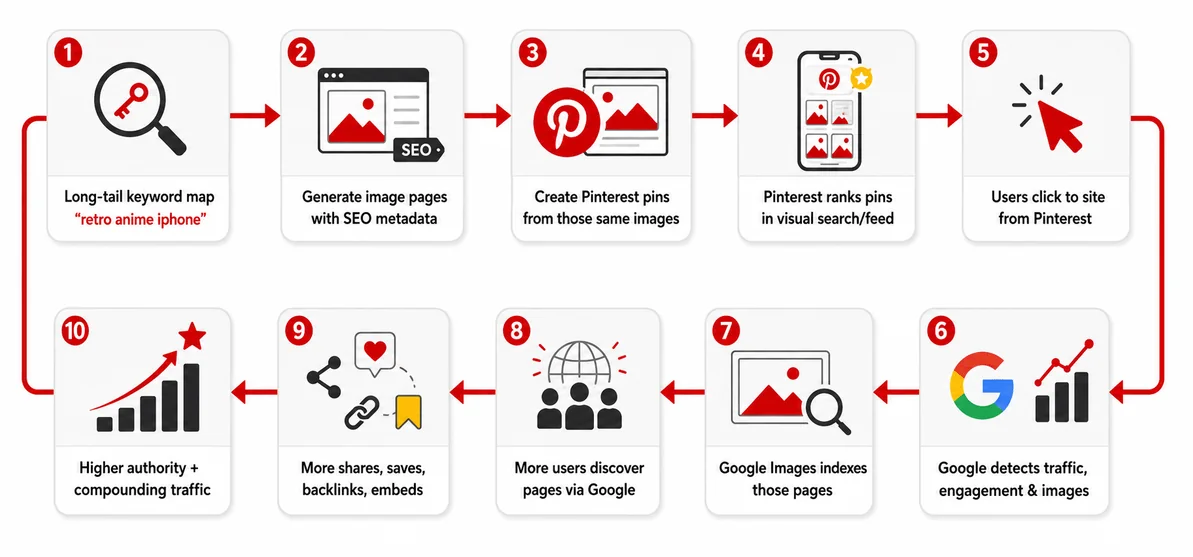
How to create supportive Pins linking to your web pages
Just to illustrate the actionable Pinterest SEO and traffic growth model, Setiawan suggests using this flow:
Create 5 unique visual assets, not 5 copies.
Do not use the exact same image 5 times. Use the “One URL, 5 Assets” rule to avoid spam filters:
- Pin 1: Standard image
- Pin 2: A specific variation of the image (e.g., filters ON)
- Pin 3: Color palette from the image
- Pin 4: Special offer designed specifically to promise more quality images
- Pin 5: Image usage examples on various devices
It’s good to design your Pins to be “save-worthy.” Use high-contrast, beautiful visuals and add text like “Save this palette / aesthetic example” directly on the image. All saves are important for your account discovery and growth.
Get your Pins in front of the right people
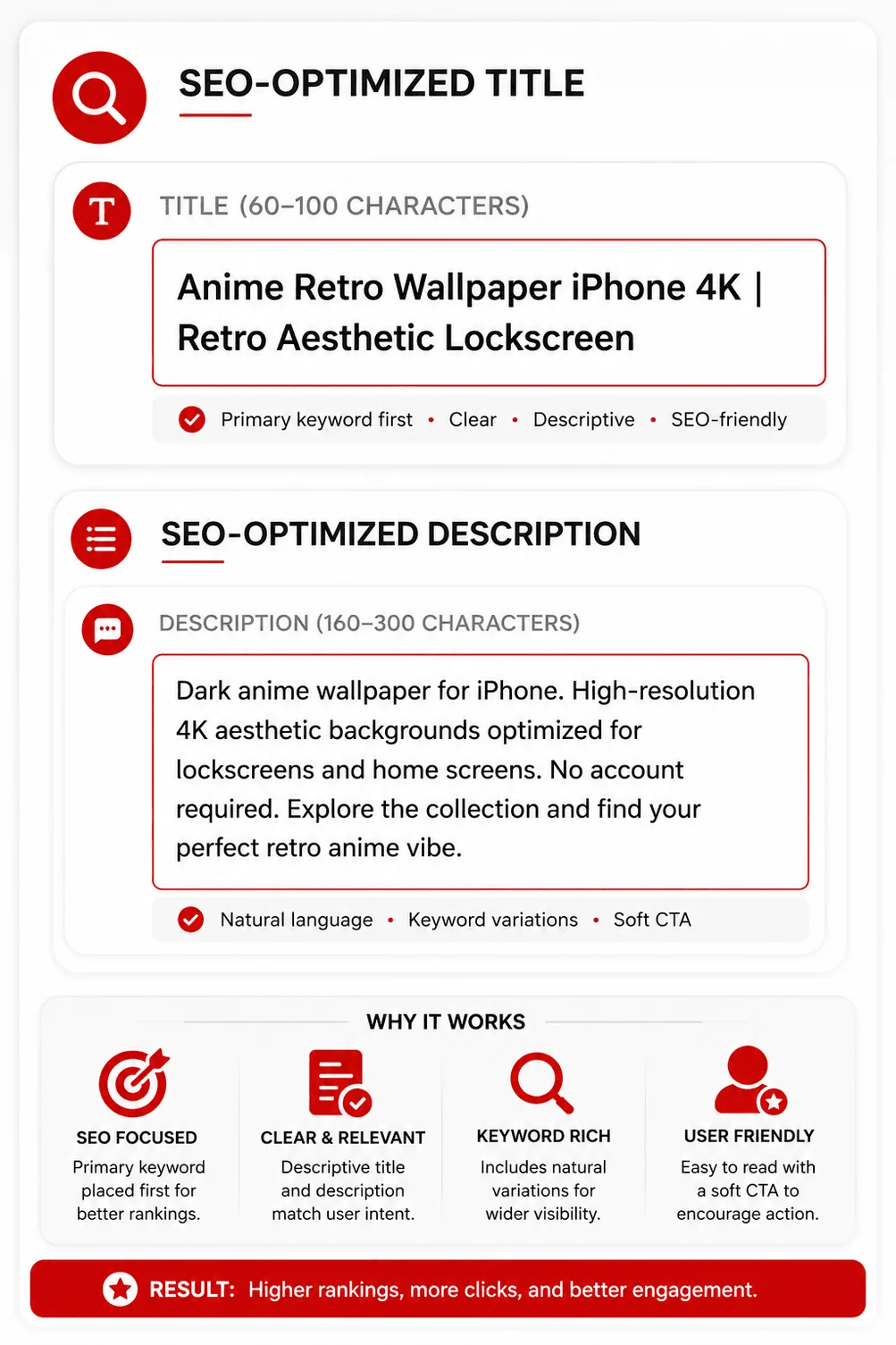
Title of 60 to 100 characters: kick it off with your main keyword and keep away from clickbait headlines.
Example: Take your iPhone with a blast of retro cool with our Anime Retro Wallpaper iPhone 4K | Retro Aesthetic Lockscreen
Write a description of 160-300 characters that sounds natural, chuck in some keyword variations, and maybe mention that people get an extra bit of value without being too pushy.
Example: Fancy some dark anime background for your iPhone? We’ve got 4k high-res aesthetic wallpapers to set off your lock screen or home screen. No account required – just grab and go.
Spread out your post timing
Don’t flood Pinterest with lots of content on the same day. Space them out by anywhere from 5 to 10 days so you don’t get flagged for spamming and can see which one does best as the days go by.
Get your onsite SEO in order
Looking for your pins to rank? Well, first you need to sort out your metadata and the schema. Make sure you get these at least covered:
- Filename: a bit more descriptive than just IMG_1.jpg, like match-that-keyword-with-your-image.jpg
- Alt Text: Just say what the pic is and the context, you know, be a bit more helpful than that
- Schema: ImageObject markup is the way to go here; we all know it’s easier when pages are properly marked up to get properly cited
Why this programmatic SEO website monetization still works
At the end of 2025, the value of pin-based backlinks experienced turmoil. There was a huge slump in how often Google discovered the page via Pinterest backlinks. It’s no longer possible to generate pages and backlinks massively.
But the strategy for monetizing websites through programmatic SEO still works, though it takes longer and more effort.
- Google still indexes image-heavy long-tail pages
- Pinterest still sends outbound clicks.
- AI-generated image content exploded, offering new visual ideas.
- Visual search demand is massive.
- Visual search is now powered by video content.
New traffic sources added for 2026 (Bing images)
Bing’s visual search has been transformed by advanced AI that excels at recognizing objects, styles, and concepts within an image. Unlike Google, which still heavily weighs the authority of the page hosting the image, Bing’s algorithm puts more weight on the image’s metadata and visual relevance to the search query. It’s a new opportunity for all publishers!
To summarize
Programmatic SEO image sites win by combining visual search demand, content distribution across platforms like Pinterest, and Google + Bing Image indexing.
Instead of writing endless blog posts, Setiawan creates multiple image-focused pages targeting long-tail keywords, then amplifies them through Pinterest and Image Search engines and internal linking.
Monetization comes from display ads (Adsterra Banners) with high-CPM niches like AI tools, apps, software games, and utilities. The real advantage is scale: one image can generate traffic across multiple platforms for months or years.
If you automate intelligently and focus on visual discovery, you can build durable, low-cost media assets with huge monetization potential with Adsterra ads!