Advertisers and affiliate marketers have the most powerful advertising formats in the history of digital marketing to reach potential customers. Yet, one format that has remained ever relevant is Popunder advertising.
For advertisers, Popunder traffic is about getting a marvelous opportunity to present an offer and bring myriads of users to a landing page. However, a high number is not necessarily a useful number. Meaning that traffic volume alone does not make a campaign successful on the spot.
For better understanding, we shall look into how to approach Popunder traffic from a performance point of view, with regards to audience, niche, targeting, landing pages, tracking setup, and optimization.
If you’re ready to test Popunder traffic with Adsterra, you can access 45,000+ publishers, 248 GEOs, in-house anti-fraud security and tracking software, together with the unique Partner Care Approach for every advertiser.
What is Popunder traffic?
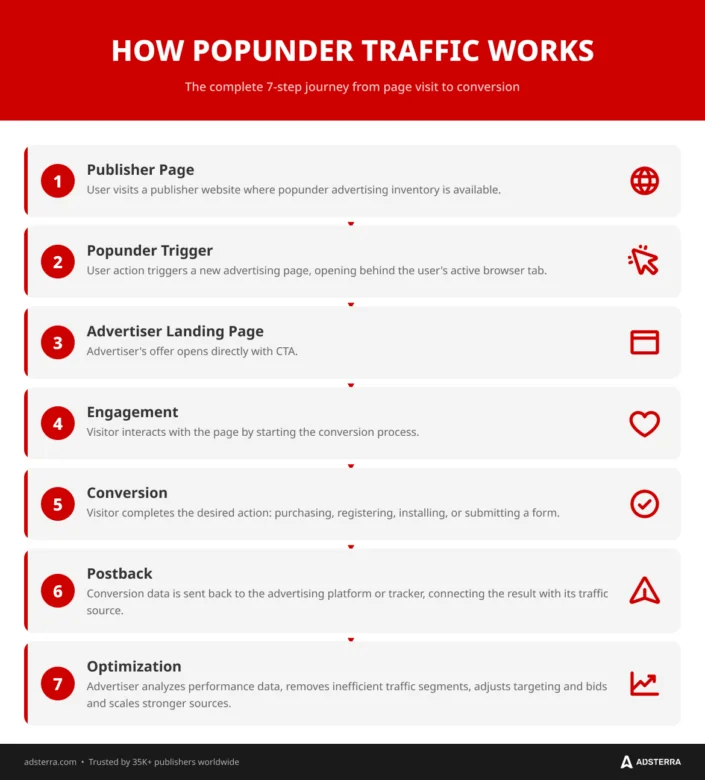
Popunder traffic is generated when a trigger (a click or a mouse hover) causes Popunder ad to open in a new browser tab or new browser window, containing an advertiser’s offer page. Popunder ads work subtly without interrupting user experience, and support good user engagement and attention.
Where Popunder traffic comes from
Popunder traffic is fundamentally different from the traffic coming with an ad format that requires an immediate click. With Popunders, your practical result is a different user journey with an uninterrupted user’s browsing experience.
When the user closes the current browser window or minimizes their main active window, the advertiser’s page becomes visible. This way, you can send the user directly to a landing page, product page, registration form, app offer, or another conversion-focused destination.
Additionally, you can apply prelanders as a way to filter out or prepare the targeted audience, making your campaign more effective. More to it, the format is also relatively simple from a production perspective.
What are Popunder traffic costs in 2026-2027
In digital advertising, there is no single fixed price for Popunder traffic, just like with other ad formats and traffic.
Popunder CPM, as a cost per 1000 impressions, depends heavily on GEO, competition, targeting, device, and traffic quality.
| GEO tier traffic | Typical countries | Approx. popunder CPM | Approx. cost for 100,000 impressions |
|---|---|---|---|
| Tier 1 | US, UK, CA, DE, AU, FR | $0.45–$1+ | $45–$100+ |
| Tier 2 | IT, ES, PL, BR, MX, TR | $0.15 | $15+ |
| Tier 3 | IN, ID, VN, PH, BD, EG | $0.08–$0.50 | $8–$50+ |
| Global | Mixed | $0.50–$1.00 | $50–$100+ |
There is no global average CPA for Popunder-generated traffic that we can refer to with high precision. CPA depends primarily on the conversion event and vertical, apart from GEO.
The best reference here can be:
Target CPA = the maximum amount the advertiser can pay for one conversion, remaining profitable.
There is no one-size-fits-all initial budget in Popunder advertising. An adequate test budget should have enough for you to collect relevant information, yet small enough so that an unsuccessful experiment does not damage your acquisition economics.
Is Popunder traffic worth the costs and the trouble?
Once the data is segmented, the pattern becomes clearer as well as the potential.
When Popunders are exceptionally effective:
Popunder ads and Popunder traffic are excellent for broad-audience offers, direct-response funnels, fast testing, and scalability-focused campaigns.
When Popunders are likely to underdeliver:
When the product needs a lot of extensive decision-making, deep brand trust, specialized intent, precise explanation, or a long sales process prior to conversion.
What makes risky offers for Popunder ad campaigns:
Complex services, lengthy sales funnels, high-ticket B2B products, and affiliate marketing offers where a significant amount of trust is needed first for conversion completion.
What KPIs should inform your decision:
CPA (cost per action), conversion rate, ROAS (return on ad spend), revenue per visitor, lifetime value (total profit from one customer), and profitability, instead of impressions or traffic volume alone.
Available pricing models and its best application:
| Pricing model | What advertiser pays for | Best for |
|---|---|---|
| CPM (cost-per-mille) | 1,000 impressions | Reach, scale |
| CPC (cost-per-click) | Clicks | Traffic acquisition |
| CPA (cost-per-action) | Conversions | Performance campaigns |
| CPV (cost-per-view) | Visits/views | Direct-response testing |
With Adsterra, you can apply the most suitable pricing model, get expert advice from personal managers or live chat support, and monitor statistics in real time for fast decision making. You can build workflows, compare traffic segments, and scale and optimize easily.
When advertisers have key benefits from Popunder traffic
Popunder traffic is not automatically relevant for every business. Its usefulness depends heavily on the offer and conversion funnel. Popunder ads and traffic can be worth testing for industries where a user can understand the proposition quickly and take a measurable action.
Among popunder-thriving niches are Utilities, VPN, Mobile apps, Entertainment, Sweepstakes, iGaming & Sports, Subscriptions, E-commerce, and other verticals that provide measurable, direct results.
Here, broad-audience offers can have an advantage because Popunder traffic may reach users with different interests. On the other hand, a narrow-niche product may require sophisticated targeting before the Popunder traffic becomes yielding.
You can do the right maths by starting with the business model. If these questions have clear answers, Popunder traffic becomes much easier to use:
- What action do I want users to take as the overall goal?
- Can my landing page handle high traffic volumes?
- How quickly should a user convert?
- How much can I afford to pay for that action?
- Which devices are most converting?
- Which geos are most converting?
Why should advertisers consider Popunder traffic?
The strongest argument for testing popunder traffic is its wide reach. A business does not have to abandon search, social, native, or display advertising like Banners, In-Page Push, Social Bar, etc. to experiment with Popunder traffic. The format can be added as another acquisition channel and evaluated according to similar performance principles.
1. Large traffic potential
Popunder ad inventory can provide substantial volumes because the format suits well across many websites and target audiences. When you are looking into scaling, this can be useful when other channels have become expensive or highly competitive.
High volume, however, should never be confused with high-quality traffic. The objective is to identify the traffic segments that produce targeted actions and allocate more budget to them.
2. Direct path to the offer
Popunder ads can take a user straight to a landing page instead of requiring them to notice a small banner, understand its message, and click.
That can be useful for campaigns where the advertising page does most of the selling. Examples include product offers, app installations, lead-generation funnels, subscriptions, promotions, and selected affiliate campaigns.
3. Potentially low cost per acquisition
Popunder ads tend to be charged on an impression pricing model, making tests potentially easier to conduct compared to other types of ad sources. The profitability depends heavily on GEOs, devices, targeting, traffic quality, and ad network efficient operation.
Expert feedback from Afflift community
I’ve been using Adsterra’s popunders for 5 years already. Spent close to 6 figures I guess. Their managers are the best and the traffic has good quality.
Step-by-step guide to launching your Popunder ad campaign
An effective campaign must be considered an experiment, not a single attempt. Once a pattern is discovered, it turns into a great potential.
Here is how to start:
Step 1: Define the business objectives
Prior to purchasing traffic, clearly determine what is considered as a result. It can be a purchase for an online store, an installation with the completion of the registration process for an application, or a filled form for a lead generation campaign.
This distinction matters because raw visits are not the end goal. The campaign should ultimately be considered by the value generated after the visit.
Step 2: Select your GEOs strategy
Country targeting can dramatically change campaign profitability. User behavior, competition, purchasing power, traffic costs, and conversion rates differ between markets.
Rather than launching everywhere, begin with a limited group of GEOs that match your offer. Run them separately whenever possible so you can compare performance accurately.
Once you have enough data, you can increase bids or budgets in stronger markets and reduce exposure in weaker ones.
Step 3: Select devices and operating systems
There can be a vast difference between mobile and desktop audience behavior. A particular landing page may work well on one device and not that great on another.
Test out separating campaigns by device and OS. This allows you to control bids and budgets more precisely and identify where your offer has the strongest economics.
Step 4: Prepare the landing page
The advertising page is one of the most critical aspects of your pop under marketing strategy. This is because the person did not necessarily ask for the offer, and that is why it has to be valuable. So how do you approach that?
- Keep the proposition clear in the ad content
- Make the primary action obvious
- Remove unnecessary friction
- Use a prelander if needed
How the destination page should be built for Popunder traffic type?
Look closely into:
- Mobile-first design
- Fast loading
- One primary CTA
- Message-vs-offer match
- Minimal distractions
- Trust signals
- Clear value proposition
- Appropriate localization
- Shorter conversion path
Step 5 (optional): When to use a prelander?
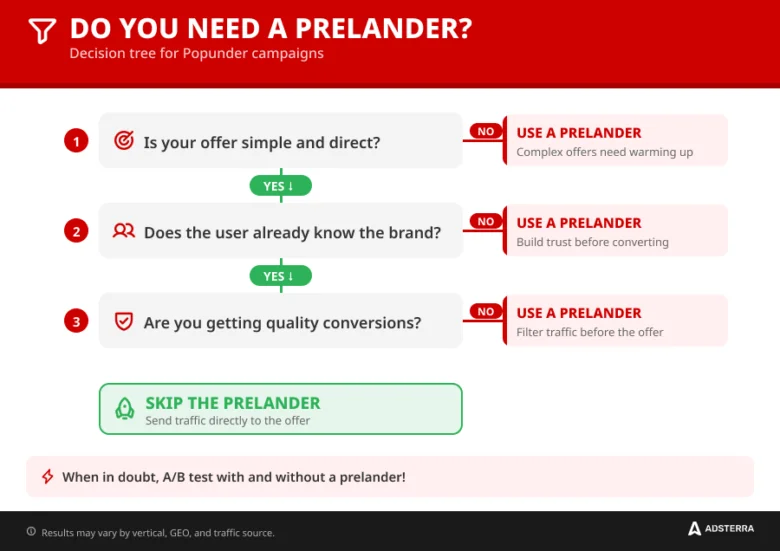
The simple answer would be: use a prelander when the offer requires some kind of explanation. The prelander could introduce the problem, product, or advantages before moving the users over to the primary landing page.
What does it mean?
- You can qualify your traffic. A prelander could be the medium through which you distinguish interested users from passers-by.
- You can make the landing page more relevant, when it’s too direct. A more informative page could ease the transition to a sales page.
- You can support the message localization. A prelander is able to support headlines, languages, currencies, and culture-related information prior to presenting your affiliate marketing offer.
- You may need to test different angles. Several prelanders can let you test messaging while keeping the main offer page unchanged.
- The traffic may require additional trust building. Users’ reviews, explanations, comparisons, FAQs, or product education can sometimes help before the conversion page.
Skip the prelander when:
- The offer is simple and clear to understand straight away.
- The advertising page clearly communicates the offer of the product already.
- A well-optimized conversion funnel that needs no extra pages added to the process.
- One more page would create unnecessary friction or reduce conversion rates.
Expert feedback from Afflift community
My experience with Adsterra traffic has been good especially with the popunder traffic. It’s easily one of the top quality traffic platforms for me.
One cool thing I’d like to specify that the support team offered their expertise and experience to evaluate my campaigns to optimize and scale my campaigns.
I recommend this traffic platform.
How to track, optimize and scale Popunder ad campaigns?
One of the biggest mistakes advertisers and affiliate marketers can make is evaluating Popunder traffic only by volume. A campaign may generate thousands of visits while producing very few targeted actions. Hence, tracking is vital.
Tracking is the foundation for optimization
Optimization begins when the evidence becomes specific. Without granular tracking, it is impossible to know which traffic is responsible for the results.
At minimum, you can monitor:
Impressions: How much exposure did you purchase?
Visits: How many users reached the destination?
Conversion rate: What percentage completed the desired action?
CPA: How much did each conversion cost?
Revenue: How much value did the campaign generate?
ROAS: How much revenue was produced for each unit of advertising spend?
You can also apply multi-event tracking technology that makes Popunders campaign even more transparent and controlled. It is capable of registering multiple key actions, which are valuable for the marketing funnel analysis and budget distribution.
Optimization flow
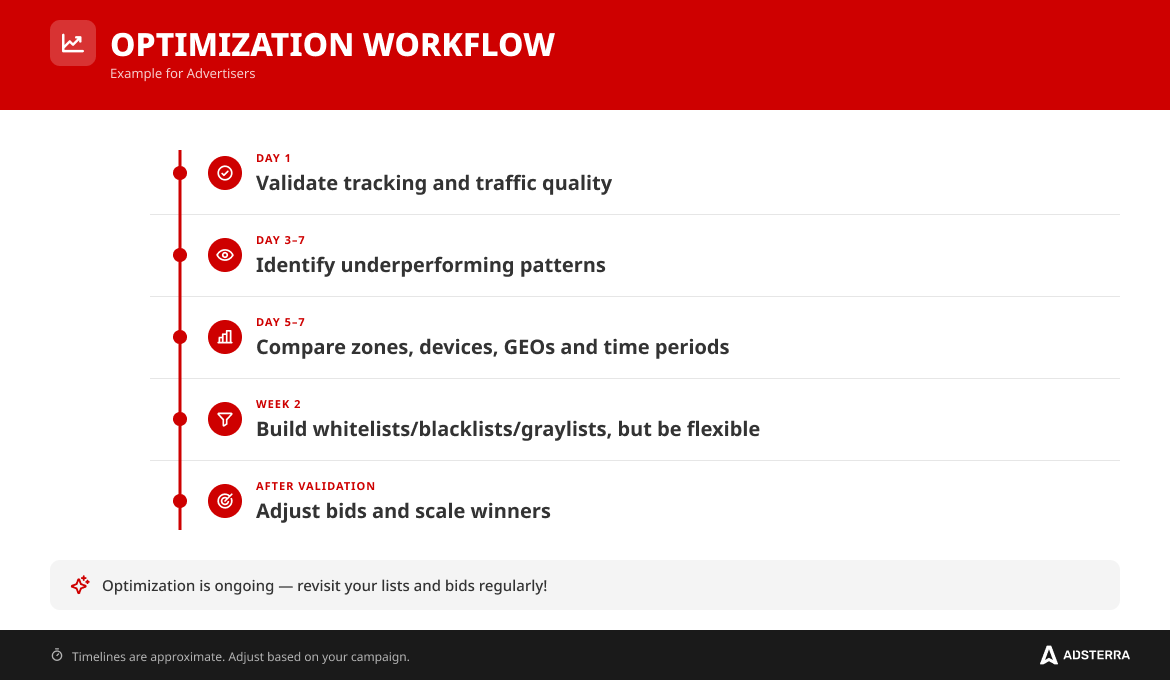
It’s worth working out a consistent flow to optimize your Popunder ad campaign while getting the traffic. A simplified example can look like that:
What are your first campaign stats actually telling you?
Normally you have the funnel that looks like that:
Ad network → tracker → landing page → conversion → postback → ad network.
The question is: What exactly shall I track?
Let’s look at the practical side of stats and signals, what it may be telling you and what to check next.
| Signal | Possible inputs | What to check next |
|---|---|---|
| High impressions, few visits | No meaningful page visits | Campaign setup, traffic source, targeting, and billing model |
| Many visits, few engagements | No match for traffic-offer or the offer message is not clear or quick | Headline, offer, page speed, and message match |
| Good engagement, few conversions | Interest, but obstacles | CTA, form length, price, trust signals, and conversion flow |
| Conversions at high CPA | Funnel works, but traffic acquisition may be too expensive | Compare GEOs, zones, devices, bids, and conversion rates |
| Low CPA from one segment | Possible promising audience or traffic source | Isolate the segment and test additional volume before scaling |
| Large differences between GEOs | Offer may have stronger product-market fit in certain countries | Separate GEO campaigns and allocate budget according to profitability |
| Mobile significantly outperforms desktop | Your offer or landing page may be particularly suitable for mobile users | Test mobile-tailored creatives, pages, and targeting |
| One zone/source dominates conversions | Some inventory may be substantially more valuable than the average campaign traffic | Analyze source-level performance and consider a whitelist strategy |
| Traffic but zero conversions | You don’t yet know whether the problem is traffic, offer, tracking, ad format, or insufficient data | Verify tracking first, then collect enough data before making drastic decisions |
| Conversions suddenly stop | Something may have changed in traffic, tracking, landing page, page speed, offer, or availability | Check postbacks, tracking parameters, campaign settings, landing page vitals, and offer status |
When should you scale?
Scaling should come after validation. When a campaign delivers conversions with satisfactory costs consistently, start increasing the volume gradually rather than increasing your budget significantly. Notice whether the performance is still stable when you add one more traffic source. The key is to preserve the conditions that made the original campaign profitable.
What may scaling include?
- Increasing the budget
- Scaling with new GEOs
- Testing out devices
- Adding up new Popunder traffic sources
- Testing landing pages
- Increasing exposure to high-performing segments
- Launching related offers
Smart bidding strategies, targeting options, and budget tips
The first campaign is rarely the final campaign. Popunder advertising can generate a large amount of data, giving advertisers an opportunity to identify differences between traffic segments. The goal is to turn that information into progressively better targeting.
Treat the first result as a signal, not a concrete conclusion. Start by looking for patterns across:
- geographical location
- device type
- operating system
- browser
- time of day
- day of week
- traffic source
- placement or zone
- frequency
- landing page
- conversion event
In case one segment converts at a profitable CPA, but the other is eating up budget without producing any results, the answer is not always to cut off the whole campaign. Rather, find the weak segment and cut down its exposure, then focus on the strong one.
This process is especially important because traffic can vary substantially between individual sources and in time.
How to сhoose a bidding strategy?
You can utilize these points when developing your bidding strategy and tactics:
Use smart tools
You no longer have to rely on the bid-with-closed-eyes technique. Instead, you can bid only slightly higher than your competition while not bidding the most expensive amount to acquire the traffic you want. This is called the second-price auction algorithm where your bids are made in a smart way.
Manage your budget
Track your entire budget not only for your campaign but also for daily spending. You may do that automatically on certain platforms using daily budget capping.
Apply frequency caps
Repetition of the same type of advertisement too often may lower its effectiveness and even make a poor experience. Caps on frequency let advertisers manage the number of times the individual sees your campaign within a given time frame. The optimal frequency varies depending on the offer, target audience, geographical location, and the goal of your campaign. Follow your intuition and track the results. In the case of a direct-response campaign, you should test various options to find out if the repetition of ads brings you exponential conversions or only higher spending.
Test, apply, loop
It is good for data-driven marketing as a whole and for the strategies designed for bid-based campaigns in particular. Get insights, optimize your targeting settings, monitor, and repeat.
How does bidding strategy work?
Here is an example of how to make it work within Adsterra.
These elements are needed to begin the process of creating an ad campaign:
- Log in to the Advertiser account or register.
- Go to the Create campaign menu option.
- Make use of targeting settings, such as the operating system, device, location (country-region-city), Popunder traffic sources, and so on.
- Select one of the available pricing models: CPM, CPA, CPC.
- Pick the Popunder ad format.
- Use S2S tracking of your choice and get a postback to control the performance of your ad campaigns better.
- Use useful tools, such as Smart CPM, Custom Bid, and CPA Goal.
- Use blacklists, whitelists, and graylists and be flexible about it, because traffic can vary.
- After several days, end your campaign and make a report of its performance, including CTR, sign-ups, and conversions.
Expert feedback from Afflift community
I’ve found that Adsterra’s popunder ad format is one of the best traffic sources for me. I’ve generated good numbers with them and highly recommend it
Quality Popunder traffic: telling real Popunder inventory from bot traffic
In order not to wonder: Is Popunder traffic real?, you should always evaluate the quality of the Popunder traffic you purchase. Invalid traffic, bot traffic, automated activity, accidental interactions, and low-intent users can obviously distort campaign statistics.
Popunder traffic quality depends on the ad network technology that vet traffic. Reputable advertising platforms use different mechanisms to identify and filter suspicious activity, like a 3-level security system, to prevent fraud traffic and false views and clicks.
Final takeaway
Popunder traffic advertising should not be viewed as a replacement for every other advertising channel. It is better understood as another performance marketing tool that can provide additional reach and a direct route to an advertiser’s page.
For advertisers and affiliate marketers, the smartest way to approach Popunder traffic is therefore like that: test with clear goals, track meaningful steps, identify profitable segments, cut what’s lagging behind, and scale only when the numbers justify it.
Popunder traffic: FAQ
How to set up Popunder ads for maximum conversions?
What you can do is to set off with one offer and one conversion goal, localized fast-loading landing pages, precise targeting, frequency capping, tracking, and optimization.
How to target US audience with Popunder advertising?
Use a US-specific campaign, prioritize US GEO targeting, and then break down to devices, operating systems, and more settings available. Then, arrange the scaling of best performance.
Where can I find reputable platforms to buy Popunder traffic for affiliate offers?
For affiliate offers, try using reputable advertising networks, among which are Adcash, PopAds, Adsterra, TrafficStars, etc. After that, you can start comparing their inventory, targeting capabilities, costs, tracking methods, expert advice from the support team, and overall quality.
Which ad networks provide high-quality Popunder inventory for online gaming offers?
For online gaming, consider ad networks based on creative inventory, geographical location, pop traffic quality, targeting, quick moderation, and conversions, not traffic volume only. Look into ad network capabilities for iGaming vertical in particular.
Can you recommend tools for tracking and analyzing Popunder campaign data?
There are various tools that help you track clicks, conversions, costs, revenue, performance of sources, and postbacks for optimization. Tools such as Voluum, RedTrack, Binom, Keitaro, and others can do a great job. With Adsterra, you can access a step-by-step guide on the most effective and accurate s2s tracking.
What are the average costs per thousand impressions for Popunder ad placements?
There is no universal average. Current examples range from $0.10 to $1+ CPM depending on GEO, targeting, inventory, competition, and a few other factors.
What types of products or services best suit Popunder advertising strategies?
Products that have a clear value proposition, simple funnel, large audience base, and measurable outcomes are more suited for Popunder ad campaigns rather than complicated products. Among especially profiting niches are iGaming & Sports, VPN, Utility, Antivirus, Mobile Subscriptions, Browser Extensions, Addons, Social Dating, E-commerce, and Sweepstakes.
What are the key strategies for optimizing my Popunder campaigns for better performance?
The process of optimization involves segmenting by GEO-country-region-city, device, OS, carrier, niche or mainstream pop traffic, and also capping, etc. It’s normally followed by cutting off sources which provide less relevancy and efficiency, also testing different versions of landing pages, applying platform advanced tools for optimizing bids and budgets, and scaling successful campaigns.
What are the main challenges advertisers face when running Popunder campaigns?
Challenges may include inconsistent pop traffic quality, lack of intent, limitations of browsers (that can be tackled by an anti-AdBlocker feature from your ad network), tracking issues, increased competition, and targeting highly profitable niches.