This case study is shared by Leandro, our new publisher whose website idea is even more interesting than his first profit. Leandro hasn’t been monetizing for 2 years, adjusting and polishing SEO and programmatic strategies. Now, he’s probably a bit sorry for not starting to make profits earlier. His story is about how a niche site from Brazil makes money, hitting over $700 in the first monetization month.
Disclaimer:
The story was translated by the Adsterra Content team. We had to depersonalize web screenshots and remove sensitive data to protect the publisher’s privacy. We tried to keep the copy authentic, but we may have misinterpreted local naming or slang. Please be tolerant of this
- Site niche: OBD2 trouble code reset guides for popular Brazilian car models
- Site launch: March 2024, no monetization at the beginning
- Monetization start: March 2026
- Final monthly ad impressions: 1,278,194 (92% Brazil)
- Monetization model: a four-week rotation of Native Banners. Next, a two-week test of Popunder and Social Bar units.
- First ad revenue: $732
The idea: Car code resets for the Brazilian DIY mechanic
If you own a car in Brazil and that check engine light pops on, you’ve probably been down this road:
- Buy a cheap ELM327 scanner from some website.
- Plug it in, see a code like P0420 or U0100 pop up.
- Start Googling for “código P0420 como resetar.”
- Realize most of what you find is generic, half-baked advice or dealerships just telling you to “schedule a service.”
People needed a real guide in Portuguese—something specific to their actual car, not just random tips that might or might not fit. Dealerships just hit you with the same old “agende serviço” sales-funnel pitch. Forums were all over the place, and it’d take hours to dig through them. And YouTube? Tons of videos, but they’d gloss over those little details that change with each model year.
That’s hpw Leandro came up with the idea of creating a narrow-niche website for car owners. Most pages would be optimized for every common DTC + car model + year combination, with a 3‑minute reset sequence and a short embedded video. This was a partly programmatic SEO play, but executed with patience and real quality control.
Why not global traffic?
If you want to get ranked faster, you’d better focus on low-competition blog niches. There were already websites (e.g., OBD‑Codes.com, YourMechanic, RepairPal) and countless YouTube videos covering DTC resets. While many are not strictly model‑year‑specific, the niche was not empty, and the competitors were authoritative for Google.
Trying to beat forums and dealer sites in search rankings is tough and useless. Forums have serious domain authority, and dealers dominate the high-intent queries like “schedule service.” If your site doesn’t have much real content, you’re in for an uphill battle.
SEO strategy: How to create a niche site in Brazil
Following Google’s Helpful Content changes in 2023-2024, the launch of a new website turned into a nightmare. The plan that Leandro selected proved right: he picked a niche with low competition and genuine problems faced by the target audience. The ranking and making Google recognize the website involved five major steps.
Let’s look at how Leandro actually did it, starting with the basics, month by month.
Stage 1: Building real quality, or manual signals of content quality (months 1–3)
- Leandro wrote 20 hand‑crafted pillar posts for the top 5 DTC codes × 4 best‑selling cars (Gol, Onix, HB20, Strada).
- Each post included original photos of the dashboard, exact steps, and a 2‑minute video shot on a phone.
- All guides were optimized for long-tail keywords (navigational intent).
- Schema addition: HowTo + FAQ.
Zero ads during the first 3 months to pass Google’s filters and gain organic visits. And no ads till 2026, but for another reason. Leandro first tried to sell ads directly to small businesses in his segment, but gained a one-time payment of $450 from a car accessories e-shop.
Stage 2: Programmatic SEO, drip‑fed posting (months 4–10)
Leandro built a Google Sheet with the most popular:
- 25 DTC codes (P0128, P0420, P0171, …)
- 8 car brands (VW, Chevrolet, Fiat, Honda, Toyota, Nissan, Hyundai, Ford)
- 8 popular models
- Years 2019–2026
The above are search query components. They generated 2,500+ possible pages to optimize solely for long-tail keywords.
Just to illustrate: here’s a sample Google Sheets table that can be used (not all brands, models, and years).
| P0128 | Honda | Civic | 2024 | =CONCATENATE(A2,” “,B2,” “,C2,” “,D2,” Reset (3 Minutes)”) |
| P0128 | Honda | Civic | 2025 | =CONCATENATE(A2,” “,B2,” “,C2,” “,D2,” Reset (3 Minutes)”) |
| P0420 | Ford | F150 | 2023 | =CONCATENATE(A2,” “,B2,” “,C2,” “,D2,” Reset (3 Minutes)”) |
When publishing, Leandro stuck to just 15–20 pages each week using the WP All Import plugin for WordPress. He knew dumping hundreds of pages at once would scream “thin content” to Google and probably trigger penalties.
His template added uniqueness to each page, featuring model-specific warnings (like “On 1.0 TSI engines, hold the accelerator during reset”) and using a simple Google Sheets formula to inject a genuinely unique sentence for each model year.
All of these pages were created with the help of AI. Leandro manually reviewed and improved the first 30 pages, then refined the prompt to improve the AI output.
Stage 3: Internal linking & indexing engineering (months 5–8)
Next, after building pillars and long-tail pages, Leandro created hub pages. A hub page accumulates surface knowledge in a specific subject, leading users to more detailed content pieces, developing this subject from various angles.
Hub examples:
- /gol/ interlinked all Gol reset guides
- /p0420/ interlinked all cars with that code
Next, the “Related codes” sidebar was released to keep users on the site (massively increasing ad impressions per session—more on that later).
This stage also required the publisher to submit multiple sitemaps, but in chunks, never all at once.
Stage 4: Earning real, non-spammy backlinks (months 9–15)
Backlinks have always been highly valued by search engines, but only relevant and non-toxic.
- Leandro joined the largest Brazilian car forums (e.g., HB20 Clube) and answered 100+ questions with genuine help, occasionally linking to a guide. Some forums restrict posting links, so Leandro had to add them to answer-comment-only posts.
- When one explanatory post about “P0128 no Gol G6” went viral on a Facebook group, the site got two do‑follow links from regional auto blogs.
- Leandro created a free DTC lookup tool (just a simple database) and promoted it on Reddit, getting 4 natural backlinks.
By month 24, twelve authoritative websites were sending quality backlinks to Leandro’s site.
Stage 5: Keeping content fresh (months 16–24)
As new car model years rolled out, the spreadsheet automatically updated the template. For example, it’d add details like “Funciona nos modelos 2025 e 2026” without much manual effort.
Leandro also had to re‑shoot videos for the 20 most‑viewed pages to keep up with the updates released.
For future monetization and traffic growth, the Argentina/Mexico hreflang for 50 high‑performing pages was added. Translation could open new sources of traffic when Brazil would hit its ceiling.
The real traffic growth timeline
The attached screenshot shows a steady, unglamorous climb—exactly what an honest programmatic site looks like.
| Month | Organic Visits (BR) | Result |
| M1–M3 | 0 → 180 | Manually-created pillar pages, slow indexing |
| M4 | 1,200 | First 40 programmatic SEO pages indexed. The focus on ultra long-tail queries |
| M6 | 4,500 | Drip‑fed publishing continues. The first page with the “code + model” combo hits top 3. |
| M9 | 12,000 | 200+ pages indexed; hubs link to detailed pages and help grow internal authority. |
| M12 | 38,000 | First backlink from a forum boosts the whole pillar. |
| M15 | 82,000 | Mass indexing of all live pages |
| M18 | 141,000 | Related‑code internal linking drives deep user session depth. A Core Web Vitals check shows it’s required to improve mobile metrics. |
| M21 | 210,000 | Content refresh for 2025 car models. Then, comes the second wave of indexing. |
| M24 | 267,000 | Adding new DTC codes so the site could reach its full potential |
| M26 | 290,000 | Traffic plateau without further backlinks. With no high-traffic geos and backlinks, it’s the organic ceiling. |
Traffic sources: 92% Google Brazil organic, 4% direct, 3% YouTube embeds, 1% other.
Monetization: Adsterra Native Banners
No push ads, no pop‑unders, no affiliate links, just Adsterra Native Banners placed on every page. Leandro’s strategic thinking was primarily focused on getting the site fully compliant with Google. He didn’t contact the Adsterra team to look for alternative formats that are also eligible by search engines.
Native Banners setup:
- It took minutes to sign up as a publisher and generate the Native Banner set code.
- Using the Custom HTML Widget tool by WordPress, Leandro included the ad block to every page, in the sidebar section (sticky on scrolling).
- He customized the banners’ layout by selecting how many banners a user will see, and choosing the vertical composition.
- Adsterra AI-optimized ads to match the visitors’ preferences.
Revenues from Native Banners
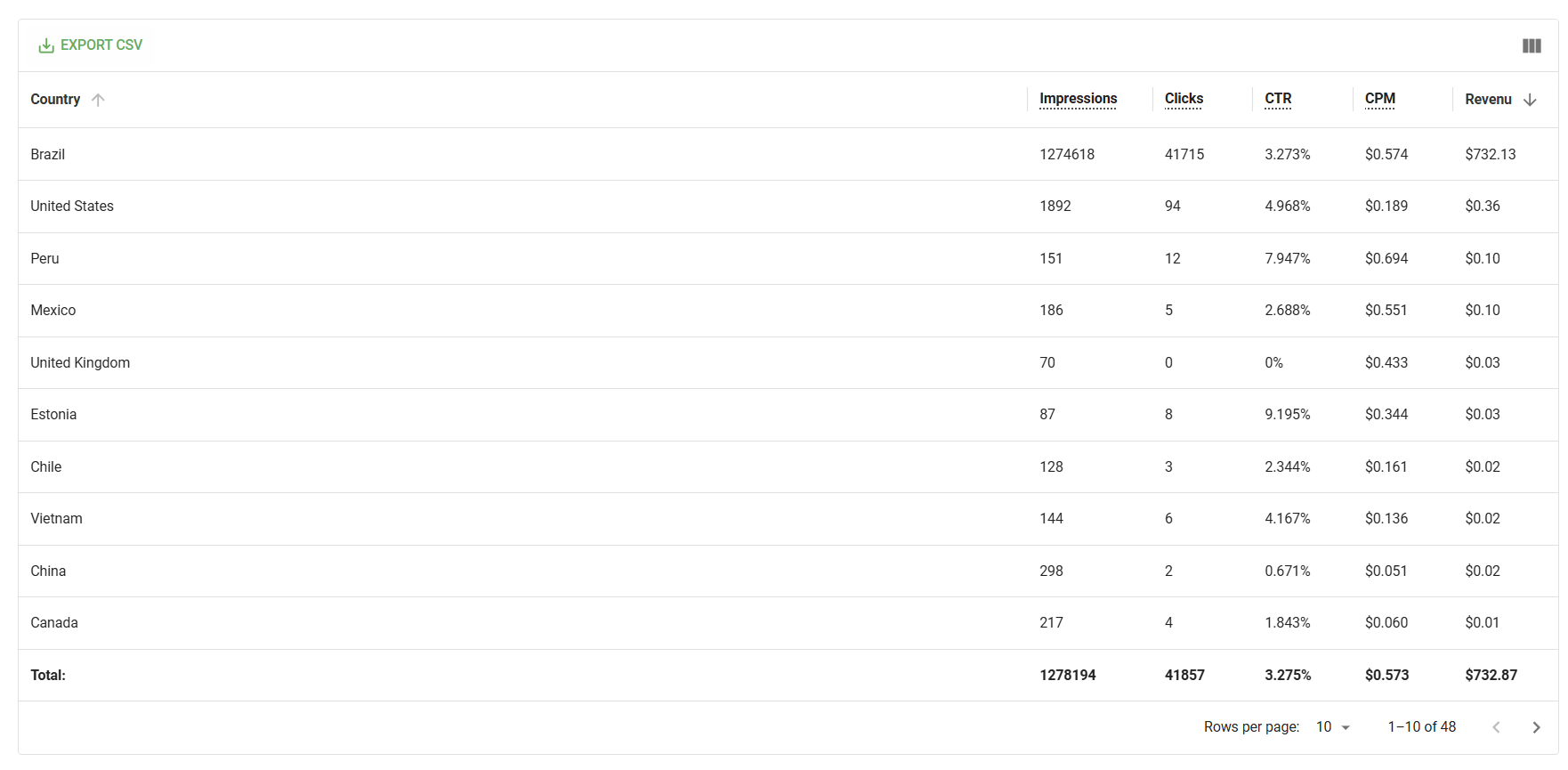
| Country | Ad Impressions | Clicks | CTR | CPM | Revenue |
| Brazil | 1,274,618 | 41,715 | 3.27% | $0.574 | $732.13 |
| Other (US, MX) | 3,576 | 142 | — | — | $0.74 |
| Total | 1,278,194 | 41,857 | $732.87 |
Ad impressions vs visits
Some 290,000 monthly visits, 1.27 million ad impressions means each visitor generates ~4.4 – 4.5 native ad views per session. This is achievable because the average session includes 2.5 page views (users click related codes, related cars).
Leandro’s advice:
Keep an eye on the content-to-ad ratio on mobile. On a 5‑inch screen, does the first thing a user sees contain meaningful content? It must be like that. If ads take more than 30‑40% of the initial viewport, reconsider changing the layout.
Extra monetization: Popunders and Social Bar
Later on, Leandro reached out to the Adsterra Support team and asked if he could put static banners in addition. The team suggested using Popunder and Social Bar instead. These 2 formats don’t compete with native ads, appearing in a different manner.
The parties agreed to test both ad types on a limited number of pages (several hub pages and target guides). Social Bar showed impressive 33% CTRs and the highest monetization potential on a website, but since Leandro put limits on page placements, traffic volumes and viewability could generate only $52 after 2 weeks.
Popunder’s CPM proved to be the best among other formats, $1.3. Again, ad impressions were insufficient to generate more revenue, but the potential was enormous.
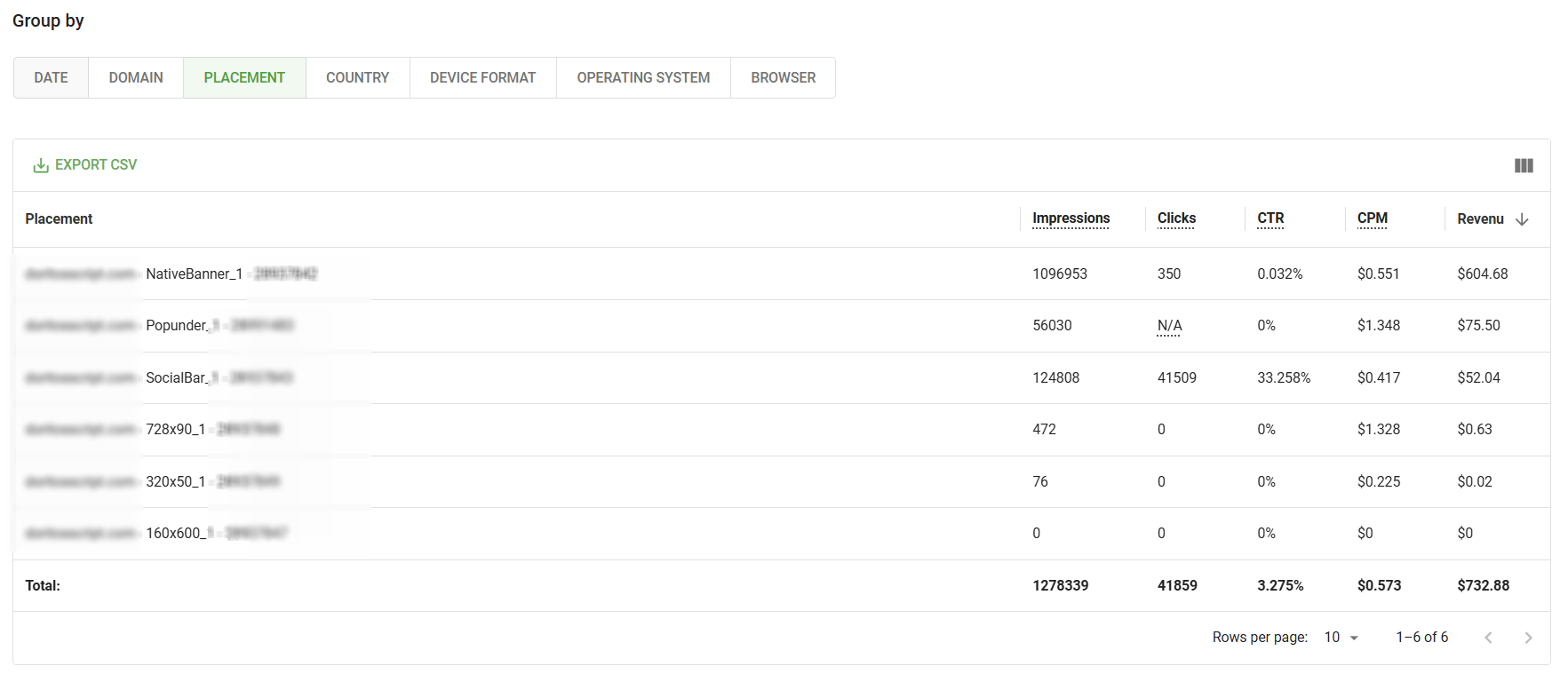
Banners that Leandro had put first were repositioned to the bottom of the pages, and, predictably, they didn’t generate enough views and money.
Strategy roast: what worked, why, and what to do
Summing up, that’s how a low-competition Brazilian niche site could gain its first income:
- Steady, realistic publishing. Rolling out 2,000 pages all at once is asking for trouble. Dropping 15–20 each week looks like healthy growth to Google.
- Genuine backlinks. Even a dozen real, niche-relevant links pushed pages up from 6th to 1st spot for tough long-tail keywords. Without them, the site wouldn’t have reached 30,000 visits.
- Prioritizing the user. Fast loading, real photos and videos, clear warnings based on the actual car, and internal links that actually helped people. Google’s Helpful Content updates definitely rewarded this approach.
- No expectations for US‑level CPMs (for now). Brazil’s CPMs can be enhanced by powering the site with Popunders. The business model works on volume and longevity.
- Precise traffic ceiling. The niche tops out around 300K visits/month for a single-country site. There’s no magic 600K without expanding to more languages or adding a forum/tool vertical.
- Growth opportunities. Even with traffic capped, the site keeps finding ways to boost ad visibility. New ad formats—not just experimental ones—are coming. With a better click-through rate and smarter ad placement, earnings should push past $5,000 a month.
These are the honest first steps made by a creative and talented publisher, whose way in traffic monetization will surely be successful! You don’t need high-volume keywords, a DR of 50 or higher, or a team of copywriters. This Brazilian niche site earns thanks to solving real problems of its audience and providing advice in the most relevant form. Which of your next ideas will be as successful?