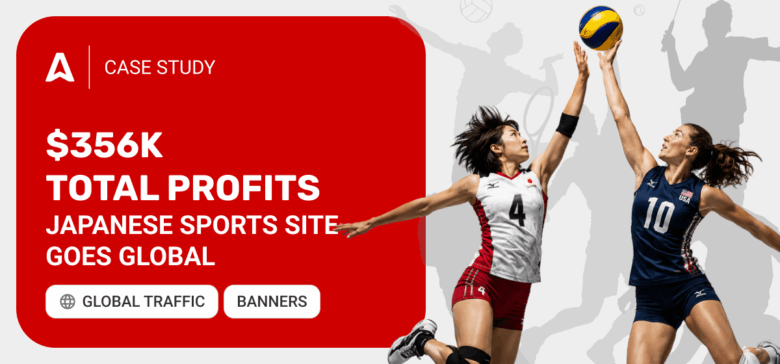
Yongxing’s monetization model is based on posting sports predictions and making money from showing banner ads to global visitors. He’s been monetizing with Adsterra for 3,5 years, starting from a minor $1,900 revenue. He allowed the Adsterra team to restructure his story into a sports-site case study so you could learn more from the data.
Disclaimer:
The story was translated by the Adsterra Content team. We had to depersonalize web screenshots and remove sensitive data to protect the publisher’s privacy. We tried to keep the copy authentic, but we may have misinterpreted local naming or slang. Please be tolerant of this 😉
Japanese sports site case study data
My website primarily covers Nippon Professional Baseball (NPB) and the J-League (professional football/soccer). A secondary focus is on sumo, judo & the Japanese national teams’ performance in international competitions, plus athlete profiles. All of these have gained massive global popularity.
| Av. monthly ad views | 7–8M |
| Peak monthly ad views | 13M |
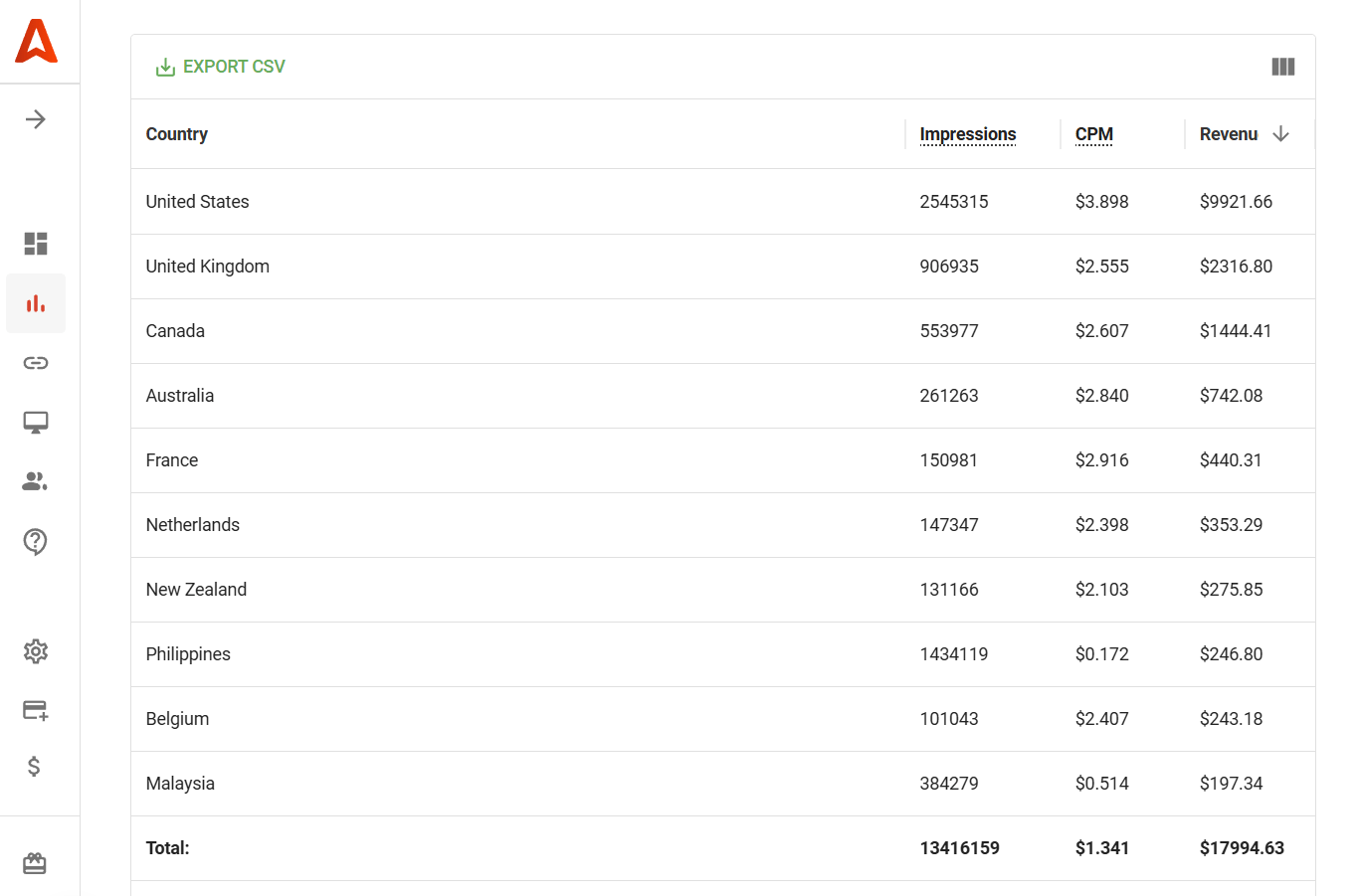
| Primary revenue geos | US, UK, Australia, Canada |
| Secondary revenue geos | France, the Netherlands, New Zealand, the Philippines |
| Average CPM rates | US: $3.5–3.8 Australia: $3.5–3.6 UK: $2.5–2.8 |
The sports site revenue model
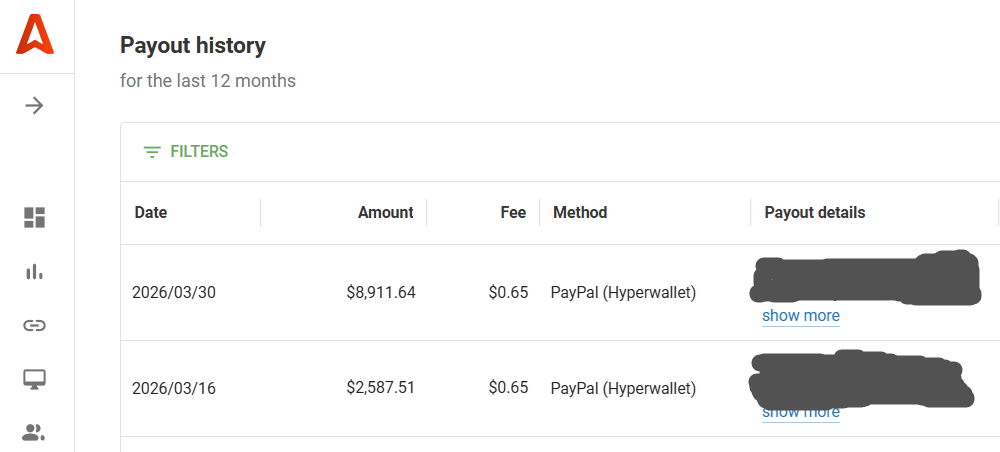
The story began in 2023, when I started posting random news and analytics with little intention of targeting global readers. Earnings began with small amounts, at around $1,900, but while traffic kept growing, they reached $8,000 per month. Fast forward to 2025, when Google Updates hit us, but we still managed to jump up to $18,000 a month, with overall Adsterra earnings exceeding $355,000.

The current monthly revenue has ranged between $8,000 and $17,000–19,000 over the last eight months. As you can see, payouts come from global traffic, primarily the US and the EU.
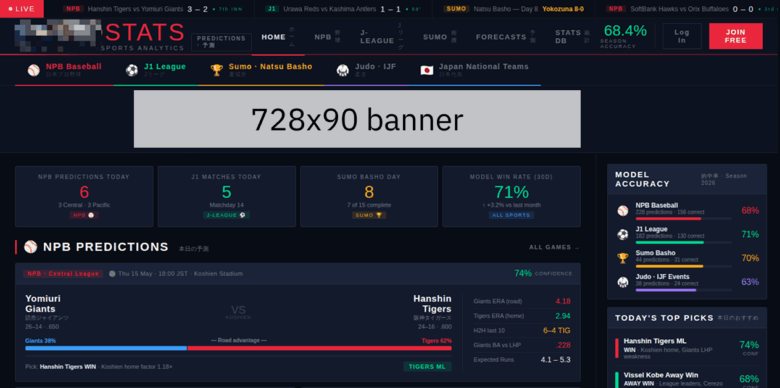
The ad revenue comes from Banner placements on all pages, and thanks to decent page depth (3 pages per session on average), users see several advertising offers per visit. Top banner sizes I selected:
- 728×90 leaderboard (above content, main page only)
- 300×250 sidebar (sticky on desktop, all pages)
The leaderboard banner placement is the most visible (the grey rectangle of the screenshot).
I also tested a Native ad block, but it only works for my expert review pages and opinion-sharing pages. Maybe I’ll get back to them someday.
Revenue growth thanks to traffic relevance and ad optimization
My manager told me Banners ads include CPA payouts. It means that a publisher can earn significantly higher profits if their traffic performs more actions. In other words, when users view, click, and then buy something, earnings soar!
Since traffic had been performing so well, the Adsterra optimization team adjusted the feed to send a higher share of iGaming, sports, and VPN app ads our way, and the results were impressive. More conversions with more payouts.
With CTR staying at a minor 0.013% level, Yongxing Li’s website attracted audiences who made lots of high-priced actions from these 1987 clicks.
I believe Adsterra performs remarkably well in both CPM rates and payments, thanks to multiple major iGaming and sports advertisers.
– Yongxing Li –
How traffic behavior affects monetization
Sports traffic has specific behavioral characteristics that directly influence monetization strategy:
- High temporal concentration. 65% of my daily traffic occurs in three windows: morning (7–9 AM), lunch (noon–1 PM), and evening (7–10 PM) UTC-4. Traffic before and during sporting events is high; traffic between events could drop unless I post evergreen playing tactics and success stories.
- Direct visits and referral traffic. 52% of our users just head straight to our site or come from referring URLs like Reddit, LINE OpenChats, and local media. This tells me we have a strong brand and a loyal following among core sports fans.
- Long session duration. Users spend an average of 7 minutes on the site and visit 3 pages per visit. This is an audience that really cares about sports statistics and spends a lot of time comparing data tables and reading extensive analyses and historical records.
- Predominantly male (83%), age 25-55. This audience commands premium CPM rates from relevant advertisers like iGaming, dating, and financial platforms, as well as gaming and VPN brands.
A strong sports site foundation
Obviously, I’m not telling a one-day success story; I’ve been seeding this brand trust for five years. Evergreen techniques exist, though, and I’m happy to share what’s worked for me.
1. Build around official statistics
Sports fans are data-intensive. Sites that host accurate, regularly updated statistics retain users longer and attract direct-navigation visits from users who use the site as a reference. Statistics content also ages well in search, unlike news articles. Which stats perform better? While I was writing my sports site case study, four groups were leading: batting averages, goals per game, head-to-head records, and fans’ favorites vs experts’ favorites.
2. Cover the sports in your local region that have an organized international fan base
NPB and J-League have had an established, loyal following for quite a while now, who watch sports day by day rather than only during tournaments. Sumo has a similar old fan base. Capitalizing on this international sports fan base allows you to maintain traffic year-round.
3. Check table rendering on mobile devices
To be frank, statistical content in mobile form without a well-executed table rendering function is a disaster. The tables should display in a compact manner in the tiny screens-it should not have any horizontal scrolling whatsoever. And, it surely requires some investment.
4. Work with your Adsterra manager on seasonal CPM forecasts
My account manager gives me CPM trend data from Adsterra’s advertisers at the start of each quarter. This lets me plan content investments for periods when advertising demand is highest. For example, during the NPB playoffs and other sporting events, CPMs were 18% higher than our annual average. If I hadn’t invested in extra content production for that period, I’d have absolutely missed the boat.
Note: Don’t go around investing money in content production to hit a specific goal – it’s not that stable. Assess your current capacities and only do more if it costs zero or next to nothing.
5. Create archived content for sports history data
Sports fans are always looking for historical data like “NPB history most home runs” or “J-League top scorers of all time,” etc. Such queries have stable search volume year-round and are very seldom in need of updates. Archived content forms the base of organic SEO traffic, steady enough in between seasons.
6. Create a strong tech stack
I own a live statistics database of NPB and the J-League. Data gets updated within 30 minutes of game completion. All data is provided on an individual-player basis, per season (historical and current). Each team’s performance stats, historical head-to-head data, ballpark statistics, and starting lineup data for upcoming games are readily available.
The value of this infrastructure is pretty easy to measure. Users who visit the stats database spend an average of 9.4 minutes per session. That’s 52% longer than users who visit just editorial content. The stats database also functions as an organic search anchor. Long-tail queries like “Yamamoto Yoshinobu career ERA by season” or “Gamba Osaka vs Cerezo Osaka head-to-head history” bring in users from Google who might otherwise have never found my site.
The cooperation with Adsterra
Adsterra acted as my trusted partner on both the strategic and the technical sides. Payments are prompt, CPM levels are in line with my volumes, and I’ve been proactively approached by my manager with new optimization ideas.
I personally like reliability in professional partnerships, especially when I can easily receive payments in JPY and track every transaction, including fees.
Final thoughts
As you could have ensured, a Japan-themed sports prediction website can reach $18,000+/month in ad revenue without any affiliate links or paid traffic. It will require combining 3 main components:
- Deliberate geo-targeting through English-language content.
- A category structure that appeals to both niche Japanese sports fans and global bettors.
- An ad strategy that layers high-viewability Banner ads and correct placement.
Surely, in the AI-search reality, such success will take longer to achieve. But if you add social traffic strategies and continue developing direct traffic channels, earn quality backlinks, and run high-paying ads, this task is more than doable.