
You might think… I’ll have high revenue if the ad network offers me high CPM. And this is a good point. But it is also a big stretch. Normal, typical or good CPM rates are not enough metrics to predict your potential earnings with surgeon-like precision. You need to look into other metrics and capabilities of your advertising platform.
It’s good to know the ins and outs when questioning: what is a good CPM in the advertising industry? But it doesn’t have to be complex.
Without further ado, let’s dig deeper until it’s all clear to decide on good cost-per-mille for web ads and display ads.
Understanding CPM one more time
Let’s start from the beginning. In digital marketing and advertising strategies, CPM is one of the common pricing models. It’s an essential metric for publishers and advertisers to understand how much you earn or spend.
CPM tells cost per mille (thousand impressions). For publishers, it means that they are paid neither per click (CPC, cost-per-click) nor per action fulfilled by the audience (CPA, cost-per-action), but first of all per thousand ad impressions (views) the ad gets on the web page.
Understanding CPM in detail… If your cost-per-mille rate is $4.85, it means that every time you deliver 1,000 views for the ad, you get such an amount to your balance.
Now, we’ll focus on calculating your good CPM. Don’t worry. You can always get a hand from your network to do so.
How to calculate CPM for publishers the best way?
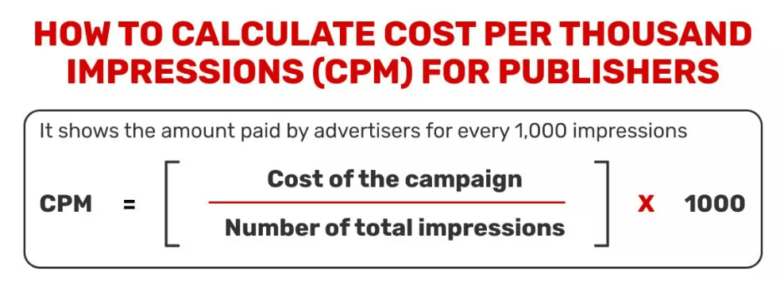
Here are your two alternatives:
1. RPM
While CPM focuses on impressions, RPM (revenue per mille) is often used by publishers to measure total future payouts from all sources per 1,000 impressions.
2. eCPM (effective cost per mille)
It’s a critical metric in digital advertising. It shows earnings from ad impressions, clicks, and conversions. Basically, it considers all ad revenue and divides it by the total number of impressions.
In digital advertising, it stands for an unfixed number, and it depends on the traffic performance and conversion rate, estimating how effectively your traffic works. Since eCPM is revenue-focused, it is very practical for publishers and webmasters.
Do not mix CPM with what is good for advertisers with what is good for publishers. Advertisers and digital marketers are more concerned to get lower CPM rates. They pay the advertising network a certain amount per 1,000 impressions their ads get. This is their own CPM metric. All the money invested in the ad campaign success (total cost) is summed up, and the ad spent is divided by total impressions.
However, and this is critical, advertisers’ key focus is to meet advertisement campaign objectives. Be it brand awareness campaigns or all the objectives tied with CTR (click-through rate) and broad audience demand.
What is a good CPM? Exploring average CPM benchmarks
The good rate for CPM is comparative and relational, depending on a few key factors. Among them are (but not limited to) ad platforms, specific audience targeting, seasonality, etc.
One more key factor is ad formats. Here, we researched the open-source and anonymous publishers’ data and web resources to put it all together for an approximate, referential standard by which you may initially consult.
| Ad Format / Traffic Type | Average CPM (on date of publication) | Notes |
|---|---|---|
| Display (Banner) Ads | $1.20–$2.50 | Standard website display ads (mobile & desktop). Mobile showing slightly lower CPM rates than desktop. |
| Native Ads | $2.50–$3.60+ | Higher engagement placements. |
| Video Ads (Pre-roll/In-stream) | $7.00–$15.00+ | Premium inventory can exceed this. |
| Push notifications | $0.40–$1.50 | Depends on the Tier. |
| Popunder | $1.00–$4.00 | Depends heavily on GEO. |
| Interstitials | $3.00–$5.90 | Varies by the niche. |
| Tier-1 GEO Traffic (US, UK, CA, AU) | $3.00–$12.00+ | Varies by format & audience quality. |
| Tier-2 / Emerging Markets | $0.50–$3.00 | Lower advertiser competition. |
So, a good CPM, what is it? It is a favorable metric for publishers. Always look deeper when evaluating your CPM. For instance, Adsterra CPM rates are high and stable for publishers, as ad revenue is calculated using eCPM, which counts for clicks, conversions, and impressions. You can take a free, quick moderation and see how it works now in real time.
Factors that affect CPM calculation for publishers
As we mentioned earlier, there are a few key factors that affect CPM, and how your good or typical CPM may look like. You can increase your gains by learning the basics of the fair game.
1. Users’ geo and CPM by country
So, what is good CPM all about here? The very simple approach would be: GEO of targeted audience and CPM rate often correlate. The CPM value is higher in Northern America and the EU as these are Tier 1 countries.
To illustrate CPM by geo from Adsterra, we gathered estimated costs per 1,000 impressions only. However, revenues differ a lot depending on the advertisers’ bids. At times, CPMs can even be higher.
Always check CPM for your country, updated bids, and the current environment with your ad network manager!
Real-life CPM example 1
Here are real-life cases of good CPM for publishers’ website traffic (mainstream) from News, Movies sites, Streaming, and other verticals, with mobile and desktop impressions on Popunder and SmartLink (Direct Link).
| Country | Platform | CPM ($) |
|---|---|---|
| MM (Myanmar) | Android | 3.2 |
| BG (Bulgaria) | Android | 2.9 |
| BG (Bulgaria) | iOS | 3.8 |
| MZ (Mozambique) | Android | 2.7 |
| MZ (Mozambique) | iOS | 2.5 |
| CZ (Czech Republic) | Android | 2.5 |
| HK (Hong Kong) | iOS | 3.2 |
| SG (Singapore) | Android | 2.0 |
| SG (Singapore) | iOS | 3.3 |
| MY (Malaysia) | Android | 4.5 |
| US (United States) | Android | 3.2 |
| US (United States) | iOS | 4.6 |
| US (United States) | Windows | 4.5 |
| US (United States) | MacOS X | 2.2 |
| AU (Australia) | Android | 2.8 |
| CA (Canada) | Android | 2.3 |
| CA (Canada) | iOS | 1.9 |
| CA (Canada) | Windows | 1.9 |
| AE (United Arab Emirates) | Android | 2.1 |
| GB (United Kingdom) | Android | 1.9 |
| GB (United Kingdom) | iOS | 1.5 |
| MA (Morocco) | Android | 1.9 |
Real-life CPM example 2
Here are examples of varying CPM rates for Tier 3 countries for niche, non-mainstream mobile, desktop and social traffic on Popunder and SmartLink (Direct Link).
| Country | Platform | CPM ($) |
|---|---|---|
| NG (Nigeria) | Android | 2.9 |
| NG (Nigeria) | iOS | 1.5 |
| ZW (Zimbabwe) | Android | 2.5 |
| MW (Malawi) | Android | 2.4 |
| GH (Ghana) | Android | 1.8 |
| CI (Côte d’Ivoire) | Android | 1.6 |
| CI (Côte d’Ivoire) | iOS | 1.3 |
| MZ (Mozambique) | Android | 4.4 |
| BJ (Benin) | Android | 2.8 |
| CM (Cameroon) | Android | 1.7 |
| CG (Congo) | Android | 1.7 |
| SN (Senegal) | Android | 1.6 |
| SN (Senegal) | iOS | 1.7 |
Some GEOs will pay more. However, we suggest looking deeper than Tier 1. For instance, the iGaming vertical and Tier 3 countries can bring more than good cost per mille rates for web ads, Popunder and Smartlink ads for mobile, desktop, and social traffic types.
Real-life CPM example 3
Muhammad, Quora blogger, Health & Relationships expert
With the right audiences from Africa, Europe, and Saudi Arabia, his average CPM for Kenya has grown to $8.7, for Chad $9.2, while for the UK the average rate is $8. One of his main social media channels is Quora. He emphasizes that the current biggest misconception about tiers is that traffic from Africa or Eastern Europe isn’t worth it, regarding the approach as outdated. Muhammad is sure one can still hit solid CPMs delivering substantial traffic from such geos. Read the full monetization story.
Traffic from other countries like Indonesian (ID), and Indian (IN), South African (ZA), and Vietnamese (VN) shows great potential in CPMs comparable to ad impressions on Tier 1. While traffic from LATAM regularly shows great spikes. Kenyan and Nigerian traffic is very promising from PIN Submits to App, VPNs, and Sweepstakes.
Real-life CPM example 4
Web designer with expertise in blogging and server administration
In the case study, Adsterra’s publisher shares that his CPM goes up to $6 with US traffic, which leaves him satisfied. He focuses his monetization efforts on Twitter traffic as the main social media channel. Clicks and conversions have raised his chances for larger payouts. One of his Twitter posts has brought him over $1,000 in 8 days. You can look into the full monetization story with dashboard statistics.
2. Audience specifics
While directing traffic to online ads, consider your niche audience segmentation: income level, specific demographics, gender, age, occupation, and other demographic features. Say, you target the higher-income target audience, then you can expect their normal CPM to be higher rather than lower CPM.
3. Web ad space
The ad space where your engaging ads really shine is also a factor that makes CPM good. The rule of thumb is that the more visible your ads are, the higher your CPM is. It’s usually content-rich, middle-page ads and banners placed just below the fold.
4. Right ad creative format
Video ads attract more attention from users and result in higher CPM. At the same time, it’s seldom that users watch video content while engrossed in content reading. Plus, it takes more effort to make a video ad for advertisers, who are always looking to optimize their ad spend and return on ad spend (ROAS).
A lower, but stable CPM for a static ad or display banner is also a good choice.
5. Ad size choice

The ad needs to be on the page, but it also needs to be noticed, right? If the ad is smallish and has not much potential to attract attention, cost per thousand impressions or cost per click can be of less value.
6. Ads quantity on the website
It’s worth keeping the number of ad creatives on the page moderate. It helps provide the smoothest user experience (UX) and preserve your CPM healthy enough. Maintain your clean layout by placing ads organically.
7. Season, date, or coming events
Holiday season and other time-and-experiences-bound activities can influence web traffic volatility and rates. Typical CPM will be traditionally higher for Sports calendar events, Sales Fridays or Cyber Mondays, holidays, and national traditions. The lower CPM seasonality, like January, might be less profitable.
8. Competition and market demand
It is not usually obvious how many competing advertisers want to opt in for your ad placement. The more your audience type makes up for the current demand, the more CPM value you can enjoy.
9. Device type
Mobile traffic is globally prevailing these days, still desktop traffic is not going anywhere, especially with Tier-one-country households and the B2B space.
On desktops, you get higher resolution for ad content, ad copy visibility, and more interactivity and engagement. Think desktop, however, think mobile first.
10. Ad relevance
This is the factor you should not worry about if you partner with an advanced ad network. Online ads are automatically matched to the niche and the right people.
11. Page load speed and website capabilities
Your website speed and the inconsistent UX on the web page or landing page are other indirect factors that can contribute to lower CPMs.
12. Show time and daily capping
Here, you don’t want your website visitors to sigh, thinking “could they show me their ad at least once a day”? That’s why advertisers can control it through their dashboards how often they show ads to your audience.
It happens by default for our publishers, but it’s really good to know that Adsterra has it under control, and there is optimal timing for users to see ads, and so they would be happy about it.
Consequently, you boost important metrics for good engagement and relevance score to be reflected in better CPM.
13. Bounce rate
Your readers should show high engagement. If your bounce rate is high and you cannot deal well with it, your CPM will unfortunately downgrade.
14. Choice of advertising platform
It’s always handy to join an advertising network with best CPMs that provides you with all you need. Quick and easy moderation, anti-AdBlockers, and the revenue-focused eCPM metric right in your stat data. Some networks match you with better demand and provide 100% ad fill rate with maximum ad quality inventory and regular payouts.
Want higher CPM? Tips to optimize CPM
It’s time to move on to turning your CPM for the better. There are quite a few practices for digital advertising inventory.
It’s likely that you have or plan a few websites to diversify your passive income. If so, then it’s a fantastic opportunity to test.
How? Here it is:
- Analyze CPM for all your web pages,
- Process them by filters, traffic specifics, ad placement, geos, week, and month,
- Look at similar sites with a gap in revenue generation.
Now let’s go through what you can do today to improve your CPM:
1. Check website parameters
Insert your site url into the empty field to analyze through PageSpeed Insights. Ensure the results are satisfying.
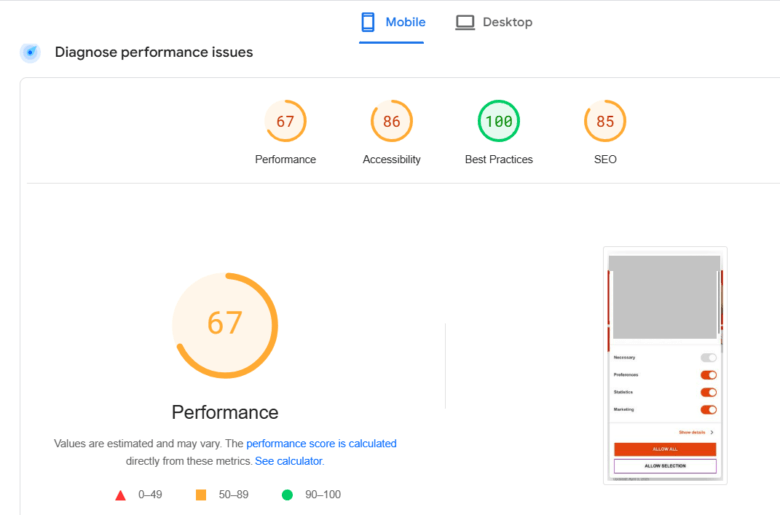
Source: PageSpeed Insights
2. Be consistent how many ads you display
At first glance, the more ad units you place on your website, the more revenue you earn. But no matter how attractive the thought is, you need to put yourself in the shoes of your viewers. Well-dosed, well-fitted display banners are more likely to appeal to your visitors and bring profit rather than clutter.
It’s a good move to use a mixture of ad formats first and single out a proper fit for your page and your target audience. You can use a Popunder, Smartlink, and Social Bar or its subunits, like Interstitial, Icon Widget, In-Page Push, etc.
3. Choose formats with 33X higher CTRs (click-through rates)
You can prefer ad quality formats that overcome the famous ad fatigue, like Smartlink and Social Bar, that bypass ad blockers by default. They interact with users in a non-intrusive, entertaining way, and back up your monetization strategy with higher CTRs.
4. A/B tests and user behavior check
You can’t beat A/B testing when it comes to desktop vs mobile and iOS or Android-oriented traffic. With mobile-type devices, you are likely to get good and better CPM among iPhone users as a more invested type of the device. You can also test out the new advanced ad formats and combos vs traditional ones.
5. Check ad blockers
Before you even come to dissecting what is your good CPM value, it is worth checking if you have the anti-AdBlock feature integrated to your website.
Ad networks that adopt new technologies for quality and effective monetization for publishers and creators, can offer you detecting and countering of ad blockers for your websites. It can boost your revenue by up to 35%. You can find such a feature in your Adsterra publisher’s account.
6. Consider mobile devices first
No matter that mobile users prevail in most niches in digital marketing, it’s not that easy to meet their expectations. With a shorter attention span, they will hardly tolerate disorganized content. Neither do they stand being bombarded with intrusive ads.
7. Study and play with more traffic types
Diversifying traffic types might be a good idea to accelerate your cost per click. You can always try to concentrate on one geo location, at the same time you can experiment with sources like mainstream or non-mainstream, social network traffic, etc.
8. Drive traffic from more than one geos
This one is as obvious as it gets. Experiment with Tier 1, 2, 3 for your website or blog. As you know, Tier 1 (US, UK, CA, AU, etc.) users are most profit-generating by statistics. Therefore, advertisers usually bid higher and the CPM-based rates increase.
For that, tweak your content and ad copy, covered topics, and other related aspects to embrace more than one geo. Get more insights by jumping to our in-depth guide on Tier 1-3 countries and the affiliate marketing industry.
9. Invest time in researching your audience
It seems like an ABC tip, however, being in sync with your niche audience gives you more possibilities to customize advertising options. Understanding CPM and your audience, you can be more precise in tuning settings in your publisher’s account and drive higher cost per click.
10. Attract new audience and increase site traffic
More genuine traffic means more unique impressions, which optimizes CPM. Here, you can get creative and use other social media platforms, advertising channels like email marketing, or a well-planned SEO approach for search engines.
11. Partner with ad networks
If you are not yet partnering with an advertising network, it’s about time to reap the benefits of such collaboration. Instead of looking for individual advertisers, pitching traffic to suit their marketing strategies, and hoping for a better CPM, you can get access to thousands of advertisers.
Publishers join Adsterra for 3 top reasons: best ad variety, easy payouts, and good support. And they stay with Adsterra for high CPM and Partner Care Approach. You can join Adsterra right now by following the easy tips below.
SIGN UP AS A PUBLISHER
Step 1. Register as a Publisher
Step 2. Fill in:
- Your Name and a Valid email
- Type in Login and Password
- Enter your Messenger account
- Highlight the preferable Payout method
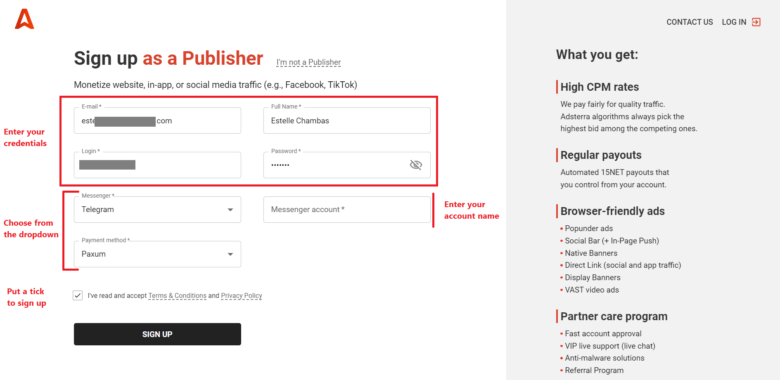
Step 3. Tap SIGN UP
Check your email to find verification link by Adsterra.

Step 4. After you click CONFIRM E-MAIL in email letter from Adsterra, your account is set up. The sign-in page will open.
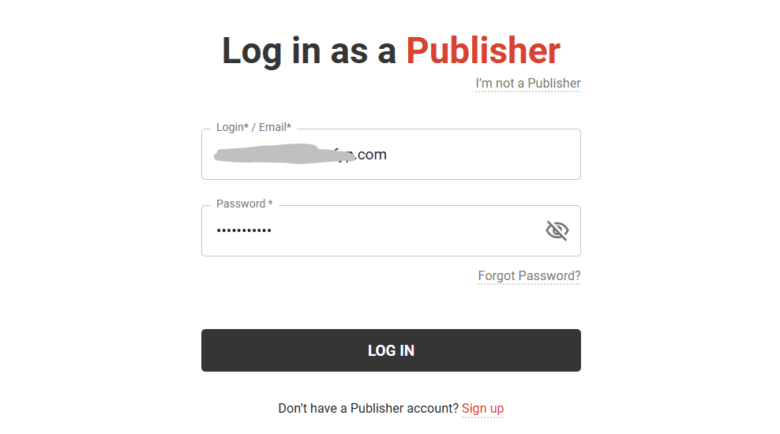
ADD A WEBSITE
Step 1. Log in as a Publisher
Step 2. Find Websites. Tap ADD WEBSITE
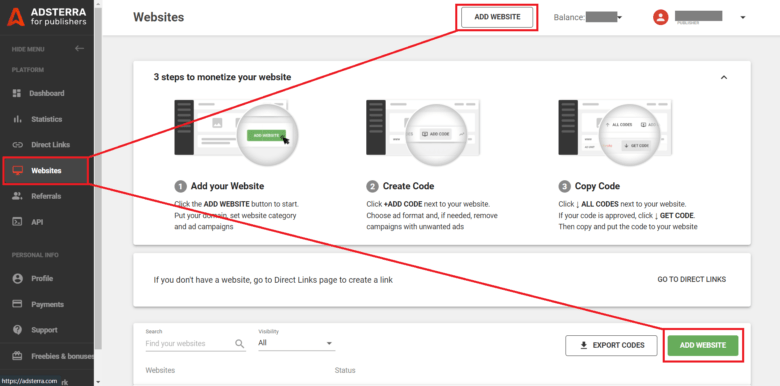
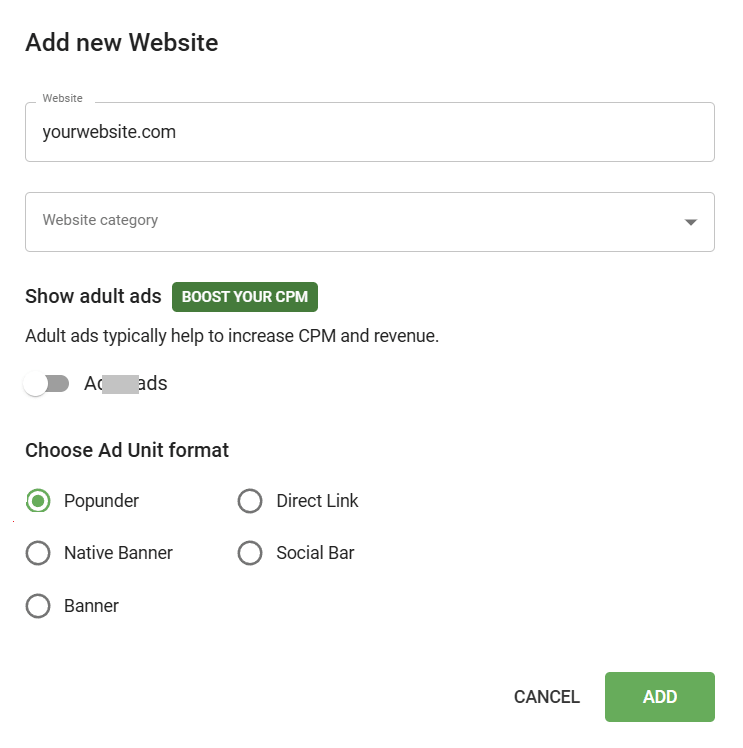
Step 3. A new pop-up window will open. In this pop-up window, fill out the fields:
- Your website URL in the format example.com.
- Choose the category that describes your website best. For example, Anime or iGaming.
- Choose Ad Unit you want to set up for your site.
- Omit campaigns that you don’t want.
- Tap Add.
NOTE: If you don’t have a website, you can start earning easily with Smartlink. Read our guide for kick-off monetization with no extra effort or investment.
Final Thoughts
We’ve explored the good part of what a CPM is for publishers. Now, with the tips and hacks mentioned, you do not need to choose your ad network or another advertising platform flying blind. Follow the general recommendation, set clear objectives, and be consistent.
Most importantly, don’t rush: pick a strategy to foresee outcomes, apply and measure results, rinse and repeat. While continuously monitoring and gathering data, you’re able to make informed decisions.
What is a good CPM to have? FAQ
Why does CPM play an important role?
It is really important for publishers to look deeper into how the CPM metric is built and changes, as it influences their payouts. The metric is also important for advertisers when dealing with Meta ads, Facebook ads, YouTube ads, Google Display Network ads, Google ads, Google Search Ads, and advertising platforms that calculate CPM costs for advertiser demand.
What is a good cost per 1,000 impressions?
There are a few factors to consider when evaluating a good cost per 1,000 impressions. But the general amount is between $2 and $10, depending on the ad platform, industry, target audience, etc.
What is the normal CPM range?
Your typical or normal metric for CPM is the cost per 1,000 views you get on average for your niche, industry, and viewers. Also, pay attention to how stable your CPM is with the ad platform and if you can enjoy the 100% fill rate.