
Geotargeting is a tactic that allows advertisers to serve relevant ads based on a user’s location. With location data from IP addresses, GPS, and Wi-Fi signals, marketers avoid wasted impressions. Ad spending focuses on high-profile or high-value audiences exclusively.
In iGaming campaigns, geotargeting automatically stops displaying ads to players from regulated jurisdictions. E-commerce brands fine-tune marketing campaigns to zip code-level precision, eliminating costly shipping cities. SaaS companies use radius targeting around business locations to attract quality leads.
Geo-focused (one country per campaign) and location-targeted ads deliver 1.5-2X higher CRs than those with bulk targeting.
This guide will walk you through:
- How to set up a geographic-intent targeting campaign
- Location-based advertising and geotargeting essentials
- Benefits of geotargeting for advertisers and affiliates
- Specific strategies for iGaming, E-commerce, and SaaS industries
- Common pitfalls in geotargeting that whittle down campaign performance
- The all-in-one free Geotargeting Infographic for download.
What is geotargeting?
Geotargeting (geographical targeting) is a marketing practice when you deliver advertisements to users based on their geographic location, from states to a concrete physical location. Unlike vast-reach marketing, geotargeting relies on data and utilizes the following technologies:
1. IP address targeting
Every device connected to the Internet has a unique IP address. This address acts like a marker that reveals the user’s country, region, and city location. It’s a backbone of geographic targeting when speaking of desktop devices.
2. GPS data
GPS provides accuracy within 5-10 meters when targeting smartphone users. With this setting, you can enable pro tactics like radius targeting. You can even control foot traffic to local offers if you can operate specific coordinates.
3. Wi-Fi or cell tower targeting
Apart from GPS signals, ad software can refer to cell towers nearby to approximate locations within 100 to 500 meters. It ensures a higher precision in target audience identification.
Geotargeting nuances on various ad platforms
The technology behind geotargeting differs depending on the ad platform you work with. For instance, Adsterra provides high-precision targeting from countries to cities. Google Ads allow for even more focused location-based marketing: you can advertise among people within your district or street.
Practical applications of geotargeting for marketers and advertisers:
- An online gaming house can exclude over-regulated states (e.g., Washington) from ad campaigns or remove several regions where iGaming ads are banned.
- Software providers can target consumers using IP ranges, but it only makes sense in the campaign optimization stage.
- A fashion store can exclude remote areas’ zip codes where shipping costs exceed profits.
- A SaaS company targets ads to IP ranges that match with business districts during office hours.
The geotargeting technology now performs at the highest level in all digital channels:
- Display networks use location data to help advertisers market in profitable areas, reducing ad spend. Also, location targets enable bulk management: you will only need to enter cities/regions to include or exclude.
- Social platforms offer granular focus down to neighborhood-level, allowing marketers to create highly native ad messages for their target audience.
- Search engines powered with paid ads (Google, Bing, and Baidu) apply location modifiers to their clients’ PPC campaigns, enabling hyper-local delivery.
How does geotargeting work?
Let’s now dive a bit deeper into the technology behind geotargeting marketing. We won’t do hard math but decipher how this or that piece of software can process localized advertising.
Modern platforms provide geotargeting options based on this pipeline:
1. Data collection
When a user accesses a website or a mobile app, the platform collects several location signals:
- Mobile devices share GPS coordinates if location permissions are enabled.
- Desktop and mobile browsers reveal approximate location through IP address databases.
- Connected devices send nearby Wi-Fi networks’ names and cell tower IDs.
2. Location check
Modern software must take into account VPN connections or other ways to anonymize user locations. To do so, the following techniques are used:
- IP geolocation databases like MaxMind and IPinfo.
- Mobile carrier tower triangulation
- Historical location data to check behavior patterns.
3. Ad display based on data
The platform then decides whether to display ads or not.
- Checks the user’s location against campaign targeting settings
- Applies bid adjustments for the given locations (for instance, smart CPM bidding)
- Serves customized ad creatives with relevant language chosen for this location.
4. More precise geotargeting options
Marketers target customers’ locations on platforms like Google Ads or Facebook. They create location groups or radius targeting zones along with classic location targeting. Ads are displayed when target audiences physically enter these areas. For example, a sushi chain could switch on geotargeting ads to potential visitors within a two-mile radius during dinner hours.
Even more sophisticated strategies are presented by proximity marketing. Virtual boundaries trigger push notifications on smartphones to deliver ads. The so-called “Geofencing” relies on real-time location alerts, whereas geotargeting deals with broader location-based marketing.
Examples for geographic intent targeting
Location targeting is an irreplaceable marketing strategy for iGaming and Sports brands. E-shops and SaaS enterprises also can’t do without spotlighting specific locations. Let’s lay out a couple of real-world geo targeting examples and illustrations of location-specific marketing campaigns.
iGaming geotargeting success story
An online gaming platform announces a special offer for sports fans. The competition is stiff. Marketers should stick to effective KPI and minimize ad spending. How can they test the offer on new traffic and narrow targeting segments? Let’s see:
- They can create a list of licensed states (New Jersey, Nevada, Florida) or provinces and regions if the offer targets India or Brazil.
- Next, they set up a Popunder or Push campaign with either licensed states included, or regulated areas excluded (e.g., Washington, Utah, Arkansas).
- They can narrow targeting to certain locations (cities), e.g., Atlantic City (NJ), if needed.
- Finally, they can bid higher to outperform competitors with the same target audience.
- To enhance the campaign efficacy, marketers can customize bids when they get the first campaign results. Similarly, they may need to remove zones or regions with poor results.
E-commerce geotargeting example
A fashion retailer launches a global Winter Holiday Sale campaign to attract more customers from certain regions. The brand chooses PPC ads on Facebook. What can the team do to prompt sales for their special offer?
- They select only urban areas with large populations, excluding rural locations.
- They can exclude zip codes with a population of less than 50,000, as Facebook allows for postal code targeting.
- Next, advertisers can fine-tune settings to display winter coats in cold climate states or counties.
Some ad networks even support weather targeting, but that’s a non-generic use case.
Benefits of geotargeting
There are dozens of advantages of geotargeting for marketing campaigns to grab user attention and generate clicks and conversions. Ads become more tailored to users’ demands, resonating with their current needs. In a nutshell, these are the main benefits of geo-targeted ads.
1. Laser-focused audience outreach
By targeting only users in specific countries or regions, marketers witness:
- 10% to 50% higher CTR on ads with localization.
- Lower customer acquisition costs when unnecessary areas are excluded. However, with precise targeting, costs normally grow as competition intensifies.
- Up to 25% higher return on investment.
2. Regulatory compliance
Regulatory compliance is the cornerstone for gaming and finance brands. Geotargeting enables them to:
- Automate blocking of restricted jurisdictions
- Bulk zones and areas management
- Culture-specific messaging (e.g., no mentions of curing illnesses in healthcare ads for Singapore).
3. Creative optimization
Marketing pros can manage ad elements, adjusting them by various parameters depending on the region:
- Local language and even slang
- Regional payment methods (e.g., you can highlight Pix payments in your iGaming offer for Brazil)
- Cultural references (it’s recommended to use ad spy tools to parse the best examples)
Geotargeting marketing pitfalls
When figuring out your potential audiences, you want to target the most relevant customers, but it’s not that easy from the start. Apart from geotargeting benefits, there are common disadvantages that can limit your campaign or reduce efforts to zero:
- Over-targeting: the most common mistake of starting out a campaign with a too small audience segment. Ensure you don’t exclude potential customers who can convert.
- Location targeting without creatives’ localization. Ensure you adapt the content and send the right message to the right people.
- Skipping bid adjustments: different locations will convert differently, and your job is to keep your bids competitive.
- Geotargeting without additional cost optimization. Try automated ways to optimize costs when buying loads of impressions (CPM) or clicks (CPC/PPC campaigns). One of those is the CPA Goal that auto-unlinks sources with high spend and low performance.
Types of geotargeting
1. Countries
Arguably, the most used location targeting strategy is to select a geo and choose additional targeting settings. For example, India, mobile audiences, 3G/4G users, Android OS. Such campaigns are easy to set up and track. However, sometimes the country-leveraging geotargeting may not be enough.
2. Regional targeting
Regional targeting can protect you from wasting money on low-performing areas within one country, heading your ad message to only those zones where your industry is not regulated. You can exclude California from a campaign that promotes online gaming houses or sweepstakes or select California as your exclusive target when you promote a Dating platform in this state.
3. City targeting
How about targeting coastal cities for swimwear? That’s what you can do at this level of geotargeting. Don’t overdo it, though. Hyper-localization has its drawbacks, since you may not get enough traffic to run effective tests.

4. Hyperlocal (radius targeting)
This type of geotargeting is used when you need granular results:
- Attract visitors to a local store
- Promote an event available only to this area’s residents
- Invite downtown workers to a business lunch in your restaurant
Geotargeting vs. geofencing
So, what is the difference between geofencing and geotargeting? Simply put, geofencing automates local sales and orders, and geotargeting boosts digital conversions and brand awareness. Geofencing technology employs GPS to determine when a target customer crosses a virtual boundary. Businesses set such virtual fences around physical locations where they want to meet customers.
Geofencing is a proven and accurate method to drive foot traffic. Restaurants, hotels, and boutiques hone geofencing to beat neighboring competitors and generate more local sales. In the meantime, geotargeting covers wider areas. The latter is crucial for digital marketing campaigns with the following objectives: conversions, leads, subscriptions, and online sales.
While often confused, these two strategies differ by design. They both aimed to target people but employ different proximity mechanics and vary by distance reach.
| Feature | Geotargeting | Geofencing |
|---|---|---|
| Coverage | Entire regions / countries | 100-500m radius |
| Precision | District and neighborhood-level | Building-specific |
| Use case | Digital ad campaigns | Promo activities in physical venues |
Geotargeting best practices to improve performance
Geotargeting is not an exclusive setting that turns magic on. It will only deliver solid cash savings and great results if combined with a set of other audience filters. Let’s drop some best practices advertisers apply.
- Prefer broad targeting (large audience) when launching a campaign on a new traffic source. Showing ads to larger segments, you get transparent results about the offer quality.
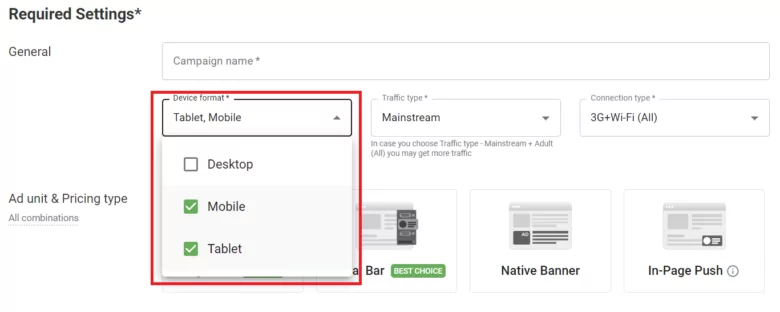
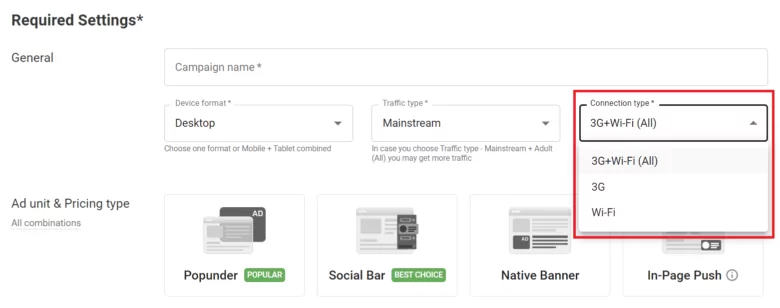
- Pair geotargeting with the following settings: device type, connection type, traffic type, and ad format.
- Add location targeting if you’re sure about the top-performing areas; remove zones where your offer is not allowed.
- After analyzing the first results, customize bids for the best placements, add more filters (OS, browsers, etc), and create whitelists.
Creative localization
- Translate ad copy to local languages using advanced translation services (e.g., Deepl) or outsource translation tasks.
- Localize visuals and triggers: use slang, sports chants (for iGaming), culture-specific symbols, and colors.
- Offer area-specific benefits (e.g., payment systems) on your landing pages
- Place reviews by local influencers on your landers
- Vary messages when targeting loyal audiences or when entering new emerging markets.
Performance monitoring
When you target locations, it’s reasonable to track the results of ad delivery per each area. Depending on your goals and the ad network you partner with, you can use the following resources:
- Accurate location-based stats: impressions, clicks, CRs, expenses, eCPA (Adsterra ad network)
- Zip code-level ROI (Facebook Ads)
- Distance reports (Google ads location targeting): when you can see how marketing content performs at various distances from your target location (e.g., a five-mile radius or two miles).

How location affects ad pricing and performance
So, how much does geotargeting cost after all? Geotargeting has no universal price. Location can significantly influence both traffic costs and campaign results. Costs also depend on the advertising platform, competition, targeting precision, ad format, and bidding model. Other factors that play a role are target audience size and purchasing power, and available inventory which sometimes differ between GEOs and ad platforms.
Competitive country markets and audiences of Tier 1 typically cost more. That said, never underestimate 2 and 3 tier traffic, which can yield great results with less ad pricing. When planning campaign budgets, what you can do is to test and compare not only CPM, CPC, CPA, and conversion value, but the complete performance: traffic cost → conversions → CPA → revenue → return on revenue.
Where can you run geotargeted ads?
Geotargeting is possible in all major digital advertising networks. Users can be geographically targeted according to country, state, city, or any other geographical specification available through the network.
The choice of the best platform depends on your audience, budget, and required targeting precision. Common options include search ads, social media ads, and geotargeting ads networks.
With the Adsterra geotargeting ads network, advertisers can use 20+settings in their dashboard. Within the platform’s advanced ad technology, special attention is given to support precise geotargeting and geo specific ad monitoring: region → country → city with the traffic that comes from 248 countries and 36K+ vetted publishers.
How to set up a geotargeted campaign?
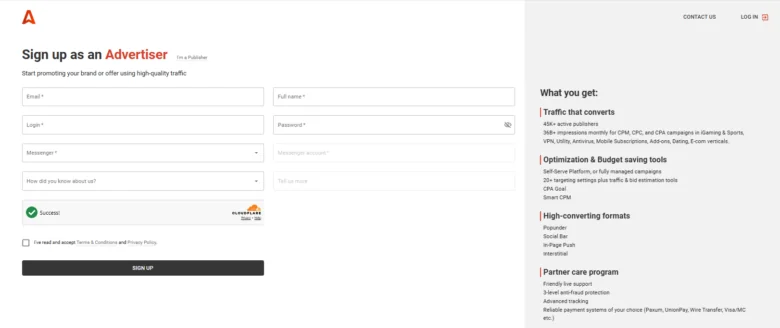
1. Login or set an advertiser’s account
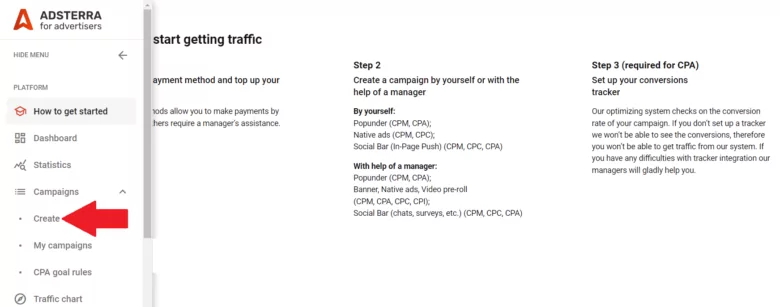
2. Click Campaigns, then Create
3. Set device type targeting
4. Set traffic and connection type
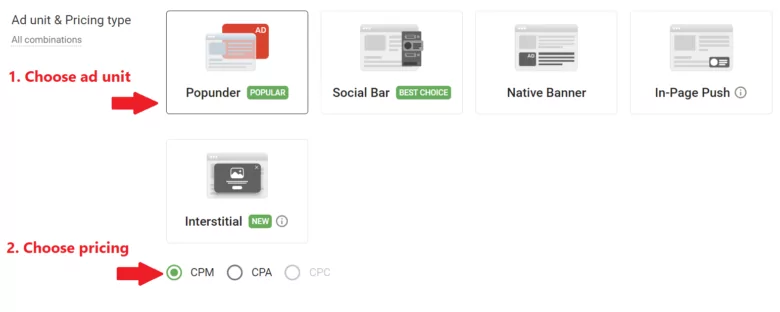
5. Set ad unit (aka format) and pricing type
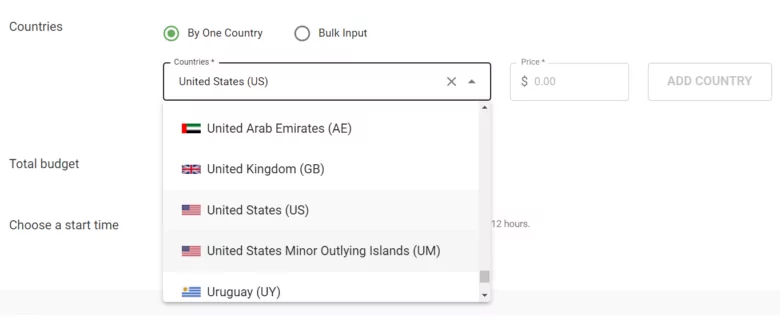
6. Set geographic location for more relevant ads
Finally, here is how advertisers use geo-targeting in online campaigns. Geos are your targeting centerpieces. You can easily go for a bulk input, but in most cases, it will come down to “one country per campaign,” that makes optimization much more manageable. Select a region, a country, or a city from the drop-down.
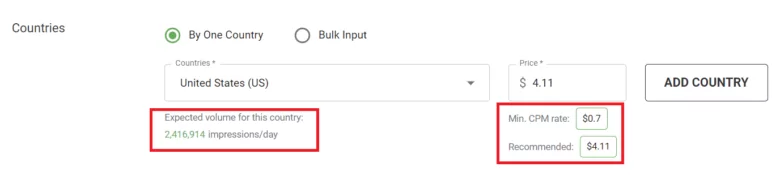
7. Set bidding tactics
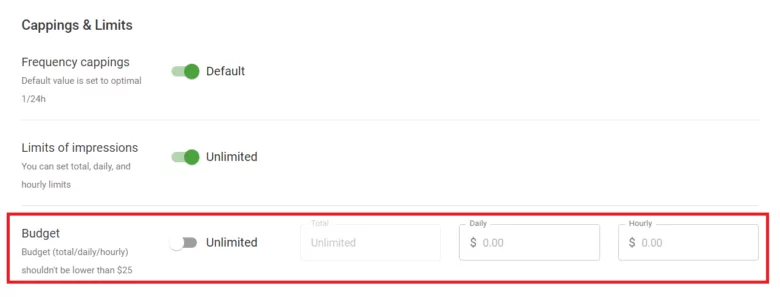
8. Set budget limits
9. Schedule geotargeting campaign

10. Submit the campaign for review
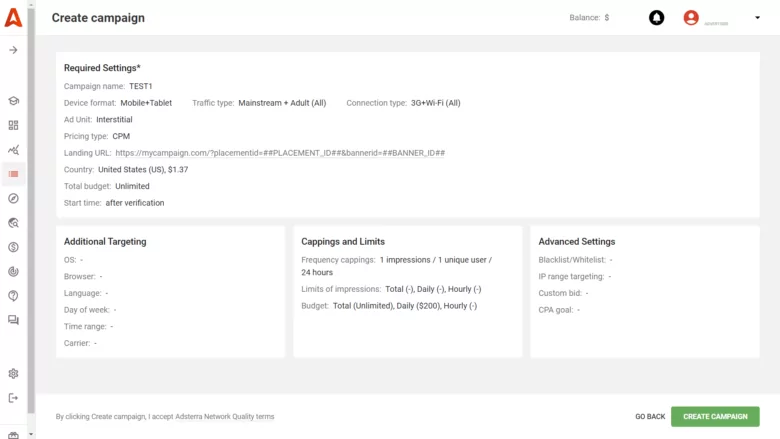
The general rule: For your first campaign, start broad and optimize gradually as performance data comes in. Keep in contact with your manager for insights, create separate campaigns for different GEOs, test traffic consistently with budget limits, and use multiple ad creatives and templates to discover what performs best.
Geotargeting infographic
Save this geotargeting infographic to have faster access to the best practices and use cases for your geotargeting ad campaigns.

Conclusion
So, what is geotargeting? As we’ve just figured out, it’s a must for effective digital advertising. Geotargeting transforms generic campaigns into precision tools. Location intelligence delivers measurable advantages, whether you’re promoting iGaming offers, e-commerce products, or SaaS trials.
Implement the best-fitting geotargeting strategies in your next campaign to scale campaigns and maximize content relevance paired with soaring ROI.
Geotargeting: FAQ
How effective is geotargeting?
According to open-source research, ad campaigns enjoy 50-70% higher engagement rates on average if they use location data. Geotargeting is effective since it tracks location data and delivers targeted ads, defining audiences by area.
Geotargeting relies on IP addresses, GPS trackers on mobile devices, and cellular towers to figure out the audience’s location. For instance, an e-shop can include specific regions with a higher demand for raincoats during a particular season (the so-called weather targeting.)
What differs campaigns with geotargeting?
Unlike wide reach marketing, geotargeted advertisements make sure that the content is directed towards potential consumers from their places of residence, workplace, or destination. Tools such as Google Ads provide advertisers with the freedom to choose the target location in terms of countries, cities, ZIP codes, or a personalized location radius.
Some of the major geotargeting tools used for geotargeted advertisements include geotargeting software, which collects real-time location data and then merges it with the ad manager platforms. Another geotargeting tool is the use of demographic data to narrow down the target audience to parents located near schools. Combining location targeting with audience targeting, marketers boost relevance and profits.
Why is geotargeting important?
It helps prevent budget waste on irrelevant audiences. Among other benefits of geotargeting, you can add up the following:
–Increased engagement: deliver relevant content based on local events, culture, or preferences.
–Cost efficiency: minimize ad spend by removing irrelevant regions or costly areas.
–Higher conversion rates: experience a burst of signups when localizing creatives when promoting a dating app, or getting a solid uptick in foot traffic if you’re a coffee shop using radius targeting.
–Personalization: adapt messaging to specific dialects or cultural preferences.
–Competitive advantage: grow loyal customer base and dominate specific countries or cities with tailored local campaigns.
You can also use a proxy to verify a geo-targeted offer before you spend.
What is an example of geotargeting?
An iGaming operator applies geographically targeted advertising to localize ad creatives for baseball fans in Atlantic City. Another example is a mobile shopping app that applies geo ads to reach people in Indian provinces where people actively shop online and delivery services costs are the lowest.
How does geotargeting help increase online sales?
Geotargeting enables advertisers to provide relevant ads to customers within selected locations. The campaign may be tailored for products, pricing, languages, offers, and creatives that resonate well with the local audience. Relevant geotargeted content can help increase engagement and conversion rates and decrease costs by not serving advertisements to customers who will probably never make a purchase.
What are the privacy concerns related to geotargeting?
There may be an increasing privacy concern over geotargeting. Marketers have to collect location data only that is necessary and not do any further processing of it without proper notification to customers and their consent. At the same time, following applicable privacy laws and advertising-platform requirements gives advantages of geotargeting and more efficiency for your marketing campaigns.