
CPM tells you how much 1,000 ad impressions cost. RPM tells you how much revenue your traffic generates per 1,000 pageviews or impressions, or sessions of the whole website, depending on the type of RPM being reported.
For publishers, the useful insight isn’t simply knowing which acronym means what. It is understanding of what the difference between CPM and RPM is and what the distance between them can reveal about your monetization.
In this article, we’ll get a more specific view, rather than just presenting a CPM-RPM glossary and meaning. This guide explains how to read these signals and use CPM, RPM, and eCPM together when understanding and optimizing ad revenue streams.
Meanwhile, you can rely on Adsterra for real-time, precise data for accurate decisions. The registration takes less than 10 minutes, and you can start monetizing your traffic and monitor transparent statistics in your publisher’s dashboard at once.
How RPM and CPM differ at a glance
Let’s still briefly answer the frequent question: what is CPM and RPM?
Here it is.
CPM (cost per mille) represents a cost per 1,000 ad impressions. It is fundamentally a pricing metric just the way CPC, CPA, CPI are, meaning cost per click, per acquisition, per install, and so on. Advertisers’ CPM is useful to understand what they pay for ad exposure, while publishers can use reported CPMs to assess demand and the market value of inventory.
What is RPM in advertising then?
RPM (revenue per mille) looks at monetization from the publisher’s side and estimates how much income a publisher generates for every 1,000 ad impressions all together.
The similar metric Page RPM is the estimated ad revenue a publisher generates for every 1,000 pageviews of a particular page.
The difference between CPM and RPM does matter because an ad impression and a pageview are not the same event. One pageview can create several ad opportunities. Some pages may receive ads, some may not. Some ads may render but receive limited visibility. Those impressions can also have different prices.
But it’s clear that RPM in ads is not a fixed number. It will depend on many factors, such as page visits, ad codes, ad visibility, user behavior like engagement and bounce rates, CTR, etc.
Example
Comparing a $5 CPM with a $10 Page RPM does not mean the publisher somehow earned twice as much money as what the advertiser paid. The two figures have different denominators.
CPM vs. RPM formulas
Now, let’s do the maths. How to calculate CPM and RPM for a website monetization and other metrics?
The basic CPM formula is:
CPM = (advertising cost ÷ ad impressions) × 1,000
Suppose advertisers spend $600 to generate 100,000 ad impressions:
($600 ÷ 100,000) × 1,000 = $6 CPM
RPM uses a different calculation:
RPM = (publisher revenue ÷ ad impressions) × 1,000
Suppose a website receives 100,000 impressions and earns $900:
($900 ÷ 100,000) × 1,000 = $9 RPM
Page RPM = (publisher revenue ÷ pageviews) × 1,000
($700 ÷ 100,000) × 1,000 = $7 Page RPM
So we have:
- CPM: $6
- RPM: $9
- Page RPM: $7
There is no contradiction in how to calculate CPM and the rest of metrics. A site can contain multiple advertising placements and therefore generate more than one ad impression. However, RPM combines the actual revenue generated from those monetization opportunities and divides it by impressions.
Publishers must identify the RPM to which they refer to. For example, page RPM, session RPM, and impression RPM differ because of the denominators. The same may refer to two platforms with incompatible metrics.

Expert tip
“CPM and payouts you get from ads depend on several factors: traffic quality, GEO and type of traffic you send to an ad network, traffic volume, and niche and if you learn to consider them, you will be able to manage your total ad revenues.”
Watching your revenues with Adsterra
Adsterra self-service platform for publishers is the control panel where after adding your website you will be able to monitor its performance and manage different ad placements based on certain metrics.
Real-life monetization metrics you can check
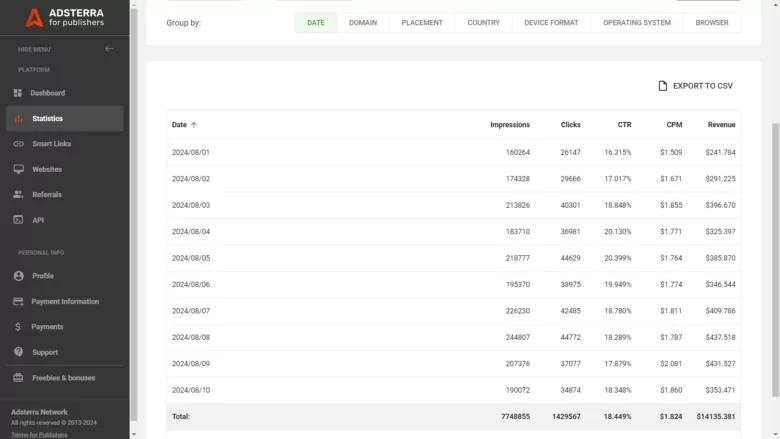
IMPRESSIONS: the number of times your advertisements have been displayed,
CLICKS: the number of clicks on your ads,
CTR: click-through-rate, or clicks on the ad divided by impressions for this ad,
CPM: the price that advertisers pay per 1000 ad impressions on your site. CPM data is automatically calculated for each website and is based on the traffic quality. It is affected by a great number of factors, such as visitors’ country, device, browser, OS, format of your ads and other things as well
REVENUE: all your actual earnings.
You can group websites’ stats by date, domains, placement, country, device format, or operating system and export your .CSV statistic report.
Further reading: $19,999 a Month: How a Filipino Publisher Earns From Copyright-Free Audios and Books and a surge in CPM rates and overall revenues in his stat report after the ad network pre-selected ads.
What CPM tells you as a publisher
If advertisers compete more aggressively for a certain audience, placement, format, device, geography, or time period, the CPM associated with that inventory may increase. If demand weakens, CPM can decline.
That makes CPM useful when comparing:
- ad placements and formats;
- geographic markets;
- device categories;
- direct and programmatic demand;
- seasonal changes;
- sections or audience segments.
However, CPM has a significant limitation: it doesn’t tell you how efficiently your website turns traffic into estimated revenue.
Example
A $15 CPM looks attractive. But if only a small portion of your pageviews produce monetized impressions, it may generate less total revenue than a setup with a lower CPM and much stronger delivery.
This is why publishers shouldn’t automatically interpret the highest CPM as the best monetization outcome.
Further reading: How We Hit $3K/Day With One Short-Term Event, relying on real time data (impressions, CPM, revenue, CTR). Anyone can use the approach for their next event.
Why RPM is usually higher than CPM, and the cases where it is lower
Page RPM can be higher than an individual ad CPM because one pageview can produce multiple monetized ad impressions.
Example
Consider a situation where 1,000 page views result in 2,500 paid impressions. Even at reasonable impression costs, the earnings from the impressions build up page by page.
This relationship can be simplified conceptually as:
Page RPM ≈ monetized impressions per pageview × average publisher revenue per ad impression × 1,000
The actual ad stack is more complex than that, but this approach helps us understand why the addition of one more good, visible ad placement increases Page RPM without increasing the CPM of existing placements.
However, RPM is not automatically higher than CPM.
Page RPM can be lower when a site generates relatively few monetized impressions per pageview. Possible contributors include low fill rate, limited ad density, ad blocking, weak ad delivery, low viewability, technical rendering problems, or pages where audiences leave before additional ads have an opportunity to load.
The relationship depends on what each metric measures and what happens between a page being loaded and actual revenue earned.
Why your CPM and RPM can move in opposite directions and never match
Publishers sometimes expect CPM and RPM to move together. They can but there is no requirement that they should.
Consider a site where CPM rises 20%.
That sounds positive. But during the same period:
- fill rate falls,
- the traffic mix shifts,
- viewability deteriorates,
- more visitors leave quickly (higher bounce rate),
- high-value placements generate fewer impressions,
- fewer ads are served per page.
The site can therefore sell some impressions at higher prices while earning less revenue per 1,000 pageviews.
The reverse can happen too.
CPM might decline while Page RPM rises because more ad opportunities are successfully monetized, the site generates more viewable impressions per page, or changes to page/session behavior create additional monetization opportunities.
This is the important publisher insight: CPM describes the value of impressions, while RPM describes the estimated earnings of traffic of the page or site.
CPM and RPM measure different stages of the monetization process, so they should not be expected to match.
Expert tip
“Those publishers who own websites generally use Popunder ad format as it shows impressive CPM and total revenue generation. But they can add Smartlink, too, to get the combo effect and see their advertising revenue rise.”
RPM vs. CPM troubleshooting flow: what to check when your metrics move
A $15 CPM certainly sounds good, but when only a small number of views actually get converted to monetized views, it could potentially make you less money than an advertising strategy with a smaller CPM and better delivery.
| Publisher sees | Start investigating | Possible diagnosis |
|---|---|---|
| CPM↑, RPM↑ | Demand, fill, monetized impressions/page | Higher-value demand appears to translate into higher-level monetization. See which GEOs, formats, and placements have contributed to this. |
| CPM↑, RPM flat | Fill, impressions/page, viewability, delivery | While advertisers might be paying more for some impressions, it does not translate into higher revenue per pageview. |
| CPM↑, RPM↓ | Fill, traffic mix, ad delivery, impressions/page | Higher impression prices could be outweighed by fewer monetized opportunities or a change in traffic composition. |
| CPM↓, RPM↑ | Impressions/page, fill, layout and engagement | Less expensive impressions could compensate with greater monetization opportunities per pageview. |
| Traffic↑, RPM↓ | GEO/device/source mix, new landing pages, engagement, monetization rate | Additional traffic can monetize in a different way than the prime audience. Compare segments before making changes to the ad stack. |
| High CPM, weak total revenue | Fill, scale, impression volume, ad requests | Pricing may be attractive enough for a relatively small number of exposures to lift RPM. |
| Impressions↑, RPM flat | Impression value, viewability, placement performance | Extra impressions aren’t generating sufficient revenue per pageview. |
| RPM↑ after adding ads | Viewability, Core Web Vitals, engagement, pages/session | Total revenue increase is real, but verify that it isn’t accompanied by deterioration elsewhere. |
The key is to investigate changes, not isolated numbers.
Example
The RPM is $12. Do we want to use only industry benchmarks to assess this number? Not really. Compare the same RPM within comparable traffic segments within your site and timeframes, and see what has happened.
A good advertising partner is already half the battle for increasing and maintaining your revenue. With Adsterra, you access 16K+ advertisers, 100% fill rate, Partner Care support team 24/7 for immediate expert advice, and a variety of tools and ad formats to keep your metrics substantial.
How eCPM connects CPM and RPM
| Entity | Stands for | Calculations | Denominator | Evaluation |
| CPM | cost per mille | (cost / impressions) X 1,000 | ad impressions | advertisers’ payments per mille |
| eCPM | effective cost per mille | (income / impressions) X 1,000 | ad impressions | total earnings per mille |
| RPM | revenue per mille | (income / pageviews) X 1,000 | often as pageviews | total page earnings |
There is a useful third metric between advertiser pricing and page-level revenue: eCPM or effective cost per mille.
eCPM is a complete synonym to RPM or revenue per thousand impressions when the denominator refers to the whole website. The eCPM metric revolves around advertisement income accumulated together whether it is based on advertisement impressions, clicks or conversions.
For publishers, eCPM is commonly calculated as:
eCPM = (ad revenue ÷ ad impressions) × 1,000
Why is that useful?
A publisher may monetize ad inventory through ad campaigns, pricing model, network, or demand sources, whereas eCPM converts it into real revenue from all kinds of conversions and sources.
Think about the three metrics as answering three separate questions:
CPM: What is the impression pricing cue?
eCPM (website RPM): How much revenue are these impressions effectively producing?
Page RPM: How much revenue is the page traffic producing?
This is more useful than trying to find one “ever-working” metric.
Whether publishers should optimize for RPM or CPM
For most website owners, the answer shouldn’t be CPM or revenue optimization.
Use eCPM/RPM as an outcome metric and CPM as diagnostic signals.
If the goal is increasing revenue generated from existing traffic, Page RPM gives you a useful top-level measure per page. You can compare it across devices, GEOs, traffic segments, and time periods.
But optimizing Page RPM blindly can create another situation. The addition of more advertisements increases Page RPM by 15%, yet causes the pages to become slower or for there to be fewer page views per visit, or users coming back to the site less often.
If both RPM and CPM are considered together instead of being seen as rivals, publishers can make them work better. While CPM indicates how advertisers value your inventory, RPM indicates how well you convert your website visitors into money. It’s about more than just maximizing CPM or RPM, rather, the aim should be to make each visitor bring in money while ensuring you don’t lose what draws them to your site.
When looking to smartly accelerate your CPM, eCPM, RPM metrics, always remember to turn to your advertising partner for assistance in ad placements choice, highest-paying ad format combos, anti ad blocker solutions with up to 35% ad revenue increase, and more helpful advice.
RPM vs. CPM: FAQ
Is CPM equal to RPM?
The answer is no. Although CPM and RPM may sometimes have the same numeric value, it doesn’t mean that they are equal. CPM reflects cost per thousand impressions, while Page RPM refers to revenue per thousand pageviews.
Which is better, CPM or RPM?
Either metric cannot be generally superior to each other since they respond to different matters. The publisher may use RPM to assess whether the traffic brings profit and CPM to gain insight into how much an impression costs and what kind of interest it raises among advertisers.
How do RPM and CPM affect my ad revenue on popular ad networks?
Publishers need to pay attention to the definition of the metrics presented in the dashboard of a certain ad platform when comparing the CPM or RPM with another platform. CPM suggests the perceived worth of those impressions for advertisers, yet the publisher’s income depends not only on it, but also on the successful monetization strategy of the ad inventory. The RPM represents the earned money in relation to pageviews. Fill rate, viewability, format, geo, device, ad density, advertiser demand competition, and traffic behavior may all affect the final result.
Which ad network types generally offer higher RPM for publishers?
No category of ad networks is sure to provide the highest RPM for any publisher. The results depend on geo, audience demographics, niche, users’ device balance, formats, advertiser interest, quality of traffic, ad inventory, and the network’s capability to monetize traffic. Rather than selecting among different ad networks by an announced CPM/RPM benchmark, publishers can conduct experiments and compare performance.
How do major advertising companies define RPM versus CPM?
Advertising platforms normally define CPM as cost per thousand impressions, while RPM is the publishers’ revenue per thousand ad units, be it pageviews or impressions. But since terms and calculations may differ from platform to platform, it would be wise for publishers to verify each company’s metrics denominator before making comparisons between RPM and CPM numbers.
What is the difference between RPM vs CPM in digital advertising?
RPM is a measure of the amount of money made by a publisher for every 1,000 page views, impressions or sessions, whichever metric you choose. CPM is a thousand ad impression costs. So, is CPM and RPM the same? No, CPM is the cost of ad space whereas RPM is estimated earnings generated from traffic.
Should I focus on RPM or CPM to maximize earnings from my blog ads?
You can employ RPM (eCPM) as your main income metric, yet do not focus on it alone. The use of CPM will give you an idea of how much advertisers are willing to pay for their ads and the value of each impression.
How do different ad formats affect RPM for a publisher?
There is the possibility that ad formats could influence the RPM through their cost, exposure, advertiser demand, placement and ad space, and monetized impressions made. Different ad formats may thus show different revenue earned.