
Nearly $44 billion is expected to flow into only US creator advertising in 2026, according to IAB. However, there is no “one and only” universal monetization strategy for publishers and creators. The key to building a profitable revenue mix is finding the right match between advertising, other monetization opportunities, and your traffic and audience behavior. In this guide, we’ll help you find that match.
If you’re ready to monetize with ads as part of your revenue mix, you can register a publisher account with Adsterra. Only 5-10 minutes and you can show high-paying ads from 16K+ advertisers on your website or social media to scale your earnings.
What publisher monetization means
Publishers content monetization is the process of turning website, mobile app, or social content traffic into earnings. The strongest strategy depends on your traffic volume, audience intent, GEO, niche, and how much control you, as a publisher, have over the user engagement.
Best monetization strategies for digital publishers (compared)
Publishers can earn in a variety of ways: from advertising, subscriptions, affiliate offers, sponsored content, products, services, donations, etc., and in the best form of it — they use the most efficient combinations of these approaches.
Let’s briefly go through each publisher monetization strategy:
| Strategy | Content publishers’ monetization | When used the best |
| Display advertising | Opportunities from ad impressions or clicks | Content sites with regular traffic |
| Native advertising | Ads integrated naturally with surrounding content | Blogs, news, and editorial sites |
| Popunder ads | Revenue when an advertising page opens behind the active page | Entertainment, tools, and high-volume sites |
| Social Bar ads | Income from engaging display-style formats | Mobile-heavy and diverse traffic |
| Direct Link / Smartlink | Traffic is directed through a monetized link to a relevant offer | Sites and placements without digital ad space, social traffic |
| Affiliate marketing | Commission from referred conversions | Review, comparison, and niche sites |
| Sponsored content | Brands pay for dedicated content or exposure | Publishers with established authority |
| Subscriptions | Readers pay for recurring access or benefits | Sites with loyal audiences or premium content |
| Digital products | Earnings from courses, ebooks, templates, or tools | Expert and educational publishers |
| Services | Visitors become consulting, freelance or service clients | Professional and specialist sites |
| Donations | Audience members voluntarily support the publisher | Community and creator-led projects |
| E-commerce | Publisher sells physical or digital products directly | Sites with strong purchase-intent audiences |
Ad revenue streams
Let’s start with advertising, which is one of the most straightforward, quick-start monetization solutions for publishers. Posting ads to get paid makes it possible for publishers to generate ad revenue from their audience without selling any products directly. This can be easily done by copy-pasting the ad network’s code onto your website page.
The ad inventory you can choose from is variable enough to suit your goals and content neatly:
- Popunders,
- Social Bar ads,
- Interstitials,
- Smartlinks (for social media traffic and webpages),
- Banner ads,
- Display ads,
- Native ads,
- In-Page Push ads,
- Video ads, and many more.
The right ad combo depends on traffic characteristics, how the audience behaves, website layout, and the niche. With emerging technologies and advanced ad formats, like Social Bar and its skins, you achieve 33% higher CTRs (click through rates) than web alternatives, each time your audience sees the ad.
Here is how the average CTRs within various niches for Social Bar ads and its skins look like per Adsterra’s benchmarks in 2026.
| Vertical | Average CTR |
| Utility | 33.0% |
| Sweepstakes | 24.0% |
| Mobile Subscriptions | 23.0% |
| E-commerce | 22.0% |
| Antivirus | 22.0% |
| Finance | 26.0% |
| iGaming | 13.8% |
| VPN | 13.5% |
| Software | 19.9% |
Revenue streams that don’t depend on ads
Publishers don’t have to rely entirely on advertising. It’s a fact. Affiliate commissions, subscriptions, memberships, sponsored content, digital products, physical products, services, licensing, and paid communities… these are only some of the monetization approaches that we also mentioned above that generate revenue additionally.
These approaches are particularly important if a publisher or creator has a niche audience. If you want to know more about how to monetize your niche based on data and publisher scenarios, check out our guide: 26 Money-Making Stories to Retrieve 100% Profit Strategies.
Building a publisher strategy as monetization mix
The main lucrative revenue stream for many publishers should be the one that complements the target audience and traffic. Begin with your validated, primary source of sustainable revenue, which can include advertising, and then incorporate additional sources. Be sure to introduce each one individually and measure how they affect your overall earnings.
Picking a strategy by traffic profile
With monetization from digital publishing, you should consider how users come into your site, what they do there and their intent behind visiting. Below on the screen you can follow through the framework to assess the traffic profile you nurture for more monetization solutions.
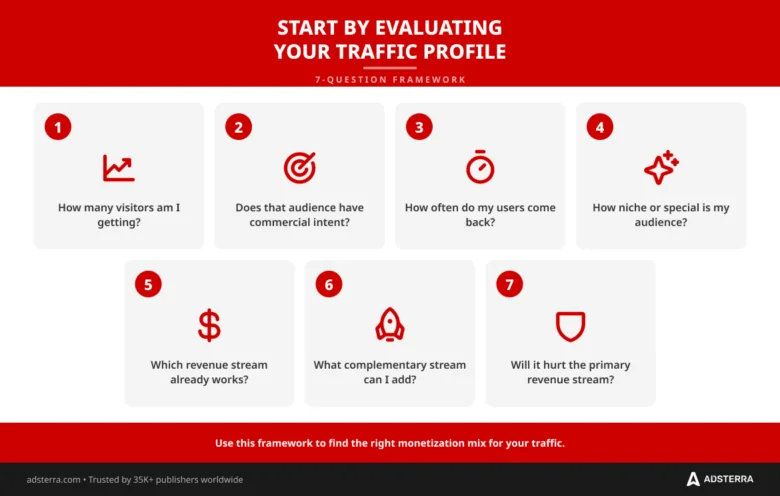
Please note large traffic doesn’t automatically become valuable traffic. Many visitors who are less likely to interact or make any purchase can earn fewer sales compared to a smaller number of users that show stronger niche interest and purchasing intent.
Example
Here is a way of making money from different segments of the same website audience simultaneously. A publisher has a substantial audience, and a part of it also returns regularly for content updates. In this scenario, advertising for general visitors is a good start which can be complemented with subscriptions for the most involved customers.
Here is a rough draft of how the correlation of traffic profile, publisher’s situation, and prioritized strategies may look like:
| Traffic profile | Attributes | Monetization strategies to prioritize |
| High-volume, broad traffic | Many pageviews, mixed intent | Display ads, Native ads, Popunders, Smartlinks |
| Low-volume, high-intent traffic | Visitors researching products or solutions | Display ads, affiliate links, ecommerce, lead generation |
| Loyal, returning traffic | High return rate, repeat content consumption | Subscriptions, memberships, donations, premium content |
| Niche traffic | Clearly defined interests or needs | Display ads, affiliate links, sponsorships, digital products |
| Professional/B2B traffic | Specialized audience valuable to advertisers | Direct ad deals, sponsorships, lead generation, gated content/paid reports |
| Search traffic | Visitors arriving with specific queries | Social Bar ads, Popunders, affiliate links |
| Social/viral traffic | Large spikes, short sessions, mobile-heavy visits | Popunders, Display ads, Smartlinks, Native ads |
| Strong email/direct traffic | Existing relationship and repeat engagement | Subscriptions, newsletter sponsorships, Smartlinks, affiliate offers, products and services |
| High-value GEO traffic | Strong advertiser demand in visitor locations | CPM-based advertising, direct ad deals, premium demand |
| Global/mixed-GEO traffic | Income varies substantially by country | Multiple ad formats, affiliate offers localized by GEO |
Real-life example
Without an additional monetization strategy so far, a niche site has reached over $700 with Native ads in the first month. Adsterra publisher, Leandro, who owns the website, is solving a real problem for his audience, sharing manuals about OBD2 trouble code reset for popular Brazilian cars. You can learn the full monetization story from Leandro of adjusting and polishing SEO strategy, building the traffic and preparing publisher monetization strategy.
Additional revenue stream without cannibalizing
When you diversify revenue strategies, remember to cater to various phases of the user experience. It is important to see if any single one of your chosen strategies is negatively impacting user experience and behavior and cannibalizing the other one. To get a better picture in numbers, you can use available tools on publisher monetization platforms and commerce media platforms, and analytic tools to measure:
- Revenue metrics (RPM, eCPM, total income),
- Monetization diagnostics (fill rate, viewability, CTRs),
- Traffic and audience diagnostics (organic clicks, sessions, audience engagement).
RPM, eCPM, fill rate, and ARPU: which one to watch
Let’s dig a little deeper into the metrics. If you look into RPM, eCPM, fill rate, and ARPU, be sure to interpret them separately as they answer different questions within different revenue models:
- RPM (revenue per mille or per thousand impressions) shows publisher revenue per 1,000 pageviews or impressions, depending on how it is defined.
- eCPM (effective cost per mille) measures effective earnings per 1,000 ad impressions, including all kinds of conversions.
- ARPU (average revenue per user) measures exactly that.
- Fill rate indicates how much available ad inventory is actually shown on the publisher’s website. For instance, Adsterra offers publishers the ongoing 100% ad fill rate, which is a nice bonus. Fill rate is something you can rest your mind about and leave out of the equation.
One of the effective approaches measuring your activities is to monitor RPM to gather what you earn, and apply eCPM for the ad effectiveness, while using ARPU for understanding the true worth of each visit.
Monetizing traffic that AdSense won’t approve
Just because an AdSense account is denied does not mean that you can’t monetize your traffic. More types of ad networks are available to accept a wider range of websites and traffic types, where publishers follow the chosen network’s policies. The niche ad networks are usually more flexible to provide the demand and ad inventory for traffic.
Real-life example
Edi is a local Indonesian news publisher who has built his monetization strategy with Adsterra on advertising as his validated, primary source of income. He operates two websites with over three million daily pageviews across Indonesia and the US. Edi tested the provided ad inventory. Initially, Native Banners generated $1,400 a month, with CPMs ranging from $0.2-0.7. After adding Smartlink ($0.3 CPM), revenue grew steadily. Within half a year, monthly earnings reached $11,500, and the publisher could unlock more value from existing traffic.
Mistakes that quietly cut revenue
Here are a few errors to be sure not to fall for while building up your revenue mix, and also possible solution initiatives:
- Rising traffic but no increase in RPM → try out another type of ad or other forms of income generation.
- High-intent readers keep coming back to high-intent content, but only on specific pages → consider a micro-targeted affiliate model.
- All income is derived from a single partner or channel → look to diversify to reduce risks.
Some more common leakage areas that account managers can sometimes notice in ad-network-publisher collaborations are:
- Unfavorable ad placements,
- High ad density,
- Slow page loading time,
- Ineffective mobile design,
- Measuring performance through just one parameter.
Publishers can also experience losses due to implementing significant changes without testing their influence on revenue generation and user engagement.
Wrap-up
So, what are the most effective monetization strategies for digital publishers? Multiple revenue sources can become the most effective solution that makes you less vulnerable to the changes in the traffic profile and market fluctuations. The profitable revenue mix is your goal, with close attention to traffic volume, audience loyalty, niche, geography, and purchasing user intent.
You are always in a safe place with Adsterra and the Partner Care support team if you need expert advice. 24/7. Be it assistance with ad code placements and anti Ad Blocker feature that increases revenue up to 35%, or recommendations for high-paying ad combos.
Publisher monetization strategies: FAQ
What are the most effective ad networks for niche online publications?
For niche publishers, it is less about network popularity and more about fit and flexibility of the network. It will help if you consider niches, digital advertising demand, offered ad fill rate, ad formats supported, and traffic volume expectations. With some ad networks, like Adsterra, there is broader niche coverage, good CPM, and no traffic volume limits to actually unfold your publisher’s content monetization in full.
Can publishers run subscriptions and ads at the same time?
Absolutely. Advertising and subscriptions may work together well. For instance, free users will be shown ads, while paying subscribers will have lesser ads or no ads at all. The crucial point is that there should be sufficient value added for the subscriber to pay their way to value consumption.
How can online publishers increase revenue through subscription models?
Publishers may increase their subscription revenue through setting different entry levels, like monthly and annual subscriptions or limited free access, and making subscriptions more flexible. A free trial period, special offers, newsletters, and a metered paywall can help in converting customers. That said, retention should rely on continued value and not subscriber acquisition only.
How much can publishers earn per 1,000 impressions?
The amount will always be different. Earnings will depend on the following factors: country, niche, device, ad format, season, competition among advertisers, and traffic characteristics. Rather than using an industry-wide CPM number, publishers can calculate their own eCPM.
How much traffic do I need before monetization is worth setting up?
No global traffic level exists. Some ways to monetize can be used even for smaller audiences, like the mini-influencer market. Affiliate marketing, services, and specialized products don’t need extra large audiences. Digital advertising will definitely become more profitable as traffic increases, but there are certain ad networks that don’t require a traffic threshold and publishers can start monetizing on the spot.
What affiliate marketing programs are recommended for digital publishers?
Instead of picking a single one-size-fits-all program, it is a good idea to find an affiliate program according to content and audience interests. Awin, CJ Affiliate, Impact, Amazon Associates offer opportunities to work with various advertisers and different types of products. Make sure you compare the commission percentages, advertiser relevance, geographic coverage, and relevance of advertisers to your niche.
How do native advertising solutions help publishers monetize their websites?
Native advertising generates revenue through optimized ad placement and native-looking ads, which are intended to blend into the existing content on the website. Since the ad experience may be less invasive than a standard display ad, the native ad format can work well on editorial sites. However, publishers should make the difference clear between advertisements and editorial high-quality content.
What are the pros and cons of paywall implementation for publishers?
A paywall ensures a steady flow of money and allows for less reliance on ads. Publishers can choose from a variety of plugins to integrate into their websites to charge one-time payments or set metered limits. On the other hand, you have to pay the recurring fee for the chosen plugin and be sure to offer and support the service, product, or exclusive content the readers will gladly pay for.
How can publishers leverage email marketing to increase monetization?
Email provides a direct way to the return of customers rather than having each visit coming only from search or social channels. The newsletter could be used to sell premium subscription services, promote affiliate links, sponsorships, events, and even products. The segmentation of the list will allow more targeted selling while lessening the chance of bombarding your audience with ads.
How do leading publishers diversify revenue streams?
Diversification involves creating complementary sources of income for the same target audience. For instance, a news site can use programmatic advertising together with direct sales, subscriptions, affiliate links, quality content marketing, among others. It’s important to note that diversification isn’t about implementing all available models, it’s rather about creating alternative income streams that suit user behaviors and do not eat out each other.
Where can I find independent reviews of publisher ad optimization services?
Investigate publisher generated content, independent comparison websites in the ad tech field, webmaster forums, Reddit threads, industry forums and references from your peers. The raw information may help you learn about the real experience. Prioritize those reports which mention traffic volume, niche, GEO, testing period, and pricing.