
Software advertising case you’ve been searching for: WPS Office — a worldwide productivity software offer taken from CIPIAI’s offerwall — run on Adsterra Popunder traffic on and off since September 2025. Here is its most recent stretch stayed profitable partly by doing less, not more.
This piece walks through one real stretch of that campaign: The March test in Vietnam that found a direct landing page beats a prelander, the expansion into Indonesia and Egypt that followed over the summer, and the GEO that used to be the top performer and now isn’t. The numbers are the real, unrounded ones, including the single month where ROI went negative (that part usually gets left out of a case study). It’s also the part that actually says something about running a worldwide offer on Popunder once the obvious GEO stops being obvious.
Disclaimer: Every case is unique, and replicating the steps does not guarantee similar success. Please use this information wisely and adapt it to your own project. If you have any questions, Adsterra managers are always happy to recommend the best approach and work with you to try it out!
Why Popunder Ads Work for Software Offers
Popunder ads load in a window behind whatever tab the user already has open, so nothing interrupts what they’re doing. They see the ad once they close the tab in front, not before. Adsterra’s own breakdown of the format calls out offers where the pitch reads fast and the ask is one measurable action, an install, a download, a signup, as the strongest match, and lists Software & Utilities among the top-performing verticals for exactly that reason.
A productivity suite offer fits that description almost exactly. The pitch is free, faster, and compatible with the files people already have, and it reads in about two seconds. The action is one click. There’s no comparison table to walk through first, no subscription tier to explain.
GEO choice tracks the same logic from the cost side.
Vietnam, Indonesia, and Egypt all sit in Adsterra’s own Tier-3 pricing band, where CPMs run $0.08 to $0.50, well under Tier-1 rates of $0.45 and up. That’s most of the reason this campaign’s EPC sits between $0.001 and $0.002 across every GEO in it: Cheap traffic clears margin at modest conversion rates because the cost underneath it is cheap too. The same conversion rate against Tier-1 CPMs would need a meaningfully higher payout to hold up.
Running a test like this cheaply also comes down to the bidding tools on offer. Adsterra’s dashboard includes Smart CPM and CPA Goal for optimizing toward a target cost per action automatically, a Traffic Chart for spotting where volume is currently concentrated by GEO, and an Offers Wishlist for flagging verticals a media buyer wants more inventory in, all faster starting points than picking the next GEO by gut feeling.
None of this means Popunder is the right call for every offer. It fits best where the pitch is fast to grasp and the ask is small, which is why Apps, iGaming & Sports, Software & Utilities, and eCommerce show up as the format’s strongest verticals. A mainstream software install sits comfortably inside that group.
Want to try Popunders? Do it today or choose one of other format options Adsterra has to offer.
The Test Setup: WPS Office on Vietnam Popunder Traffic
- Offer: WPS Office — worldwide productivity software offer, cost-per-install
- Network: CIPIAI
- Source: Adsterra, Popunder
- GEO: Vietnam
- Period: March 1–31
WPS Office already converts steadily as a WW offer, so the March test followed the standard loop for this kind of campaign: cycle through GEOs, ad zones, and prelander variants until something holds up.
The Result: Direct Landing Beat the Prelander
Nothing about that setup pointed toward the eventual finding. The advertiser’s own landing page, run direct with nothing in front of it, beat every prelander variant tested. Sometimes the system just needs to be left alone to do its job, and this was one of those times. Running that comparison took a straightforward split: half the traffic to a prelander variant, half sent straight to the advertiser page, over the same GEO and zone mix so the only real difference was the extra step.
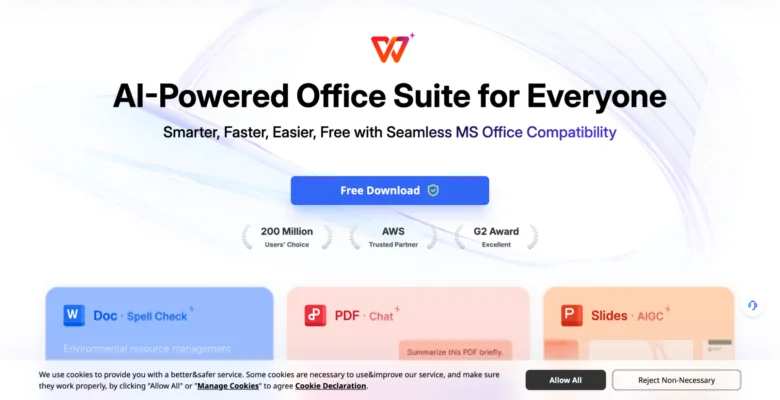
The page itself does a lot of the convincing on its own: a one-line pitch, a row of trust badges (200 million users, an AWS partnership, a G2 award), and a single download button. There isn’t much left for a prelander to warm up.
Vietnam, March:
| Metric | Value |
| CR | 0.4% |
| ROI | 30% |
| EPC | $0.001 |
That result lines up with Adsterra’s own rule of thumb for the format: use a prelander when the offer needs some explaining, skip it when the offer is already simple and clear. For an offer whose landing page already does the explaining on its own, adding a prelander in front of it can cost more in extra clicks than it earns in warm-up.
See where your traffic is concentrating right now. Check the Traffic Chart inside your Adsterra dashboard before deciding which GEO to test next.
Testing New GEOs: Indonesia and Egypt Results
Two more GEOs followed over the summer: Indonesia and Egypt. Both ran the same offer, the same format, the same testing habits carried over from Vietnam, and the monthly numbers moved around more than a tidy case study usually shows. That’s worth sitting with instead of smoothing over.
| GEO | Month | CR | ROI | EPC |
| ID | June | 0.73% | 22% | $0.001 |
| ID | July | 0.46% | −30% | $0.001 |
| ID | August | 0.71% | 27% | $0.002 |
| EG | June | 0.97% | 49% | $0.002 |
| EG | July | 0.69% | 40% | $0.001 |
| EG | August | 0.27% | 30% | $0.001 |
Reading the trend across the two GEOs:
- Indonesia drops sharply in July and bounces back almost as sharply in August — a one-month noise event rather than a real trend.
- Egypt never dips into negative territory, but its CR steadily erodes month over month (0.97% → 0.69% → 0.27%) while ROI stays relatively stable — a slower-moving signal that’s still worth tracking, even though the numbers aren’t critical yet.
- EPC for both GEOs stays inside the same narrow $0.001–$0.002 band while ROI swings from −30% to 49% — the volatility is coming from conversion rate, not click cost.
Indonesia’s July number is a real dip, not a rounding artifact, and it recovered the following month. Egypt never dropped into negative territory, but it slid from a strong June through July and into August anyway. Neither pattern is a verdict on the GEO by itself. Adsterra’s own guidance on testing Popunder traffic makes a similar point about early results: treat them as a signal, not a conclusion, and watch CPA and ROI over raw traffic volume. Indonesia and Egypt sit in the same Tier-3 pricing band as Vietnam, which is part of why EPC across all three stays inside that same narrow $0.001 to $0.002 band even as ROI swings from −30% to 49%; it’s conversion rate moving underneath the numbers, not the cost of the clicks.
💡 Tip: One bad month is noise. Two or three in a row is a signal. Don’t cut a GEO on a single data point.
GEO Burnout: Why the Same Offer Stopped Converting in Colombia
This isn’t the offer’s first run. The same WPS Office offer went out on Popunder back in September 2025, and Colombia was the standout GEO that time. It hasn’t come close to its September numbers since.
That’s the risk that comes with a worldwide offer running on a format this cheap to test: whatever combination is working right now can stop working, and there’s rarely one clean reason why. Traffic quality shifts, competing offers move in, the audience that responded well simply runs its course. Checking for it isn’t complicated: pull ROI and CR for a GEO over its last few months and compare it to its own best month, not to a general benchmark. A steep, sustained drop from a GEO’s own peak is a different problem than a GEO that’s just always been mediocre.
The response isn’t to chase the GEO that used to work. It’s to keep testing new ones on a rolling basis, and to treat today’s best-performing GEO as temporary until it’s proven itself over a few more months, not one.
Don’t chase a burned-out GEO. Set up Smart CPM and a CPA Goal in your Adsterra dashboard so the system holds your target cost per action automatically while you test fresh GEOs.
Landing vs Pre-landing: Why Less Isn’t Always Worse
The “landing or prelander” question on Popunder usually gets answered by default — almost always in favor of a prelander, on the assumption that warming the user up first is safer. This test didn’t back that assumption up.
What was tested:
- Advertiser landing (direct): One-line pitch, a row of trust badges (200M users, AWS partnership, G2 award), a single download button.
- Prelander variants: An intermediate page meant to build interest before sending traffic on to the download page.
- Split: 50/50 traffic across the same GEO and zone mix, so the only real variable was the extra step.
Result: The direct landing outperformed every prelander variant tested, across CR, ROI, and EPC (see the Vietnam numbers above).
When a prelander is likely worth it:
- The offer needs explaining — unfamiliar brand, complex functionality, a niche product
- There’s an age or GEO restriction better filtered out before the advertiser page
- Competing offers use a near-identical pitch, and standing out before the handoff matters
When a prelander is likely dead weight:
- The advertiser’s own page already builds trust well — badges, numbers, social proof
- The offer is simple and self-explanatory, the way WPS Office is: free, faster, compatible with the files people already have
- Every extra click is a point where traffic leaks, not a point where it gets warmer
Takeaway: don’t start from “a prelander is always the safer bet.” Treat it as a hypothesis to split-test, not a default step in the funnel.
💡 Tip: If the advertiser’s landing page is already doing the convincing, don’t get in its way. Add a prelander only when there’s something that actually needs explaining first.
The offer stayed live past March, and the team kept testing new GEOs and approaches on it rather than treating the Vietnam numbers as a finished result.
Popunder Testing Tips for Software Offers
A handful of things from this run are worth carrying into the next software advertising campaign, on Popunder or otherwise.
- Test the direct landing page before building a prelander for it. If the advertiser’s own page already makes the pitch in one screen, a prelander often just adds a click without adding trust, and it’s an easy A/B to run before committing design time to a prelander the direct page might already beat.
- Treat month one as a signal, not a scorecard. Indonesia’s July dip would have looked like a reason to kill the GEO, if the team had stopped checking after July instead of watching August. A single bad month on a WW offer running across several GEOs is closer to noise than to news; two or three bad months in a row is a different conversation.
- Cap frequency per user on Popunder specifically, and set a daily spend cap while testing. Both are small habits, and both are the difference between catching a bad zone after a day instead of after it’s burned through a week’s spend overnight.
💡 Tip: Cap frequency and set a daily spend limit from day one of a test — it’s the difference between catching a bad zone in a day versus after a week’s budget is already gone.
- Start broad with RON targeting before layering in whitelists or blacklists. Cutting a zone before it’s spent enough to prove itself either way is how a whitelist ends up built on noise instead of signal. A rough rule that holds up in practice: give a zone room to spend a handful of payouts’ worth before deciding, more for low-payout offers, fewer for high-payout ones.
- Test Popunder alongside Popup, not instead of it. Adsterra’s own guidance is that mixing the two Pop formats “often leads to the best results,” and recommends testing the same campaign across both rather than picking one and sticking with it. That combination wasn’t part of this case, so treat it as the next experiment, not a guarantee.
- Track real EPC and ROI per GEO, not the network’s blended CR. Postback tracking down to the individual GEO, set up through the CPA network running the offer, is what shows the actual numbers instead of one averaged, network-side conversion rate.
Where to Find Offers Like This
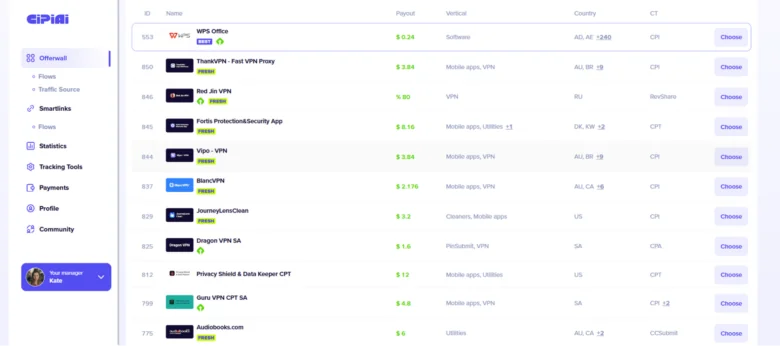
WPS Office runs through CIPIAI alongside a long list of other worldwide software and utility offers built for this kind of testing.
Quick reminder: New affiliates get the code ADSTERRA for a 15% bump on the first payout, and sets an account up with a dedicated manager from the start.
Sum Up
Two things are worth keeping from this campaign: the simpler version of the landing page beat the more elaborate one, and the GEO that worked first wasn’t the GEO that kept working. Testing didn’t stop once the numbers looked good, and that’s the only reason this CIPIAI offer is still running on Adsterra traffic today — a small but telling proof point for what disciplined software advertising looks like in practice. The questions below cover the specifics affiliates usually ask before trying something similar.
FAQ
Do software offers need a prelander on Popunder traffic?
Not automatically. This case found the opposite: Removing the prelander and sending traffic straight to the advertiser’s landing page outperformed every prelander tested. Test both before assuming either one wins.
How do you know when a GEO is overheated for an offer?
There’s no fixed threshold, but a sharp, sustained drop from a GEO’s own previous peak, the kind Colombia showed on this same offer after September 2025, is the clearest sign. The fix is testing new GEOs on a rolling basis rather than waiting for a burned-out one to recover on its own.
How long should a new GEO run before deciding it doesn’t work?
Long enough to see at least one full monthly cycle and, ideally, a second one to check it wasn’t a fluke. Indonesia’s single-month ROI swing here, from 22% to −30% to 27%, is the case in point: Judging that GEO off July alone would have thrown out a combination that recovered a month later.
Where can affiliates find worldwide software offers like this one?
Through a CPA network’s offerwall, CIPIAI included, filtering for cost-per-install software and utility offers with broad GEO coverage.
How much traffic do you need before drawing a conclusion on a prelander test?
There’s no fixed number, but the split needs to run long enough on matching GEOs and zones for both versions to rack up a comparable number of conversions — otherwise a CR difference may just be noise rather than a real result.
Can you test Popunder direct linking across several GEOs in parallel?
Yes, and it speeds up the test, but postback tracking still needs to be set up per GEO — blended stats across a parallel run can hide the fact that one market is dragging the numbers down while another is pulling them up.
What if ROI on a GEO stays positive but CR keeps slipping every month, like Egypt did here?
That kind of erosion is worth watching separately from ROI. A steady CR decline while ROI holds up often precedes a sharper drop a month or two later, which is a reason to ramp up testing on new GEOs early rather than waiting for ROI to turn negative too.