
Push notification ad networks remain one of the fastest ways to reach engaged, opted-in users at a low cost per click. Whether you’re an advertiser chasing volume or a publisher looking to monetize traffic, choosing among the many Push notification ad networks on the market can feel overwhelming. This guide breaks down how Push ads work, the main ad formats, and the top Push notification ad networks worth your budget in 2026.
What Are Push Notification Ads and Why They Still Crush It
Push ads are notification-style messages that land directly on a user’s device, whether that’s a desktop browser or a mobile phone. Unlike Banner ads or Native ads, Push notification ads don’t sit inside a webpage. They appear on the operating system level, similar to a text message or an app alert.
That placement is exactly why Push ads networks keep outperforming older formats. A Push ad doesn’t need a user to be browsing your site. It reaches subscribers hours or days after they left, whenever the ad network decides the timing is right. This makes Push notification advertising a strong retargeting tool, not just a first-touch format.
Two other trends keep Push ads relevant heading into 2026. First, Apple opened up web Push notifications on iPhones, unlocking a huge new pool of iOS subscribers that Push ad networks previously couldn’t reach. Second, as third-party cookies get phased out across major browsers, Push ads sidestep the problem entirely. Every subscriber actively clicked “Allow,” so targeting stays consent-based and reliable.
We know the difference between formats that helps you make money on it. Join today to test ad combos and find the most powerful one.
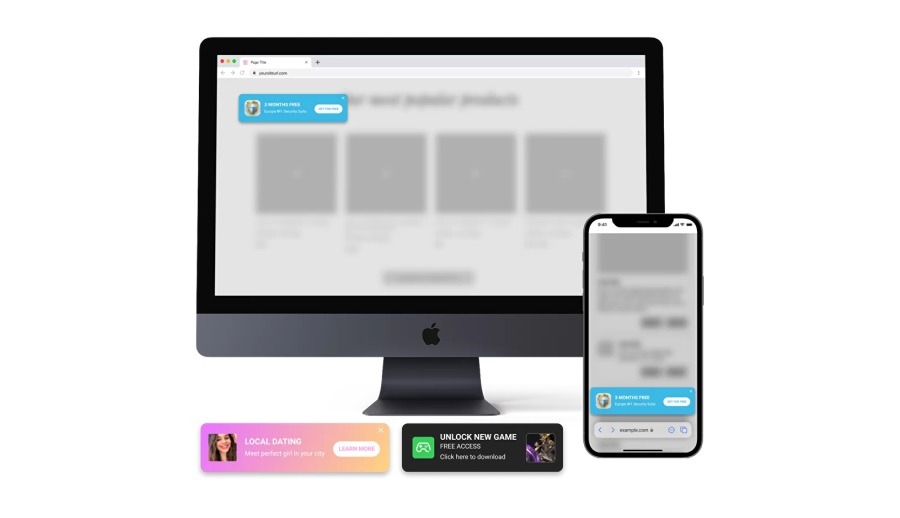
Push Ads are further classified into Web Push notifications and In-Page Push ads. Although both types share the same appearance and characteristics, they are fundamentally different in how they work.
Tip: We published a comprehensive Push advertising guide, explaining their differences and how each of them works
How Push Notification Advertising Actually Works
The mechanics behind Push notification advertising are simpler than they look. A publisher installs a small script or SDK on their website. When a visitor lands on the page, a browser prompt asks them to subscribe to notifications. Once they click “Allow,” that visitor becomes a subscriber inside the ad network’s database.
From there, advertisers buy access to that subscriber base. They set a budget, choose targeting parameters like country, device, operating system, and browser language, then upload a creative: an icon, a short title, and a description. The Push ad network’s algorithm decides which subscribers see which ad, based on bids and predicted engagement.
Pricing on most Push ad networks runs on CPC (cost per click) or CPM (cost per thousand impressions), with some platforms offering CPA Goal or SmartCPM models that auto-optimize toward conversions. Because subscribers already opted in, click-through rates on Push notification ads tend to beat cold traffic sources by a wide margin.
The Main Types of Push Ads: Classic, In-Page, and Beyond
Not every Push ad looks the same. Understanding the differences between Push formats can help advertisers choose the right traffic source and publishers select the most profitable way to monetize their audiences.
The main options are classic Web Push, In-Page Push, and newer Push-style formats. While traditional Web Push still has its place, In-Page Push has become an increasingly attractive alternative because it removes the subscription barrier and works across a much broader range of devices and traffic.
Classic (Web) Push Ads
Classic Web Push ads are the traditional Push notifications. They appear outside the browser window, for example in a desktop notification area or on a supported mobile device. Because they can reach users even after they have left a website, Web Push is well suited to re-engagement campaigns, recurring offers, and time-sensitive promotions.
There is one major limitation: users must first opt in to receive notifications. This means publishers need to build a subscriber base before they can monetize it, while advertisers are limited to the available pool of opted-in users.
The format can still deliver valuable traffic, but browser and device restrictions have made reach less universal than it once was. For example, Web Push does not offer the same device coverage as In-Page Push, particularly when it comes to iOS users.
In-Page Push Ads
In-Page Push takes the familiar appearance of a Push notification and brings it directly onto the webpage. Ads can resemble system notifications, chat messages, or other familiar UI elements while remaining part of the website experience.
The biggest commercial advantage is simple: no subscription is required. Publishers can monetize visitors as soon as they arrive on the site, while advertisers can reach users who would never have entered a traditional Push subscriber base.
In-Page Push also works across desktop, Android, and iOS, making it a more universal option for modern mobile-first traffic. Adsterra’s current In-Page Push offering supports all major GEOs, devices, browsers, and operating systems.
For advertisers, In-Page Push can be especially useful for apps, software, VPNs, subscriptions, e-commerce, dating, iGaming, utilities, and other performance-driven verticals. The format combines the attention-grabbing appearance of a notification with the broad reach of on-page advertising.
Adsterra’s In-Page Push campaigns can also be purchased on CPC, CPM, or CPA models, giving advertisers more flexibility when testing offers and optimizing for their preferred performance metric. The platform provides 10+ creative templates and supports A/B testing of up to 15 creatives.
For publishers, In-Page Push is particularly attractive because it can provide additional monetization without relying on a subscriber database. Adsterra positions the format as compatible with other ad formats, allowing publishers to add it to an existing monetization mix rather than replacing their current inventory.
Calendar Push and Other Formats
Some Push ad networks also offer alternative formats such as Calendar Push, which uses a calendar-event or reminder-style presentation to attract users’ attention, particularly on mobile devices. It is considered rather disturbing and intrusive, though.
However, Push advertising doesn’t have to stop at notification-style formats. Modern ad networks increasingly combine Push-like units with Native ads, Popunders, Interstitials, and interactive display formats, allowing advertisers to diversify campaigns and publishers to monetize different types of user behavior.
Push Ad Formats Compared
| Feature | Classic Web Push | In-Page Push |
|---|---|---|
| Where it appears | Outside the browser | Directly on the webpage |
| Subscription required | Yes | No |
| iOS traffic | Limited | Yes |
| Desktop traffic | Yes | Yes |
| Immediate delivery | Not always | Yes |
| Reach | Subscriber-based | Broad website traffic |
| Best for advertisers | Re-engagement, recurring offers | Performance campaigns, apps, utilities, subscriptions |
| Best for publishers | Sites with an established subscriber base | Sites looking to monetize more visitors |
| Creative flexibility | Relatively limited | High |
| Pricing models | Typically CPC/CPM | CPC, CPM, CPA |
| Can work alongside other formats | Yes | Yes |
| Key advantage | Can reach users after they leave a site | No opt-in + broad device coverage |
The comparison makes the main difference clear: classic Web Push relies on a valuable but limited subscriber audience, while In-Page Push monetizes users while they are actively browsing. For advertisers, this means a much broader potential audience; for publishers, it means an additional revenue stream without waiting for visitors to subscribe.
Adsterra takes this approach a step further with Social Bar, combining In-Page Push-style notifications with other interactive formats. Advertisers can choose from multiple creative templates and target traffic by GEO, device, operating system, and other parameters, while publishers can use the format alongside their existing ad placements.
This makes In-Page Push particularly useful when the goal is not simply to generate impressions, but to capture attention without taking over the entire screen. Adsterra’s 2026 benchmarks report In-Page Push CTRs of around 15–33%, although actual performance varies considerably by GEO, vertical, creative, placement, and targeting.
Ultimately, the best format depends on the business model. Web Push remains useful for reaching an existing subscriber base, while In-Page Push is generally the more flexible choice for reaching new users at scale. For publishers, combining the two can create a broader monetization strategy; for advertisers, testing both formats can reveal which traffic source delivers the strongest combination of CTR, conversions, and ROI.
Key Benefits of Using Push Notification Ad Networks
Advertisers and publishers turn to Push notification ad networks for several consistent reasons: low starting costs, large volumes of traffic, precise targeting, fast campaign deployment, and flexible monetization. Unlike many traditional advertising channels, Push formats can be launched and optimized relatively quickly, making them useful for both testing new offers and scaling campaigns that already perform well.
Low Entry Cost
One of the main advantages of Push advertising is its relatively low barrier to entry. Many Push ad networks allow advertisers to start with a minimum deposit of around $50–$150, making the format accessible for smaller affiliates and businesses that want to test a new traffic source without committing a large budget upfront.
Push campaigns can also be tested with relatively small amounts of traffic. Advertisers can start with a limited number of GEOs, devices, or traffic segments, identify the combinations that generate conversions, and then scale the budget toward the best-performing sources.
High-Quality, Engaged Traffic
Classic Web Push traffic comes from users who have previously opted in to receive notifications, which can create a highly engaged audience. Instead of competing for attention with every other element on a webpage, the notification arrives directly in the user’s notification area.
This can be particularly valuable for time-sensitive offers, promotions, app installs, subscriptions, e-commerce deals, and other campaigns where immediate attention matters.
In-Page Push provides a different advantage: it does not depend on a subscriber database. Since the ad is displayed directly on the webpage, advertisers can access a much broader audience, including users who have never subscribed to Web Push notifications.
As with any paid traffic source, traffic quality still depends on the network, GEO, targeting, and campaign setup. Advertisers should therefore evaluate performance using conversion and ROI metrics rather than assuming that a Push format will automatically outperform other channels.
Advanced Targeting Options
Push ad networks typically provide granular targeting tools that allow advertisers to narrow down their audience and control where their budget goes. Depending on the platform, targeting can include:
- Country, region, or city
- Device type and model
- Operating system
- Browser and browser language
- Mobile carrier
- Internet connection type
- Traffic source or placement
- Time of day and day of week
This level of segmentation is especially useful when an offer performs differently across GEOs or devices. For example, an advertiser can discover that an app converts strongly on Android in one country but performs poorly on iOS, then adjust bids instead of paying the same rate for both segments.
Adsterra combines detailed targeting with a large international traffic pool, allowing advertisers to test individual GEOs and audience segments before scaling. Its Push-style Social Bar and In-Page Push campaigns can be targeted by factors such as GEO, device, operating system, browser, and connection type, depending on the campaign setup.
Fast Campaign Launches
Push campaigns are relatively simple to prepare compared with many traditional advertising formats. A standard creative usually requires only a short headline, description, icon or image, and landing-page URL.
This makes Push particularly useful for advertisers who need to launch campaigns quickly or test multiple creative concepts. Once the campaign and creatives pass network moderation, traffic can start flowing without the lengthy production process associated with video or large display campaigns.
The simplicity of the format also makes creative testing easier. Advertisers can prepare several headlines and images, run them against the same audience, and compare CTR and conversion performance to identify the strongest combination.
Flexibility Across Verticals
Push traffic is used across a wide range of verticals, from mainstream performance marketing to more specialized offers. Depending on the network’s advertising policies and GEO restrictions, common use cases include e-commerce, mobile apps, utilities, VPNs, subscriptions, dating, finance, digital currencies, iGaming, and sweepstakes.
This flexibility is particularly valuable for affiliate marketers, who often need to test multiple verticals and offers rather than rely on a single advertising channel.
However, advertisers should always check the network’s current compliance requirements before launching a campaign. Some verticals, creatives, claims, and landing pages may be restricted in particular countries even when the broader vertical is supported.
Real-Time Optimization
Push campaigns can generate data quickly, which makes frequent optimization possible. Advertisers can monitor impressions, clicks, CTR, conversions, CPA, and ROI and identify the placements or audience segments that are consuming budget without producing results.
Many Push platforms also provide automated optimization features such as rules, bid adjustments, zone management, and automated campaign optimization. These tools can reduce the amount of manual work required to monitor campaigns and help advertisers react faster when performance changes.
A typical optimization process might look like this:
Launch → collect data → identify weak zones → adjust bids or blacklist placements → test new creatives → scale profitable segments.
The exact tools vary by network, but the principle is the same: Push advertising works best when campaigns are treated as an ongoing optimization process rather than a set-and-forget traffic source.
Additional Monetization for Publishers
For publishers, Push notification ad networks provide another way to monetize an audience without relying entirely on traditional display inventory.
Classic Web Push can generate revenue from a publisher’s existing notification subscriber base, while In-Page Push can monetize visitors without requiring them to subscribe. This distinction is important because it allows publishers to choose a model based on how their audience interacts with the site.
Push-style formats can also complement conventional banners and native ads rather than replacing them. A publisher can use standard display placements within the page while adding Push or In-Page Push as another monetization layer.
For example, Adsterra’s Social Bar can be integrated alongside other ad formats, giving publishers an additional source of revenue while keeping their existing advertising setup intact. This can be especially useful for publishers with high mobile traffic, international audiences, or visitors who do not stay on the site long enough to generate substantial value from multiple page views.
Push Advertising Benefits at a Glance
| Benefit | For Advertisers | For Publishers |
|---|---|---|
| Low entry cost | Start testing with a relatively small budget | No major investment required to add another monetization format |
| Large reach | Access broad audiences across multiple GEOs | Monetize more visitors and traffic segments |
| Targeting | Segment traffic by GEO, device, OS, browser, and other parameters | Match monetization to different types of traffic |
| Fast launch | Create and test campaigns quickly | Add a new format without rebuilding the entire site |
| Creative simplicity | Test multiple headlines and visuals with minimal production effort | Push-style units require limited on-page real estate |
| Optimization | Adjust bids, zones, and creatives based on live performance | Optimize monetization according to traffic quality and demand |
| Multiple formats | Test Web Push, In-Page Push, and other ad formats | Diversify revenue beyond standard banners |
| Cross-vertical use | Test offers across a wide range of performance verticals | Monetize audiences across different content categories |
Overall, Push advertising combines low testing costs, fast deployment, granular targeting, and strong optimization potential. For advertisers, it can serve as a flexible performance channel for testing and scaling offers. For publishers, it provides an additional monetization layer that can work alongside existing ad placements.
The most effective approach is usually not to treat Push as a standalone solution, but to compare its performance with other formats and optimize the mix based on actual revenue, conversion rates, and user engagement. Networks such as Adsterra make this easier by combining Push-style formats with other monetization and acquisition options within the same platform.
Top Push Notification Ad Networks in 2026: Honest Reviews and Comparisons
Dozens of platforms sell Push traffic, but a smaller group consistently delivers for both advertisers and publishers. Here’s an honest look at the Push notification ad networks worth testing this year.
RichAds
RichAds has built one of the largest Push inventories on the market, with billions of daily ad impressions across more than 200 countries. The platform offers classic Push, In-Page Push, plus Native, Popunder, and direct click traffic from the same dashboard.
What sets RichAds apart is its optimization toolkit. Performance Mode delivers fresh whitelists on a weekly basis, while microbidding lets advertisers raise or lower bids by targeting segment based on live results. Traffic is filtered through Adscore, a third-party bot-detection service, before it reaches campaigns. Minimum deposit sits around $150, and personal account managers are available to help set up campaigns.
PropellerAds
Founded in 2011, PropellerAds is one of the longest-running players among Push ad networks. It reports well over a billion daily impressions across 195-plus countries, alongside Push, In-Page Push, Interstitial, Popunder, and Native formats.
PropellerAds’ standout feature is Audiences: targeting by interests, gender, and age layered on top of standard geo and device filters. Combined with CPA Goal bidding, which automates spend toward a target cost per action, the platform suits advertisers who want hands-off optimization at scale. PropellerAds also runs a strong publisher program, with a 100% fill rate promise and payouts through PayPal, Payoneer, wire transfer, etc.
Adsterra
Adsterra is one of the largest networks serving 1.7 billion weekly impressions of In-Page Push traffic from direct publishers. The platform provides affiliates with unique traffic sources from 35,000+ direct publishers. Affiliates benefit from running CPA, CPC, and CPM campaigns on VPN/Utility, Apps, Dating, iGaming, Sweeps, and E-commerce verticals. Minimal deposit is $100, pretty comfortable across the market.
It stands our with its Partner Care approach, smart bidding tools, 3-level security, 20+ targeting and optimization options, outstanding delivery with 30% CTRs, and even more. While common In-Page Push ads look the same from one ad network to another, Adsterra enhanced its looks to meet digital natives’ expectations. Social Bar advances your campaign with 20+ templates. You can apply animated widgets, icons, large images, and OS-native designs.
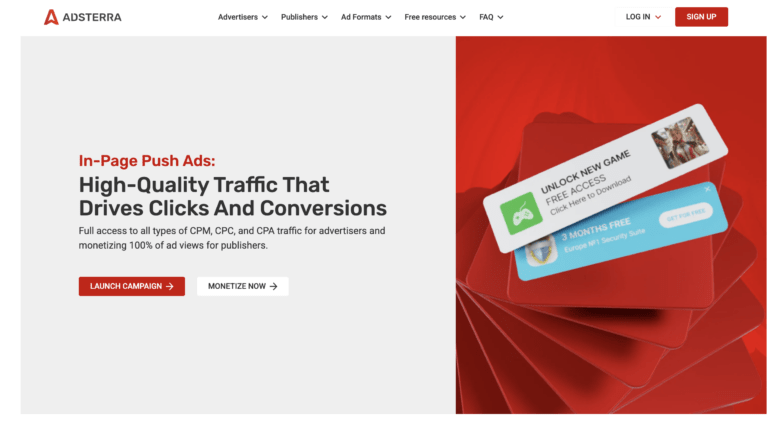
Social Bar can serve Push Ads and more advanced visuals. They provide an imposing range of ad inventory, targeting options, and payment systems. You can start partnering with the best push ads network right now by going through quick registration.
Clickadu
Clickadu started out in Popunder traffic back in 2014 before expanding into a genuinely multi-format network. Today it sells Push notifications, In-Page Push, video, instant text message, and skim ad formats, with over 90% of traffic sourced directly rather than through resellers.
Clickadu supports five pricing models, including SmartCPC and SmartCPA, which automatically hunt for the zones most likely to convert once you set a test budget. Advanced targeting covers geography, device, OS, browser, browser language, carrier, and day-parting. The minimum deposit is $100, and the network is known for accepting verticals that some competitors restrict, like iGaming and non-mainstream offers.
Push.House
Push.House has focused exclusively on Push traffic since 2018, and that specialization shows in its feature set. The network reports hundreds of millions of active subscribers across 180-plus countries, delivered through web Push, In-Page Push, and on-click formats.
A built-in competitor research tool, Spy.House, lets advertisers see which creatives are currently running on the network before launching their own campaign. Push.House runs on CPC and CPA Goal models with an RTB auction and adjustable win rate, plus audience-building tools for retargeting and blacklists. The minimum deposit is a low $50, making it approachable for smaller budgets testing Push notification advertising for the first time.
PlugRush
PlugRush is a self-serve network covering pop traffic, Native ads, banners, and Push ads for both mainstream and non-mainstream verticals. It has picked up industry awards for ad network performance, and publishers frequently cite strong fill rates and reliable, on-time payments.
Advertisers get full targeting control, including device, geography, and connection type, with support for both self-managed and assisted campaign setups. PlugRush works well for teams that want one account covering multiple traffic types rather than juggling separate Push ad networks for every format.
AdMaven
AdMaven keeps its barrier to entry low, with a minimum deposit around $50, while still delivering roughly 1.5 billion daily impressions sourced from tens of thousands of publishers. The network leans on Smart Bidding to automate optimization and pairs it with dedicated support for advertisers who want hands-on guidance.
AdMaven publishes its own blog ranking Push ad networks for publishers, reflecting a strong focus on the monetization side of the business alongside advertiser-facing tools.
EvaDav
EvaDav is built specifically around Push-notification monetization for publishers, with a wide library of ready-made landing pages and support for popular trackers like Binom, Keitaro, and BeMob. Publishers can choose between a Revenue Share model or private CPA terms, with a minimum payout of just $25.
Every EvaDav advertiser goes through a verification step before campaigns go live, which the network positions as a quality-control measure against low-effort or fraudulent offers.

Traffic Nomads
Traffic Nomads, built by the MOBIPIUM affiliate network and headquartered in Lisbon, differentiates itself with an exclusive Push subscriber base collected in-house rather than bought from resellers. That base runs into the tens of millions of users, delivering hundreds of millions of impressions per day with very little bot traffic reported.
The platform performs particularly well for digital currencies, e-commerce, iGaming, dating, and sweepstakes verticals. Self-service campaign management and weekly optimization guides make it a solid pick for media buyers who want to stay hands-on with Push ad campaigns.
How to Choose the Right Push Ad Network for Your Campaigns
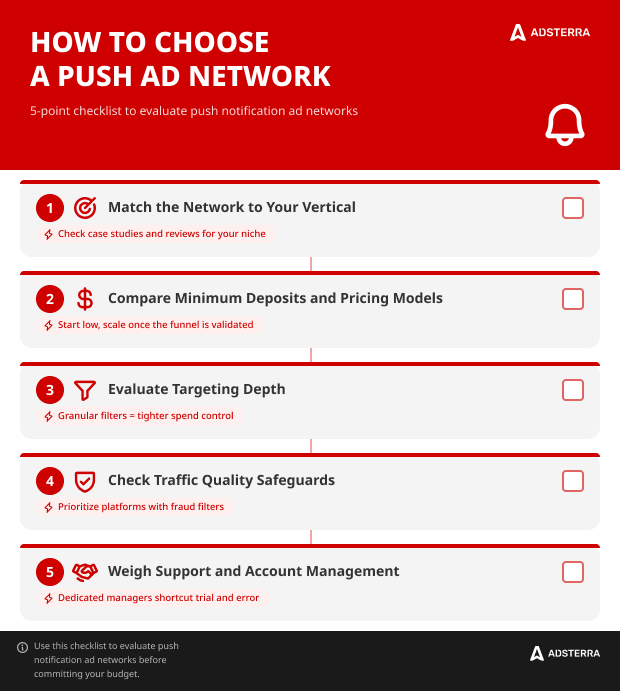
With so many Push ad networks competing for budget, a structured checklist beats guesswork.
Match the Network to Your Vertical
Some Push notification ad networks over-index on specific verticals, like iGaming, dating, or sweepstakes. Check case studies and forum reviews for your exact niche before committing a full budget.
Compare Minimum Deposits and Pricing Models
Entry costs range from $25 to $150 across the networks above. If you’re testing a new offer, start with a lower-deposit network and scale into pricier platforms once you’ve validated the funnel.
Evaluate Targeting Depth
Look for granular filters: device model, carrier, browser language, and connection type matter far more for Push traffic than broad country targeting alone. The more targeting options a network offers, the tighter you can control spend.
Check Traffic Quality Safeguards
Bot traffic quietly drains budgets on weaker Push ad networks. Prioritize platforms that mention third-party fraud filters, like Adscore, or that publish transparent subscriber-verification processes.
Weigh Support and Account Management
A personal account manager can shortcut weeks of trial and error, especially for advertisers new to Push notification advertising. Networks like RichAds, Push.House, and AdMaven all highlight dedicated manager access as a core benefit.
Best Practices for Running Profitable Push Campaigns
Picking a strong network is only half the job. Even with quality traffic and good targeting options, campaign performance depends heavily on creatives, segmentation, bidding, and ongoing optimization. These practices consistently move the needle on Push ad campaigns.
Write Short, Curiosity-Driven Creatives
Push notification ads live or die on the title and description alone, since there’s no landing-page context yet. Keep titles under 30 characters where possible, and lead with a clear benefit, intriguing statement, or question rather than a generic brand message.
Avoid trying to explain the entire offer in a single notification. The goal is to create enough curiosity to earn the click while keeping the message easy to understand at a glance. Where possible, test different angles — such as urgency, curiosity, discounts, or direct benefits — against the same audience.
Test Multiple Icons and Images
Icons and main images carry more weight than most advertisers expect. A small change in the visual can significantly affect CTR, particularly when several competing notifications appear in the same user’s feed.
Run at least three creative variations per campaign, changing one major element at a time where possible. Test different images, icons, headlines, and calls to action, then let the smart bidding tools on your chosen ad network identify the combinations that generate the strongest results.
Segment by Subscriber Age
Fresh subscribers tend to click more often than subscribers who joined months ago. Several Push notification ad networks let you filter by subscription age, allowing advertisers to prioritize users who are more likely to engage with a new notification.
This can be especially useful for campaigns where recency strongly affects conversion rates. Instead of applying the same bid to the entire audience, compare newer and older subscriber segments and adjust bids according to their actual performance.
Use Automated Rules and Micro-Bidding
Manually checking dozens of zones every day doesn’t scale. Set automated rules to pause low-converting sources, adjust bids when CPA exceeds your target, and increase spend on segments that consistently generate conversions.
Micro-bidding can further improve efficiency by allowing you to nudge spend toward individual GEOs, devices, zones, or other high-performing segments rather than making broad campaign-level changes.
Build Whitelists and Blacklists Early
Once a campaign generates enough data, export your best-performing zones into a whitelist and exclude the worst into a blacklist. This prevents budget from repeatedly flowing toward placements that have already demonstrated poor performance.
Reusing these lists across future campaigns on the same Push ad network can shorten the optimization curve considerably, particularly when you’re running several offers targeting similar GEOs or audiences. Keep reviewing your lists, however, since zone performance can change over time.
Track Everything Through a Tracker
Connect your Push notification ad network to a dedicated tracker such as Binom, Keitaro, or BeMob. Postback integration allows the network’s optimization system to receive conversion data and optimize toward actual results rather than clicks alone.
A tracker also gives you a more complete view of campaign economics. Instead of judging a zone by CTR, you can compare clicks, conversions, CPA, revenue, and ROI and identify where the traffic is actually making or losing money.
The more accurately you track conversions, the easier it becomes to scale profitable segments while cutting wasted spend.
Conclusions
Push notification ad networks remain a strong option in 2026, thanks to their low entry cost, precise targeting, fast setup, and broad reach. Web Push and In-Page Push also give advertisers and publishers more flexibility as traditional third-party cookies continue to decline.
For advertisers, Push works well for testing and scaling offers across specific GEOs, devices, and audiences. Publishers can use Push and In-Page Push as an additional monetization layer alongside existing ad formats.
Start small, test multiple creatives and segments, and use automated optimization to identify what converts. Track CPA, conversions, and ROI, then scale only after the data shows consistent results.
Push Notification Ad Networks FAQ
What Are the Advantages of Using Push Notification Advertising?
Push notification advertising reaches users outside the browsing session, works without third-party cookies, and starts with a low minimum deposit. Because subscribers opted in, engagement and click-through rates typically beat cold, non-consented traffic sources.
What Are the Top Push Notification Ad Networks for Mobile Apps?
RichAds, PropellerAds, and Push.House all report strong mobile Push volume alongside broad device and OS targeting. Adsterra, Clickadu, and Traffic Nomads are also worth testing for app-install and mobile offer campaigns specifically.
Which Push Notification Ad Networks Offer the Highest ROI for Advertisers?
ROI depends heavily on vertical and creative quality, but networks with strong automated optimization, like Adsterra’s CPA Goal and SmartCPA, tend to produce more consistent returns than manually managed campaigns.
What Are the Best Push Notification Ad Networks for Monetizing Websites?
For publishers, Adsterra, PropellerAds, AdMaven, and EvaDav stand out thanks to high fill rates, low or no minimum traffic requirements, and multiple payout methods including PayPal and digital currencies.