Blogging earning in Pakistan has something to surprise you with. Still think local traffic from emerging markets is considered not worth monetizing? Hamza Ali, known online as Hamza Blogger, set out to test that assumption. Hamza is a 22-year-old self-taught publisher from a village in Punjab, Pakistan, running .pk education sites with no team, no office and no paid traffic.
Between 1 August and 3 September 2026, his sites earned $2,837.58 with Adsterra from almost 3 million impressions. Most of it came from just two event days, and on one of them he collected 177,039 push subscribers. Impressive, huh? In this case study, Hamza walks through his full system: How he picks topics by calendar rather than CPM, how he prepares hosting and SEO weeks ahead, which Adsterra formats actually earn, and the costly mistake that taught him never to skimp on servers.
Disclaimer to note: This is a publisher’s own account of his results and methods. Your numbers will depend on your niche, traffic and execution, but the principles are worth studying whatever your country.
The Story

known as Hamza Blogger
My name is Hamza Ali. I am 22 years old, I live in a village in Punjab, and everybody knows me as Hamza Blogger. I have been building websites since 2019, working alone, with no team and no office.
The websites in this case study run on .pk domains and serve the education audience inside Pakistan. They give students fast, correct, practical information at the exact moment they are searching for it.
For years I believed what everybody in Pakistan believes: that local traffic is worthless. I wrote in English for readers in America who never came. I collected rejection emails from ad networks that were never going to accept a small publisher from a village. Then I changed one thing. I stopped chasing foreign readers and started serving the audience I already had.
How it started
In 2019 a friend and I started together after watching YouTube videos about blogging. That is genuinely all it was: Two boys from a village watching videos and deciding to try. He works on something else now, so the sites are mine alone.
Everything I know I learned from YouTube. I have never bought a course or had a mentor, and I have no degree in this or in anything related to it. I have studied up to matric, which is my entire formal education.
My family told me this was a waste of time. For years they watched a young man sit in a room with a laptop earning nothing, and from where they stood they were not being unfair. Now they tell me to keep going.
I work from a room in my house. I start after Fajr prayer and work through until the evening. During a project period that is four hours of focused work every day, seven days a week. There is no office, no team and no separation between home and work. The room is the business.
At the moment I am learning AI and robotics, because I think that is where the next opportunity is and I would rather be early than late, the same way blogging was in 2019.
Hamza’s perspective: How he stayed motivated through the years
My first ever income online was $10 from a small SEO job on Fiverr. Ten dollars, after years of trying. Most people would stop there.
What kept me going is my faith. In our religion we are taught that the effort is our responsibility and the result is with Allah. I am asked to work, not to control the outcome. So in the years when nothing was working, I did not see it as failure. I saw it as the part where my job is to keep working. That belief is the only reason there was still a website standing in August 2026 to catch the traffic when it finally came.
I would say this to any beginner: You may have days that look like nothing is happening. From the outside, and to your family, it may look like waste. But it is not the waste, it is the cost. Almost everybody quits during this time, and that is exactly why there is room for the people who do not.
About the niche, the traffic type, and the website
Choose a niche by its calendar, not by CPM
Now for the main part. These are not general blogs. They are built around one idea: Serve people who need an answer today, not people who are browsing.
Education in Pakistan runs on a calendar: Results, admissions, dates, forms, schedules. Every one of those has a fixed day. On that day, hundreds of thousands of students search for the same thing at the same time. The model matters more than the niche, and it works for any topic that has a calendar attached to it.
Most beginners pick a topic because they read that it pays well. Then they discover the competition is global, funded and ten years ahead of them. I did this for years and earned nothing. What works for me is the opposite approach. I look for a topic where:
- A very large number of people need the same specific information;
- They all need it on the same fixed date;
- That date repeats every year, so the work compounds instead of expiring;
- The people searching are in my own country, in a language and context I actually understand.
Education results in Pakistan fit all four: Millions of students, one announcement date, the same cycle every year, and an audience whose situation I understand because I grew up in it.
Traffic source and site characteristics
All traffic is 100% organic Google Search. No paid traffic, no social traffic, nothing extra. Search traffic arrives with intent: the person has a specific question and needs the answer immediately. That intent is what makes Tier-3 traffic monetize at all. Idle browsing traffic from social media, at Pakistani rates, would not have produced these numbers.
The sites share the same traits:
- Education information written for Pakistani students, in simple language with no heavy English;
- Extremely high mobile usage and very fast page loads on weak connections;
- Content built around a fixed yearly calendar;
- Returning visitors, because they trust the information.
How I find topics
I never guess. My research routine is simple, and I follow it every day:
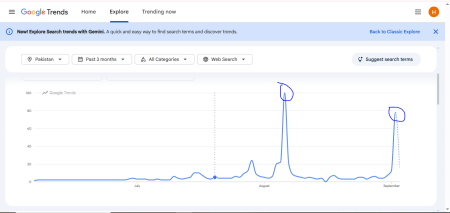
- Google Trends to see what is rising inside Pakistan right now;
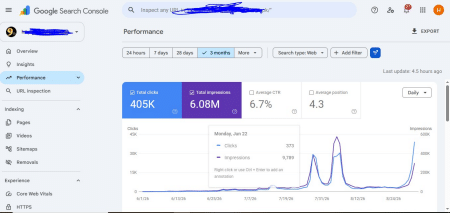
- Google Search Console to find keywords where I already get impressions but few clicks;
- The official calendar for my niche, so I know what is coming weeks ahead;
- Facebook and WhatsApp groups where students actually ask their questions;
- Google Alerts on my main keywords, so news reaches me by email instead of me chasing it.
Before I write anything I ask one question: will this page fully solve the reader’s problem in one visit? If the answer is no, I drop the topic.
Knowing the calendar before anybody else
There is no insider contact and no leaked information. I study the pattern from previous years. Boards announce results at roughly the same time every year. If the result has come in the first week of August for the last several years, it will almost certainly come in the first week of August again. That gives me the approximate window about 11 months in advance, because the past is public and most people never bother to look at it.
The information is available to everybody. What almost nobody does is act on it early. My competitors wait for the official announcement and then rush to publish, which is far too late, because Google needs weeks to trust a page. I publish two months before the event. By the time the announcement is made, my pages are already indexed, already ranking, and already have a position to defend.
There are typically 20 to 30 sites competing seriously on my main keywords, so this is real competition. Most of them get wrong the same two things: they publish too late, and they cannot handle the traffic when it arrives. Neither is about writing better articles.
Why two days produced about 85% of the revenue
In Pakistan, my income does not come from average days. It comes from event days. The top days from my Adsterra dashboard, sorted by revenue, explain my entire business:
| Date | Impressions | CPM | Revenue |
|---|---|---|---|
| 6 August 2026 | 2,291,458 | $0.646 | $1,480.35 |
| 2 September 2026 | 440,680 | $2.147 | $946.20 |
| 7 August 2026 | 49,154 | $2.342 | $115.11 |
| 1 September 2026 | 69,159 | $1.339 | $92.62 |
| 3 September 2026 | 19,833 | $3.091 | $61.31 |
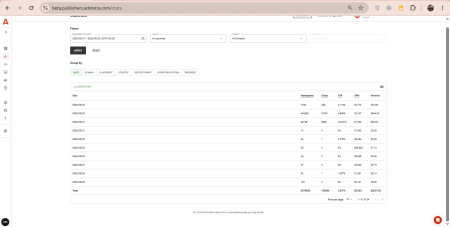
- Two days, 6 August and 2 September, produced $2,426.55, about 85% of the total.
- The top five days produced $2,695.59, about 95%.
- The remaining days of the period earned about $142 between them, many of them a few cents.
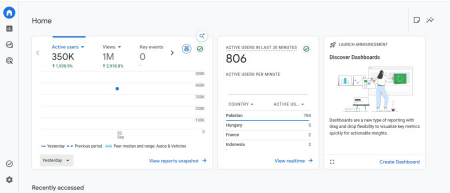
There is a second detail in that table. On 6 August I had 2.29 million impressions at a $0.646 CPM. On 2 September I had only a fifth of that traffic, but the CPM was $2.147, more than three times higher. Between those two events I changed my ad setup, and the second event earned close to the first on far less traffic. Raw traffic was not the improvement. Placement was.
This is why I tell Pakistani publishers to stop measuring themselves on daily averages. In a calendar niche the average day is meaningless. You are not running a shop that sells a little every day. You are preparing all month for a handful of days.
So my real job is not writing articles. It is three things:
- Knowing the calendar before anybody else does.
- Having the page published, indexed and ranking weeks before the event, never on the day.
- Making sure the website survives when everybody arrives at once.
The third point almost destroyed me.
Hosting: The mistake that cost me the most
I could leave this part out and look smarter. I am including it because it is the most useful thing I can give a beginner.
What went wrong
For a long time I used ordinary cheap shared hosting. On normal days it worked perfectly, so I thought it was fine. Then the spikes came: hundreds of thousands of visitors landing within the same few hours. The server crashed, and not once. Every single time. My website was down at the exact hour it could have earned the most.
The mistake cost me in several ways:
- Lost ad revenue during the highest paying hours of the month;
- Google saw a website that fails under load;
- Readers saw an error page, went to a competitor, and many never came back;
- I was saving a few dollars a month and losing far more than that.
What I do now
I moved to Cloudways and took a large server on their Plus plan, hosted in Singapore for low latency to Pakistan. Cloudways bills by the hour, which is the important part. I do not pay for a big server all month. I scale up before an event I know is coming, then scale back down afterwards. Since that change: zero crashes.
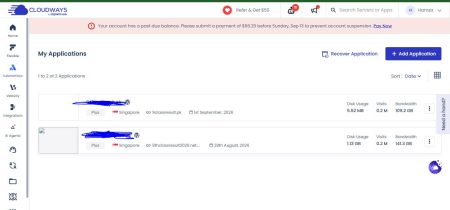
Those bandwidth numbers are the real proof. No shared hosting plan in Pakistan survives that.
Hosting is the one cost I refuse to optimise. A crash on 6 August would have cost me $1,480 to save perhaps $10 that month. My advice to every publisher in a spike niche: Hosting is not a cost. It is the difference between a crashed day and a $946 day. The moment you know a spike is coming, spend on the server. That is not an expense, it is insurance on your biggest day of the year.
Domain and SEO: .pk, fast pages and twelve backlinks
Why I chose .pk
I use .pk domains, registered for two years at PKR 3,600 per year (about $13) each. A .com would be cheaper. I still chose .pk, for four reasons:
- Trust. My readers are Pakistani students. A .pk address looks local and official to them, so they click it in the search results.
- Local relevance. I am targeting Pakistan only, not trying to rank in America.
- Availability. Good .pk names are still free, while good .com names are long gone.
- Honesty. A .pk domain is a small advantage, not magic. It will never rank a bad website.
On-page SEO
This is my checklist for every single article:
- Answer the question in the first paragraph. My reader is in a hurry.
- Put the main keyword in the title, the URL, the first 100 words and one H2. No stuffing.
- Keep paragraphs to two or three lines. Almost everybody is reading on a phone.
- Use one H1 and simple H2s. People scan, they do not read line by line.
- Use tables and lists wherever the information allows it.
- Compress every image before upload. A heavy image is fatal on a slow connection.
- Link every new article to two or three older ones, and link the old ones back to the new one.
- Update, do not rewrite. The same events happen every year, and refreshing a page that already ranks beats publishing a new one.
The result is an average Google position of 4.3 across 6.08 million impressions. That is what makes the event days possible, because on the day itself there is no time left to climb.
Off-page SEO and backlinks
I have twelve linking domains in total. Twelve, not twelve hundred. I go for a very small number of links from genuinely high-authority Pakistani sites instead of fifty weak links that Google ignores anyway. In my experience, two links from a strong Pakistani publication are enough to move my rankings.
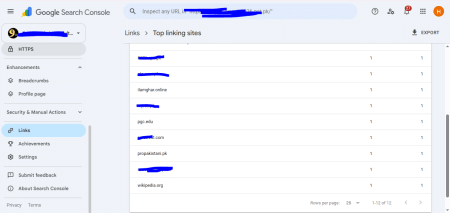
This works well in Pakistan specifically. My competition is other Pakistani sites, most of them with almost no authority, and a link from a big Pakistani publication is topically and geographically relevant. What I would tell a beginner:
- Relevance beats quantity. One link from a real Pakistani site with traffic is worth more than fifty from random global directories.
- Go slowly. A brand new site with 200 links in one week looks artificial.
- Do the free things first: proper social profiles, local listings, and being genuinely useful in the communities where your readers already gather.
- Never buy cheap bulk packages. They are the fastest way to bury your own site.
Technical SEO and speed on slow mobile internet
Nearly all of my readers are on phones, and many are on 3G or weak 4G in small towns and villages. If a page takes six seconds to load, it earns nothing, because the reader is gone before the ads even appear.
- Mobile page speed is my number one metric. I check every page on a real phone before I look at it on a laptop.
- Cloudflare for CDN and basic security, with caching switched on and actually tested rather than assumed.
- HTTPS on everything, and fast hosting, because caching cannot rescue a server that is struggling.
- A sitemap submitted to Google Search Console. I open Search Console every week, not once a year.
- Broken pages fixed fast. A 404 on a ranking page is money leaking away.
My PageSpeed scores are 95 performance, 95 accessibility, 96 best practices and 100 SEO. But the score is not the goal. The goal is that a student standing in a village with two bars of signal can get their result.

How I produce content alone, and what AI Overviews changed
There is no team. It is only me. I use AI to write the first draft: I give it the structure, the local details and exactly what the student needs to know. A solid article takes me around 20 minutes from blank page to the full one.
But I check every date and every fact myself, and this part is not optional. In education content a wrong date can make a student miss a deadline, and AI does not know Pakistan or my niche. The draft is fast. The checking is what makes the article worth ranking.
The speed is not about publishing more articles for the sake of volume. It is so I can move immediately when I see something coming on the calendar, instead of losing the window while I write.
AI Overviews: A 40% loss, and why the niche is partly protected
Yes, this hurts, and I will give you the honest number. On the queries where Google shows an AI Overview, my traffic has dropped by roughly 40%.
What has saved me is the type of information I publish. An AI Overview can summarise a general explanation. It cannot give a student their own result. The searcher wants to find theirs, by roll number, right now, which means going to an actual page and doing something. AI cannot complete that task for them, so the click still has to happen.
If your content can be summarised in three sentences, AI will summarise it and you will lose the click. The content that survives is content where the reader has to arrive and act: check something, enter something, download something, look something up that is specific to them. I do not have a clever optimisation technique for AI, and I am not sure anybody does yet. What I have is a topic where the answer is personal to each reader.
Why I moved to Adsterra, and which ad formats actually earn
Like most Pakistani publishers, I started by trying to get approved with other networks. Years went by. Rejection after rejection, always the same reason underneath: A small publisher from a village with local traffic.
In my own experience with the networks I tried earlier, the trouble came when big traffic days arrived: Serving limits applied at the hour the traffic was worth the most, and an account was suspended around payment time. A limit on an ordinary day costs a little. A limit on the one day of the month that matters costs everything. In a calendar niche I could not build a business on a setup that switches itself off exactly when my audience shows up. That was the real reason I moved, and it had nothing to do with CPM rates.
Adsterra approved me, and I was earning within days instead of after another year of appeals. It fits what I actually have: Pakistani traffic, mobile-first readers, session-based behaviour (the visitor arrives, gets the answer and leaves) and information and education content.
Why AdSense did not work for a spike niche
I want to be specific here, because this is the exact issue that stops Pakistani publishers in my niche.
- The moment a big traffic day arrives, an ad serving limit gets applied, at the precise hour the traffic is worth the most.
- Accounts get suspended around payment time, after the work is already done.
- Pakistani education traffic is valued far below what it delivers.
A serving limit on an ordinary day costs a little. A serving limit on the one day of the month that matters costs everything. In a calendar niche you cannot build a business on a system that switches itself off exactly when your audience shows up. That is the real reason I moved, and it had nothing to do with CPM rates.
Adsterra approved me, and I was earning within days instead of after another year of appeals. It fits what I actually have: Pakistani traffic, mobile-first readers, session-based behaviour (the visitor arrives, gets the answer and leaves) and information and education content.
Ad formats and what each one actually does
This is where the data surprised me. The table shows Adsterra revenue by placement across all of my sites.
| Format | Impressions | CPM | Revenue | What it does for me |
|---|---|---|---|---|
| Popunder, best placement | 460,578 | $2.712 | $1,248.91 | The revenue engine. Monetises the session rather than the click. |
| Popunder, all placements | — | $1.65 to $4.10, depending on the site | about $2,165 | Not close to second place. It is the business. |
| Direct Link, one placement | 146,389 | $3.409 | $499.04 | My highest CPM of any format, and the one most publishers underuse. |
| Social Bar, three placements | — | — | about $99 | CTR of 9.36%, 12.11% and 14.90%. Best engagement, small revenue. |
| Banner 300×250 | 1,117,486 | $0.048 | $53.40 | Harmless, but close to pointless on Pakistani traffic. |
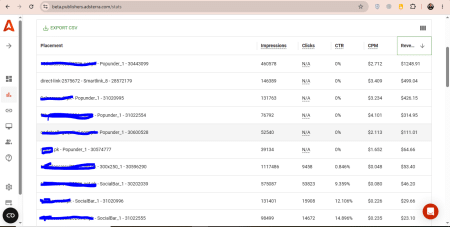
I keep Social Bar because it costs nothing and shows that my readers engage without being annoyed, but I do not pretend it pays the bills. If you rely on standard banners and wonder why the money is not there, this is your answer.
Why I refuse to overload the pages
Google sends me the reader, and Google also watches what that reader does next. If my page is buried in ads, the reader presses back and returns to the search results, and Google reads that as a bad page and drops my ranking. Overloading ads does not increase my income. It destroys the traffic that creates the income.
Push subscribers: 177,039 in a single day
This is the part of my setup that almost nobody in Pakistan copies. On 2 September, the same day the site earned $946.20, I collected 177,039 push subscribers with a self-hosted push notification service. The numbers are the point, not the tool.
| Date | New push subscribers |
|---|---|
| 31 August 2026 | 5,491 |
| 1 September 2026 | 25,473 |
| 2 September 2026 | 177,039 |
The event day brought seven times more subscribers than the day before, so the traffic spike and the subscriber spike are the same event. Of my 445,981 subscribers, 389,379 came in a single month. The cost was $500, one time, for a lifetime licence.
Here is why that matters more than the raw number. Ordinary traffic arrives once and disappears. A push subscriber has given me permission to reach them again, directly, without waiting for Google. For a spike-driven niche this changes everything:
- The next time an important date comes, I do not have to hope Google ranks me in time;
- I can notify a very large audience the moment new information is published;
- Every big event day now feeds the next one, instead of ending when the traffic drops.
How I got that many in one day
- The subscription prompt appears after the reader has got value from the page, not the second they land.
- The traffic was already enormous because the event was correctly targeted.
- The audience is mobile-first, and push works extremely well on mobile in Pakistan.
- The information genuinely matters to them, so opting in is worth it from their side.
Most Pakistani publishers take the traffic on the big day and let it walk away. Capture it instead, and one good day builds an audience you keep.
What it costs and how much time it takes
This is the real advantage of building from Pakistan. A publisher in a Tier-1 country pays for writers, tools and staff. I pay for a domain and a server.
| Item | Cost |
|---|---|
| Cloudways hosting, event month | $100 to $200, depending on server size |
| Cloudways hosting, quiet month | Much lower, because I scale the server down |
| .pk domain | PKR 3,600 per year (about $13) |
| Push notification software | $500, one time, lifetime licence |
| SEO tools | None. I use Google Search Console, which is free. |
| Writers and staff | None. I write everything myself. |
| Paid traffic | None |
The hourly billing is the key. The cost follows the traffic instead of sitting there every month. Everything except hosting can be cut, and a beginner does not need paid tools at all in the first year.
For a publisher in the United States a $946 day is unremarkable. In Pakistan it is a meaningful amount in local terms, produced in twenty-four hours by one person with a laptop and no staff. The CPM number on its own does not decide whether you can build something. Your costs and your competition matter just as much, and in Pakistan both are low.
How much should a beginner invest?
To start honestly, very little. A domain and basic hosting is enough to begin, which in Pakistan is under $50 for the first year. But the money is not the investment. The time is. I worked four hours a day, every day, for two months before the first event. Somebody who spends $500 on tools and gives ten hours a week will earn nothing. Somebody who spends $50 and gives real hours has a chance.
How much time did the active work take?
| Measure | Figure |
|---|---|
| Articles written | 150 |
| Hours per day | 4 |
| Days per week | 7 |
| Total active hours | Around 240 |
| Time to write one article | About 20 minutes |
| Total writing time | Roughly 50 hours |
| Everything else | Roughly 190 hours |
Writing was only a fifth of the work. The other 190 hours went into research, finding the right keywords, structuring pages, internal linking, technical setup, testing on phones and preparing the servers. Beginners assume this business is writing. It is not. Writing is the fastest part.
On the event days themselves I was not writing at all. I spent the whole day watching the hosting, making sure nothing went down. On 6 August that meant sitting with 2.29 million impressions passing through my servers and doing nothing except making sure they stayed up.
Key results
| Metric | Result |
|---|---|
| Adsterra revenue, 1 Aug to 3 Sep 2026 | $2,837.58 |
| Impressions in that period | 2,979,286 |
| Clicks in that period | 105,680 |
| CTR | 3.547% |
| Best single day (6 Aug 2026) | $1,480.35 |
| Previous payment received | $1,979.33 |
| Google search clicks, last 3 months | 405,000 |
| Google search impressions, last 3 months | 6.08 million |
| Average Google position | 4.3 |
| Push subscribers collected on 2 Sep 2026 | 177,039 |
| Push subscribers, all time | 445,981 |
Common mistakes, and what I would tell a publisher starting today
Mistakes I see new Pakistani publishers make
- Believing local traffic cannot pay. It pays, and your costs are low, which is the part people forget.
- Choosing cheap hosting. They save a small amount monthly and lose their biggest days.
- Publishing on the day of the event instead of weeks before. Google will not rank a page it has just met.
- Copying content from other sites. It never ranks and it never lasts.
- Filling every page with ads and then wondering why rankings fall.
- Chasing keywords instead of intent. Ask what the person wants to do in the next ten seconds.
- Writing in difficult English for readers who search in simple words.
- Ignoring push subscriptions and letting all that traffic walk away.
- Giving up in the first year. I spent years getting nowhere before anything worked.
My advice
- Do not chase a Tier-1 niche from a Tier-3 country. Very likely, you will lose.
- Look for a calendar in a subject you already understand: exams, results, admissions, government deadlines, tax dates, sports fixtures, religious dates. Every country has these.
- Your local knowledge is the advantage no foreign competitor can buy.
Nothing here is luck and nothing is a secret trick. I have no team, no investors, no office, and no expensive tools. What I have is a topic with a calendar, hosting that does not fall over, pages that load fast on a weak connection, twelve good backlinks, a push list I actually own, and a monetization partner that does not switch itself off on my biggest day.
Three years ago I was collecting rejection emails. What changed was one decision: serve the audience you actually have, in the language they actually search in, at the moment they actually need you. If you are sitting in a small town in Pakistan reading this and thinking it is not possible for you, I was in exactly that position. It is possible. Start with the calendar in your own subject and build from there.
Conclusion
Hamza’s story shows that traffic value is not defined by a CPM table alone. Low costs, a well-chosen niche and local expertise can make Tier-3 traffic a real business. A few lessons stand out:
- Choose a niche by its calendar. Predictable yearly events with a fixed date let you prepare months ahead and compound your work year after year.
- Be ready before the spike. Publish early, build for slow mobile connections, and scale your hosting before the traffic arrives, not after the server crashes.
- Placement matters as much as volume. Hamza’s second event earned nearly as much as the first on about a fifth of the traffic, thanks to a better ad setup. His results also show how differently formats perform: Popunder and Direct Link drove most of the revenue, while standard banners contributed little on this audience.
- Keep the audience. Push subscriptions turn a one-day spike into a channel you own.
- Protect user experience. Fewer, better-placed ads protect the rankings that bring the traffic in the first place.
We are incredibly happy to share your successes with you and help you move forward. This case is a true inspiration and a living proof that limits are so, so conditional. Believe in what you do and the result will come!
If you want to start blogging earning in Pakistan, or already have local traffic that isn’t earning what it should, sign up with Adsterra and test these formats on your own audience.