
Thailand’s advertising market is experiencing a surge of interest among media buyers and affiliates. But Thai consumers punish culturally tone-deaf campaigns. This playbook covers both ideation and execution tips that set profitable Thai campaigns apart from wasted ad spending. Our experts, Valeria Panenko (Head of PPC) and Polina Maydurova (Senior Graphic Designer), are here to share strategic and tactical approaches to align your creativity with marketing output.

Valeria Panenko, Head of PPC

Polina Maydurova, Senior Graphic Designer
Key takeaways
Thailand is a mobile-first country with 67.8 million internet users and one of the highest daily internet usage rates in Southeast Asia. It attracts marketers from the iGaming, e-commerce, and Entertainment industries.
- Thailand is a hybrid market. People learn about brands from billboard advertising in urban areas like Bangkok (brand awareness). But conversions and impressive ROI come from digital marketing. Mobile devices account for more than 80% of online sales in the country.
- Thai culture (hierarchy, fun, family values, no confrontation) is non-negotiable for creatives that must convert. Consumers in Thailand prefer ads that resonate with local culture and values.
- Local execution shapes every media plan: Thai-language, color symbolism, religious, political, and monarchy-related sensitivity, dominance of LINE and Facebook as complete sales ecosystems.
- Enterprise media buyers layer offline OOH* and DOOH with digital channels, using ad networks like Adsterra for visuals, targeting, bidding, and optimization loops.
- Knowing when to choose advertising agencies versus an ad network determines whether you get transparent results or opaque metrics.
*Out-of-Home (OOH) и Digital Out-of-Home (DOOH) advertising.
What makes advertising in Thailand different in 2026-2027?
Thailand’s advertising landscape is highly digitized and mobile-first, but traditional advertising still holds ground. TV advertising is expected to lose out to internet ads for the first time in Thailand: 36.3% vs. 38.6% (as of Bangkok Post).
Digital advertising is growing at ~14.5% annually, and digital platforms are increasingly influencing advertising strategies across the Thai market.
Thai audience behaviors that shape your marketing planning:
- Internet penetration sits at 94.7% of the population, with 56.6 million social media users across Facebook, Instagram, YouTube, TikTok, and LINE (79% of the total population).
- Short-form videos are favored for content consumption. Thai consumers heavily rely on digital touchpoints for product discovery and purchasing.
- Thailand is a global leader in social commerce; social media platforms act as sales ecosystems where users browse, compare, buy, and review without leaving the app.
- Messaging apps like LINE are crucial for customer retention. SMBs like Street Food and large businesses like banks use them for customer service and loyalty programs.
- Influencer marketing is becoming the No. 1 channel for brands, with an estimated annual growth rate of 13.87% through 2030 ($180.23 million), powered mostly by micro- and nano-influencers.
- Mobile-friendly display advertising (Push, Interstitials) competes with classic Popunders, and businesses use two ad formats to increase exposure.
- About 78% of Thai internet users play video games across mobiles, consoles, and PC.
From a media buyer’s perspective, Thailand is ideal for full-funnel planning: OOH and TV for reach and trust, then performance-focused digital buys with ad networks like Adsterra for installs, leads, and sales.
Today’s talk will mostly embrace digital ad strategies and include practical checklists for setting up your first successful campaign targeting Thai audiences.
Thai culture, consumer psychology, and how it shapes Thai ads
Your joke about the president can go viral in the US; your meme about the royal family in Thailand can lead to a lawsuit. Thailand’s advertising market values understanding of cultural codes, and localization means adapting language, humor, imagery, and cultural references. Companies that understand local values win the competition.
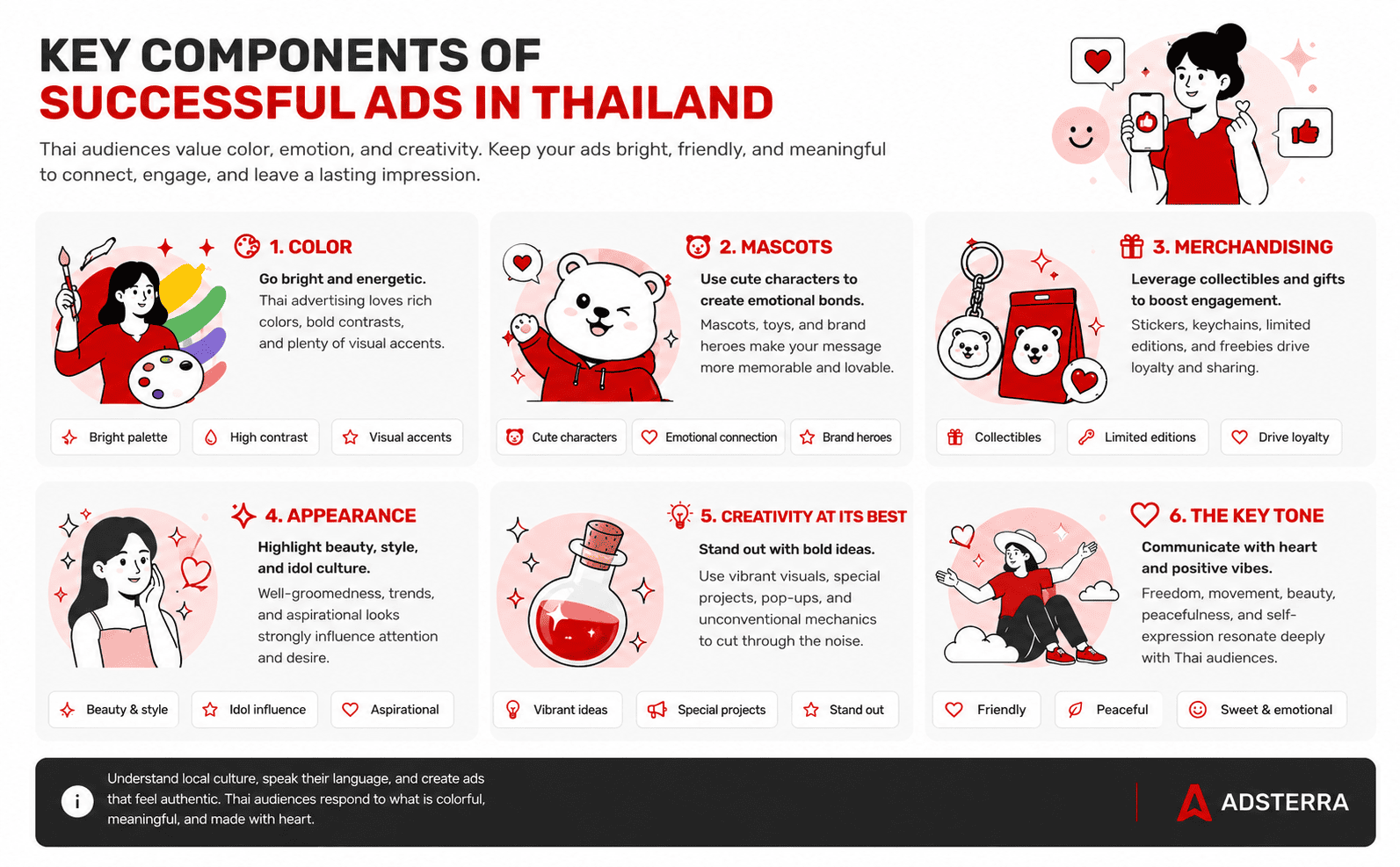
Core Thai advertising concepts to brief your creative team on:
- Hierarchy and “face”: Thailand respects hierarchy but not in the classic “collectivism” meaning. Ads must never embarrass, humiliate, or directly attack anyone.
- Humor and emotional storytelling are prominent in Thai advertising, but the humor is playful and exaggerated, never cruel.
- Family and team spirit: Scenes featuring family sacrifice, mothers, community solidarity, and friends recommending products outperform individualistic messaging. Classic Thai life-insurance commercials are famous globally for tear-jerker narratives built on these themes.
- “Sanuk” (fun): Thai ads lean into absurdity, ironic twists, and emotional crescendos. Creativity in Thai advertising often means going over the top in ways that feel alien to Western brand guidelines.
- “Jai Yen” or “cool-heart” communication: Confrontational humor and aggressive CTAs read poorly.
Expert tip:
Monarchy and related topics are out of marketing. Never depict the royal family or government symbols in commercials, as it will negatively resonate with audiences and may cause legal issues.
Language and cultural nuances:
- Landing pages, ad copy, and CTAs perform better in Thai for mass audiences. English works for premium, B2B, or expat segments. Mixed Thai + English adds prestige for luxury brands.
- Diversity: Thai ads and culture in general celebrate equity and diversity in genders, ethnics, and self-representation. The culture is built on harmony and respect to everybody.
- Buddhism: avoid casual or irreverent depictions of temples, monks, or Buddha images. Thailand has statutory advertising restrictions and an industry self-regulatory system covering religious and royal content.
Expert tip:
Over 90% of Thailand’s population is Buddhist, mostly following Theravada Buddhism. Temples work as both religious and social centers, hosting festivals and community events. You need to be cautious when referring to cherished national symbols and traditions. I recommend to never commercializing these.
Color logic in Thai ads
Advertising in Thailand treats color saturation as the starting point. Where a European marketer might limit a layout to two or three colors, Thai ads regularly stack gold, red, pink, yellow, turquoise, green, and purple in a single visual.
Gold carries specific weight. It connects to monarchy, temples, and prosperity, so it shows up across categories regardless of product type. Yellow is also associated with the monarchy; use it respectfully.
Black is associated with mourning but carries no strict restriction in everyday commercial advertising. Green conveys wellness. Red signals urgency but can feel aggressive in conservative contexts.
Expert tip:
There aren’t any strict rules regarding the use of colors in ads. There’s a general categorization by theme: food products—as bright as possible; cosmetics/personal care—pastel color schemes; the more “serious” the product, the fewer primary colors in the palette, with an emphasis on a single brand color.
The day-of-week color system
This living part of Thai culture still shapes marketing choices, especially around birthdays and personal branding.
- Monday: yellow
- Tuesday: pink
- Wednesday: green
- Thursday: orange
- Friday: blue
- Saturday: purple
- Sunday: red
Characters, visual signs, and mascot trends
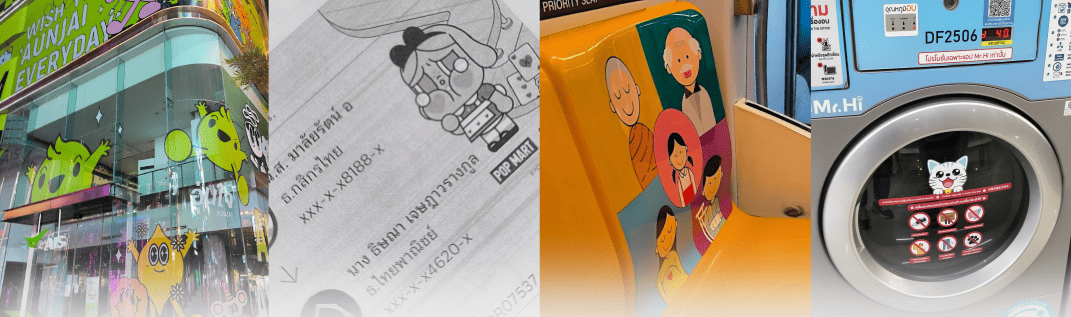
Thai brands treat mascots as commercial infrastructure. A mascot in Thailand can drive foot traffic, TikTok virality, and merch sales on its own, separate from the core product.
Three examples show the range:
- Butterbear started as a bakery mascot at Bangkok’s Emsphere mall. Choreographed K-pop-style dance routines turned it into a viral figure with millions of TikTok views and standalone merchandise sales.
- Bar B Gon, the green dragon mascot of the Bar B Q Plaza chain, has run for years as a full brand universe with comics, charity tie-ins, and collectible toy runs.
- Labubu, the Pop Mart character, became popular enough in Thailand that the Tourism Authority of Thailand officially made it a travel ambassador, dressed in traditional Thai costume for tourism promotion.
Expert tip:
Sanuk culture rewards cuteness and playfulness as an emotional shortcut. Mascots also solve a practical problem in a market with heavy tourist traffic: they communicate without needing a shared language.
Expert tip:
Sanuk culture rewards cuteness and playfulness as an emotional shortcut. Mascots also solve a Promoting a mascot is a budget-heavy task: you can’t just draw a cartoon and make it viral. I recommend this move for large businesses and companies. Affiliates and even global brands willing to reach Thai audiences can stick to basic color and composition rules. But if you happen to promote a brand with an established mascot, consider integrating it!
Visual communication: how to create Thai-friendly ads
You must communicate your offer correctly, and that’s part of the cultural code. We’ve discussed this before. But how about important visual storytelling elements? Based on our 4-year-long Thai-targeted PPC promotions, we can define truly workable (and still converting!) components.
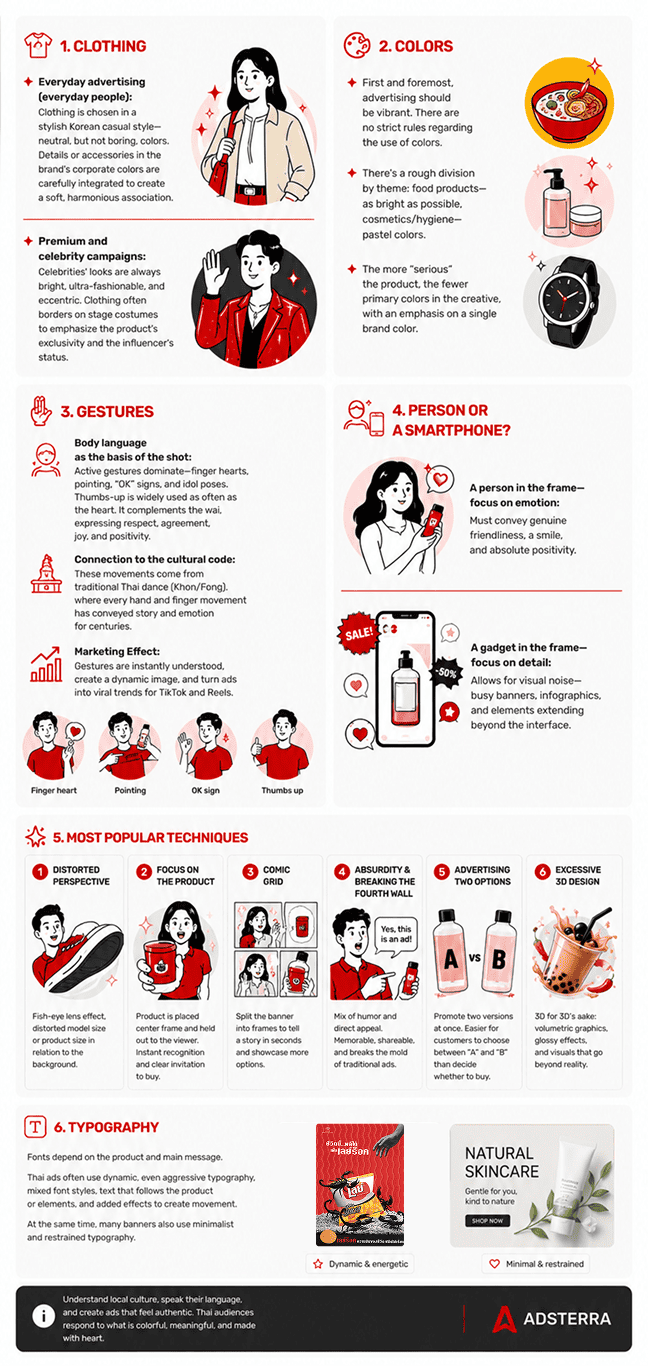
Clothing
Everyday, mass, and medium-segment advertising (everyday people): People wear stylish Korean-like casual style, neutral but not boring colors. Details or accessories in the brand’s corporate colors are carefully integrated into the images to create a soft, harmonious association.
Premium and celebrity campaigns: Regardless of the product category, celebrities’ looks are always bright, ultra-fashionable, and even eccentric. Clothing often borders on “big-scene” costumes to emphasize the product’s exclusivity and the influencer’s status.
Color combos
Advertising should be vibrant, so there are no strict rules regarding the use of colors. But there’s a distinctive division by theme: food products look as bright as possible, cosmetics/hygiene “dress up” in pastel colors. The more “serious” the product, the fewer primary colors in the creative, with an emphasis on a single brand color.
Posing and gestures
Body language as the basis of the shot: Active gestures dominate the advertising: finger hearts, pointing at the product, “OK” signs, and the signature poses of idols. The thumbs-up is a favorite technique in product advertising, used as frequently as the heart. It replaces and complements the traditional wai bow, expressing respect and agreement. It instantly conveys the main Thai cultural code—joy, lightness, and positivity.
Connection to the cultural code: This kind of movement is rooted in traditional Thai dance (Khon/Fong), where every movement of the hands and fingers has conveyed narrative and emotion for centuries.
Marketing effect: Gestures are instantly read by the audience, creating a dynamic image and turning ads into viral trends for TikTok and Reels.
A person or a product?
If you choose a person to communicate your message, focus on emotion. They must convey genuine friendliness and absolute positivity. When marketing a physical product (e.g., a gadget) in the frame, focus on detail. Create a beautiful visual noise: busy banners, infographics, and elements extending beyond the interface.
Most popular visual techniques
Distorted perspective
The fish-eye lens effect, distorted model size in relation to the space, or distorted product size in relation to the rest of the background.
Focus on the product
Focusing on a product is a classic Thai visual marketing technique. The product is placed in the very center of the frame, and the model holds it directly in front of the viewer’s eyes. This technique works well in both print advertising and billboards but also amplifies the impact of digital banners.
Comic grid
Dividing a banner into comic-style frames is also popular. Splitting the screen helps tell a story in seconds; the format replaces video by showing the development of events. This technique helps showcase more product or service options.
Absurdity and “breaking the fourth wall”
Thai marketing often combines borderline humor with direct appeal to the viewer.
Healthy absurdity: the brain willingly eats grotesque plots and crazy metaphors.
Breaking the fourth wall: characters openly admit they are inside an advertisement.
Viral potential: Unconventional humor encourages people to actively share the content.
Breaking the mold: a sharp departure from hackneyed commercial scenarios inspires trust.
Advertising two options
Advertising often uses the simultaneous promotion of two versions of the same product. It’s easier for customers to choose between “A” and “B” than to decide whether to buy; each option meets the needs of its target audience.
Excessive 3D design
In Thai advertising, 3D graphics are often used without objective justification, simply for the visual effect.
3D for 3D’s sake: volumetric graphics are incorporated even into simple and everyday scenes.
Visual overlay: an excess of glossy textures and special effects in a single frame.
Ignoring context: the aesthetics of an expensive production where a simple photo would suffice.
Traditional advertising: billboards and everyday brand visibility
We’ve all seen this in movies: a bustling street with colorful neon signs and illuminated shopping windows, where tuk-tuks navigate through a crowd. This vibrant scene also reflects to the importance of creativity in outdoor advertising in Thailand – being in front of the target audience’s eyes.
Billboards in Bangkok can be seen multiple times daily by commuters stuck in traffic, and people perceive outdoor ads as more trustworthy than online ads. Outdoor ads in Thailand enhance brand visibility and build long-term brand loyalty through repeated exposure, which increases brand recall over time.
Main offline environments for Thai ads:
- Bangkok expressways, junctions (Asok, Victory Monument, Ratchaprasong), BTS Skytrain and MRT transit lines, along with transit ads on buses and trains.
- Malls like Siam Paragon, CentralWorld, and ICONSIAM capture high-intent shoppers with extended dwell time.
- DOOH screen CPMs extend from ฿90 for office elevator LCDs to ฿2,800+ for premium airport and landmark LED facades. DOOH screens are extremely popular, allowing the broadcasting of short animations and promotions with the most loved celebrities and mascots.
Best practices for Thai billboards:
- Marketers keep copy to 5-7 Thai words maximum since billboards convey messages in just a few seconds.
- Brands invite familiar Thai celebrities, K-pop, and lakorn stars to ambassad their products.
- Strategic billboard placement targets specific consumer groups and enhances brand recognition across key arteries where telecoms, banks, and FMCG brands dominate year-round.
Combining outdoor ads with digital channels creates a combo of “awareness + lead generation”: QR codes and branded keywords on signs drive search traffic, and billboards can enhance online search interest for brands during flight windows.
Digital marketing in Thailand: channels, formats, and what actually performs
Digital marketing is the performance engine of advertising in Thailand for SMEs, e-commerce sellers, apps, and gaming brands.
Key digital platforms in the Thai context:
- Social: Facebook and Instagram (Meta) lead with ~THB 8,731 million in digital ad spend; TikTok ranks second. Video platforms are essential for brand storytelling and product demonstrations.
- Search: Google dominates intent capture via search engines, but many lower-funnel interactions happen through social search and LINE chats.
- Ad networks: Adsterra and similar platforms provide broad reach across local sites, streaming portals, and download pages through formats like Popunders, Social Bar, Native Banners, Push Ads, and Direct Link.
- LINE: The messaging app is woven into netizens’ lives, with about 92% of Thais using it weekly.
Formats and technologies that convert with Thai users:
- Short vertical video (15-30 seconds) with Thai voice-over and captions for TikTok, Reels, and YouTube Shorts.
- Static and carousel ads with price, promotional language (“ลดราคา”, “ฟรี”, “ผ่อน 0%”), and delicate limited-time urgency copy in Thai.
- UGC: Thai audiences trust everyday creators more than corporate brand accounts; micro and nano-influencers outperform corporate accounts. Trust and proof are key differentiators in Thailand’s social commerce environment.
- Line ads: CPM currently ranges from 50 – 200 THB for premium placements in 2026.
- AI infrastructure is widely adopted for personalized ad targeting in Thailand, making programmatic buys increasingly precise.
Expert tip:
Compliance: professional media buyers must check local regulations, platform policies, and ad network rules before pushing iGaming or financial content. Thailand has strict controls around these verticals and around political or royal imagery.
Working with advertising agencies in Thailand vs. running with ad networks
Local advertising agencies are strong in deep knowledge of Thai culture, slang, and taboos. They are able to integrate your brand into the culture, combining a mix of channels.
Pros
- Advertising agencies help businesses understand the Thai market through strategic planning, brand positioning, creative concepting, and local production with Thai crews and talent.
- They manage campaigns from planning to execution, work closely with media owners for TV, OOH, radio, print, and sponsorships, and use proven methods to improve campaign effectiveness.
Cons
- Unnecessary management fees; if you’re not working for a large international brand, paying a $1,500 / month is unreasonable.
- Staff turnover: once your account manager starts understanding your business, they can resign, and the expertise will be lost.
- Many agencies still get paid regardless of performance.
Contrast with using ad networks as a media buyer:
- You own the game: direct self-serve access to inventory without agency markups and multiple formats for rapid testing.
- Flexible pricing models (CPM, CPC, CPA) and tools like Smart CPM and CPA Goal to optimize spend.
- Granular targeting controls by provinces, device, OS, and connection type.
- Performance marketing instruments like multiple user event tracking and traffic source whitelisting that help focus spend on the best placements.
Reasons to choose:
- Use a Thai agency for big-budget brand campaigns needing celebrity deals, TV spots, and offline dominance.
- Use ad networks for measurable performance (app installs, lead gen, e-commerce) where you need fast testing cycles and transparent data.
- Combine both: agency handles top-of-funnel creative and offline presence; ad network handles scaled remarketing and conversion-focused campaigns.
Execution layer: How to set up Thai ad campaigns
With any digital channel, you can start running ads quickly. But there are a couple of tricks that’ll make your way much easier.
Starting out a campaign in Thailand:
- Both awareness and intent-based campaigns are better to start with RON settings. RON allows for showing your ads on all available placements: less targeting, lower costs, massive reach.
- Popunders are good for vast reach, holding traffic for almost every vertical: iGaming, VPN, App, Entertainment. Push, or Social Bar traffic comes second with their maximum CTR of 33%.
- Pricing types: CPM works for tests or complex conversions (deposits); CPA fits fast conversion flow (installs) and whitelisted campaigns.
- Daily and hourly ad spend limits (especially when running a sports/ iGaming campaign) help keep costs down before or during a popular sporting tournament.
- A pre-landing page is a must for iGaming ads if you want to filter out irrelevant audiences.
- Maximum use of Thai language in messages (feel free to include your brand name in English).
Targeting and bidding:
- Critical targeting settings: geo (one per campaign); device (mobile vs desktop); connection type (if you run an mVAS offer).
- Use location targeting if it’s required by your offer type or compliance. Note that user behavior and media consumption can differ significantly in urban Bangkok and remote areas.
- Start with a recommended CPM bid (fixed for all placements), or use Smart CPM to cover maximum traffic without overpaying if your bid wins.
- Switch to CPC/CPA once you have baseline CTR and CVR data.
- Prioritize Android mobile traffic (70-75% market share). Test separate campaigns for Wi-Fi vs. mobile data if the offer involves large downloads.
- Limit spend by placement by entering specific limits.
- Customize bids for placements with the highest I2C (impression/conversion) ratio.
- Use bulk blacklisting for non-performers; whitelist top converters and start separate campaigns with increased bids.
- Rotate creatives weekly to avoid fatigue; Bangkok users see many ads daily.
- Align ad scheduling with Thai peak usage times (evenings after work, weekends) and national holidays like Songkran. Be mindful of periods of national mourning: it is better to monitor the situation, restrict, or temporarily suspend entertainment and overly vibrant promos during these days.
- Maintain control with auto-optimization rules for conversions/eCPA (CPA Goal).
Expert tip:
Exploring digital marketing strategies and polishing targeting settings are not enough if you ignore Thai clients’ preferences and cultural patterns. The ambiance of Thai culture creates a vibrant mix of tech-driven content for consumers to engage with advertising content.
Design and сopy nuances for high-performing Thai digital ads
Even perfect targeting fails if creatives ignore Thai clients’ preferences.
General visual guidelines:
- Bright, color-rich but clean palettes on contrasting backgrounds; many users view ads on small screens.
- Feature real Thai people; avoid foreign stock photos for both mass-market and exclusive offers.
- Clear product shots and prices for e-commerce; Thai shoppers are price- and promo-aware.
- Mass-market ads and characters’ wardrobe: stylish casual style (never boring); use branded colors or neutral looks.
- Premium ads and characters’ wardrobe: ultra-fashionable looks, sometimes eccentric like those worn by celebrities.
- When advertising services, focus on people; convey emotions, genuine friendliness, and smiles.
- When promoting products, focus on details or the interface and add zoomed-in elements.
Expert tip:
A classic Thai visual marketing technique: The product is placed in the very center of the frame, and the model holds it directly in front of them. The product is immediately perceived by the viewer in a split second; the model literally holds it out, inviting them to buy it. This technique works well in both display advertising and billboards.
Key composition tricks:
Western and Thai ads differ in how marketers deliver the main idea. Additionally, Thai ads tend to be more element-rich, style-mixing, and abundant compared to Western traditions.
Copy specifics:
- Keep headlines short in Thai; lead with benefit (“ลดราคา”, “ฟรี”, “ผ่อน 0%”).
- Use polite wording for formal messages; test casual wording for younger audiences.
- CTAs: “ดูโปรโมชั่น”, “สมัครเลย”, “โหลดตอนนี้”. For lead gen, emphasize speed but never appeal to fear (“ลงทะเบียนใน 1 นาที”).
- Avoid sensitive themes (religion, monarchy, politics). A Thai ad leading to an English-only website typically underperforms.
Expert tip:
The optimal workflow is to test maximum visual concepts per test campaign, then use Adsterra’s stats reporting to quickly double down on top combinations for Thai audiences. For display ad inspiration, study what competitors in your vertical are running on the ad network and Thai social media platforms. Keep what’s trending in-platform; don’t transfer approaches from Meta to Adsterra and vice versa.
Measuring success: Metrics, brand Lift, and long-term impact in Thailand
In Thailand, you balance hard performance metrics with softer brand metrics, especially when investing in OOH and emotionally driven Thai ads.
Digital performance evaluation and metrics:
- CTR, CVR, CPA, I2C broken down by format or placement.
- CTR vs CR reviews: high click rates with poor conversion require immediate action.
- Segment by device, OS, region, and placements to find profitable pockets of Thai traffic.
- Multiple filters to detect budget-consumers: placements and devices.
Offline and brand metrics:
- OOH reach based on traffic counts and GRPs; outdoor ads are seen repeatedly, increasing brand recall.
- Brand recall surveys pre- and post-campaign in Bangkok and key provinces.
- Increases in branded search volume on Google and YouTube after major billboard or TV flights. Consistent messaging across formats strengthens brand recognition.
Cross-channel measurement:
- Track lift in direct and organic traffic during billboard and TV bursts.
- Use promo codes or short URLs on Thai OOH creatives to link offline exposure to online conversions.
Cross-channel learning loops:
- Feed Adsterra performance insights (best creatives, times, audiences) back into Thai agency briefs and OOH concepts.
- Use each flight’s data to refine creative tone and media mix in future quarters; if digital CPA is half of offline retargeting cost, allocate more to digital for lower funnel.
- Create a unified offer with QR codes across digital and physical channels to reach out to all audience segments and increase the likelihood of a purchase.
Wrapping up
Signature Thai ads are never dull. And you will be challenged to keep the balance between creativity and humility. With this guide, you have all the basic best practices to use and crucial no-nos to avoid. So, the next step is to give it all a try in the real world, not on paper. Start with a direct advertising method, a Popunder that will open in a new browser tab once a user visits a publisher’s website. Then, experiment with all the creative techniques discussed using Social Bar ads. By the way, all templates are free to access in your account.
FAQ about advertising in Thailand
Is it necessary to run ads in Thai language to succeed in Thailand?
For mass consumer campaigns, yes. Thai-language ads consistently outperform English-only creatives in CTR and conversion, especially outside central Bangkok. English can work for B2B SaaS, luxury, or international schools targeting expat customers. Try testing two sets of messages (Thai vs. English or mixed) and letting the data prove which mix delivers the best CPA in your niche.
How much budget do I need to test digital advertising in Thailand with an ad network?
A typical test needs USD 100-200 for one ad format, and the same amount if you split your test across 2 formats (example: Popunder and Social Bar). Possible budget optimization: set daily spend caps per campaign, use Smart CPM (second-price auction) or CPA Goal to manage risk while collecting meaningful Thai traffic data. For a detailed walkthrough, explore the Adsterra campaign setup guide.
Do I really need a local advertising agency in Thailand, or can I run everything remotely?
Remote media buying via Adsterra is a solution for performance-focused campaigns where you control creatives, spend, and KPIs directly. For big brand plays, you involve TV, celebrity endorsements, and complex outdoor promos. Hiring a Thai agency’s local network and negotiation power justifies their fee. Start with remote digital tests to validate offer-market fit, then bring in a local agency once scaling offline makes financial sense.
Which sectors perform particularly well in Thai digital advertising?
iGaming, mobile gaming, entertainment and streaming, e-commerce (fashion, beauty, gadgets), financial services (wallets, BNPL, personal loans within local regulations), and utilities/VPNs. Each vertical uses different creative angles rooted in Thai culture: games lean on fun and social play, beauty on social proof and before-and-after comparisons, finance on trust and clear benefits. Review current Thai ads in your vertical on social media platforms, then translate those emotional patterns to your own campaigns.
How do I avoid cultural mistakes or offensive Thai ads?
Always run Thai copy and visuals past a native Thai marketer or translator before going live. Avoid religious, political, or royal imagery. Humor based on humiliation or loss of face can trigger backlash and legal consequences. Start with safer emotional themes like kindness, family, self-improvement, and humor without cruelty until your brand and team gain more local experience. CTA adv: REACH THAI CUSTOMERS