This guide is for publishers who want to increase revenue while ensuring Popunder monetization aligns with their goals. You’ll learn effective strategies for popunder traffic monetization and see examples of how publishers make money with this ad format.
What is Popunder monetization?
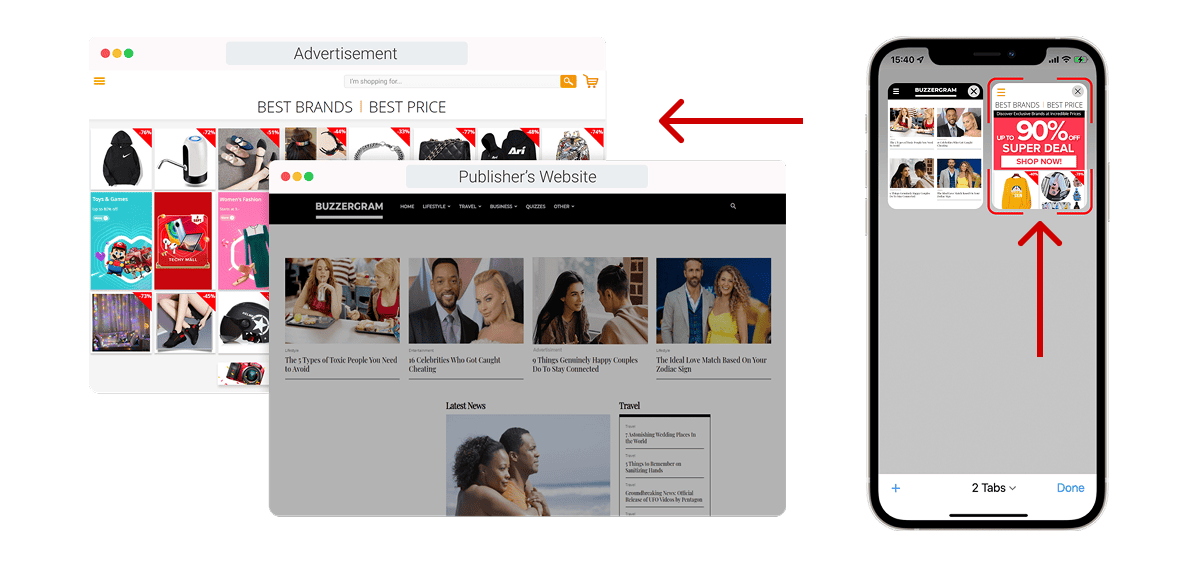
Popunder monetization is a digital advertising model in which a new browser tab or window opens behind the user’s active tab, and the publisher earns from ad impressions (CPM).
Popunder, in its turn, is an advertising page that opens as a new browser window, a new page, or tab at a more convenient moment. Popunders do not take up space on the actual webpage, which helps maintain a clean site design and positive user experience.
Ads don’t require an ad space but a simple JavaScript snippet to be placed in the <head> section of your website’s HTML.
Why do many publishers choose Popunder ads?
Popunder ads appear behind the main browser window, allowing users to continue browsing without interruption. Popunders are effective for overcoming ad blindness by appearing in less expected locations compared to banners. They also serve a better user experience, as they can be closed immediately. What else?
- Low bounce rates when an ad network optimizes offers carefully.
- Competitive rates: Popunder monetization is the most profitable in terms of CPM.
- Steady demand: Popunder ads are preferred by advertisers because they deliver conversions across various niches.
- Pops are driving conversions along with views: if your advertising network pays for conversions (CPA), you generate more revenue.
- You can monetize social traffic by placing Pop or Smartlink code on a landing page.
- Popunder ads work in any browser and on any operating system, allowing you to target audiences of any Tier.
- Significant results: Popunder ads can drive higher conversion rates compared to traditional display ads, staying non-intrusive but assertive.
Popunders are less effective on mobile devices because users may not notice a new tab opening in the background. But this drawback is compensated for by the specifics of current browsers, which reveal all hidden tabs.
Profitable Popunder monetization examples
Making money demands real figures. Popunders remain one of the most lucrative ways of website monetization. Publishers earn money basically from ad views and conversions (CPM/CPA).
Tier-3 Popunder traffic monetization
Popunder ad earnings vary significantly by traffic geography. Traffic from Tier-1 countries usually yields higher CPMs than from Tier-3 countries, though high volume in lower-tier regions can still be very profitable. For example, a website posting seasonal Ramadan content achieved an average CPM of $5.35 for pop ads and single-day revenue of $1,627.
Niche websites can also profit from Pop placements, attracting global traffic, like this food blog from Vietnam with a blended CPM of $2.8 and $15K monthly revenue.
Ad revenue from pop traffic in Tier 1-2
Popunder ads achieve higher click-through rates (CTR) than traditional banner ads, making them a valuable ad format for publishers. But it all depends on traffic quality and the cost of each user. Typically, advertisers pay more for users in the US, UK, Canada, or mixed traffic like we witness in this Japanese nightlife website case study. Things have changed in the past 5 years. Today, getting an $8.7 CPM for Kenyan users is as usual as getting $8 for the UK, as this Quora traffic monetization case study proves.
What are the types of Popunder ads?
A Popunder (also: pop-under, click-under) is an advertising page that appears when a user clicks or hovers over something on a publisher’s site. The first type is a trigger-on-click (or tap) Popunder; the latter is triggered by a mouse hover. A delayed Popunder appears after users spend some time on a page, minimizing false clicks and user churns. Popup ads work on the same principle, but they overlay the current page that website visitors are viewing.
What impacts your Popunder monetization?
- Traffic quality, including the share of new versus returning users, significantly impacts popunder ad earnings. Advertisers are interested in higher numbers of new target audiences.
- Mobile traffic is getting increasingly valuable for Popunder monetization, with higher engagement and conversion rates compared to desktop traffic.
- Traffic volume is still in top-3 factors affecting your profitability, but if you send bot traffic, this will result in revenue drops and account bans.
- Geo: Advertisers are willing to pay more for Popunder ads in regions with high purchasing power, which often correlates with Tier-1 countries.
- Popunder ads are effective in impulse-driven niches such as Dating, iGaming, Apps, and E-commerce, which can vary by region.
- Social traffic: if you drive Facebook, TikTok, or YouTube audiences to a website, you can expect higher payouts.
- Ad frequency: if you can change how often a user can see an advertisement, your chances to enhancing income increase.
How to increase revenue by changing Popunder frequency?
Let’s say you’re sending 100,000 unique users and want to display Popunders not more than 1 time per 24 hours. We have 3 advertisers that want to get your traffic: their bids are $2, $1.5, and $1. Adsterra will connect you to the highest-paying one, and you will get $200 revenue with a CPM of $2.
Another example with a 3/24 frequency. This time, you will get paid by all three advertisers because each user is now able to see 3 Popunders within 24 hours. Your revenue will grow up to $360. However, your CPM will be lower, $1.63. Therefore, the CPM rate is not ultimately equal to the income.
Adsterra offers you a default setting of 4 Popunders in 2 hours with a 10-second delay between them. For the majority of websites, it is the ideally balanced frequency that doesn’t annoy users. You can control how often popunders appear by setting a frequency cap, such as limiting it to one Pop per user per 24 hours. How exactly? Ask our Support team in the live chat. We’re online 24/7 for you 🙂
Choosing an ad network for Popunder traffic monetization
First, focus on the important stuff: high fill rates, anti-malvertising system, and GEO coverage. This set will tell you if an ad network cares about your safety and if it has advertisers in your geo. The top players in this space include Adsterra, PopAds, and PopCash, offering high payouts and quality support. Also, look out for things like low payout thresholds and 24/7 support. Next, pay attention to the pop ads types and prefer those that open up “under” the browser window, not harming user experience. Frequency caps should be available to control how many Popunders a user sees per day to prevent user irritation.
If you are just starting out, test out a few different networks and see which one delivers the best results for your traffic. Check this market review of the Best Popunder Ad Networks.
Expert opinion: Are Popunders still fine for website traffic monetization?

Popunder ad format offers a non-intrusive approach with advantages both for advertisers and publishers.
First, Popunder ads are less disruptive. As they open in a new window, it allows users to complete their tasks, resulting in high engagement and leading to higher interaction rates.
Second, they tend to deliver higher conversion rates, as they pay more attention to the content, leading to increased chances of engagement. It produces better click-through rates (CTR) and conversions, as users are not immediately bombarded with advertising but rather see it at a more convenient moment.
Popunder ads maximize publishers’ earnings by non-intrusive monetization strategies that don’t compromise user retention. Also, Adsterra’s Popunder ads are compatible with a wide range of devices and platforms, and feature sophisticated anti-ad-blocking technology.
In summary, it strikes an effective balance between user experience, ad engagement, and revenue generation, making it a valuable tool for everyone.
How to monetize traffic with Popunders: setup and integration
To implement Popunder ads on your website, you need to request the code from an ad network and add it to your web page according to its instructions. Here are your step-by-step instructions.
Step 1. Request Adsterra Popunder code / script
You can apply for a Popunder code if you’re a registered publisher. So please sign up now and check your inbox because we will send you a verification email. You can check this guide to getting started with Adsterra for more details.
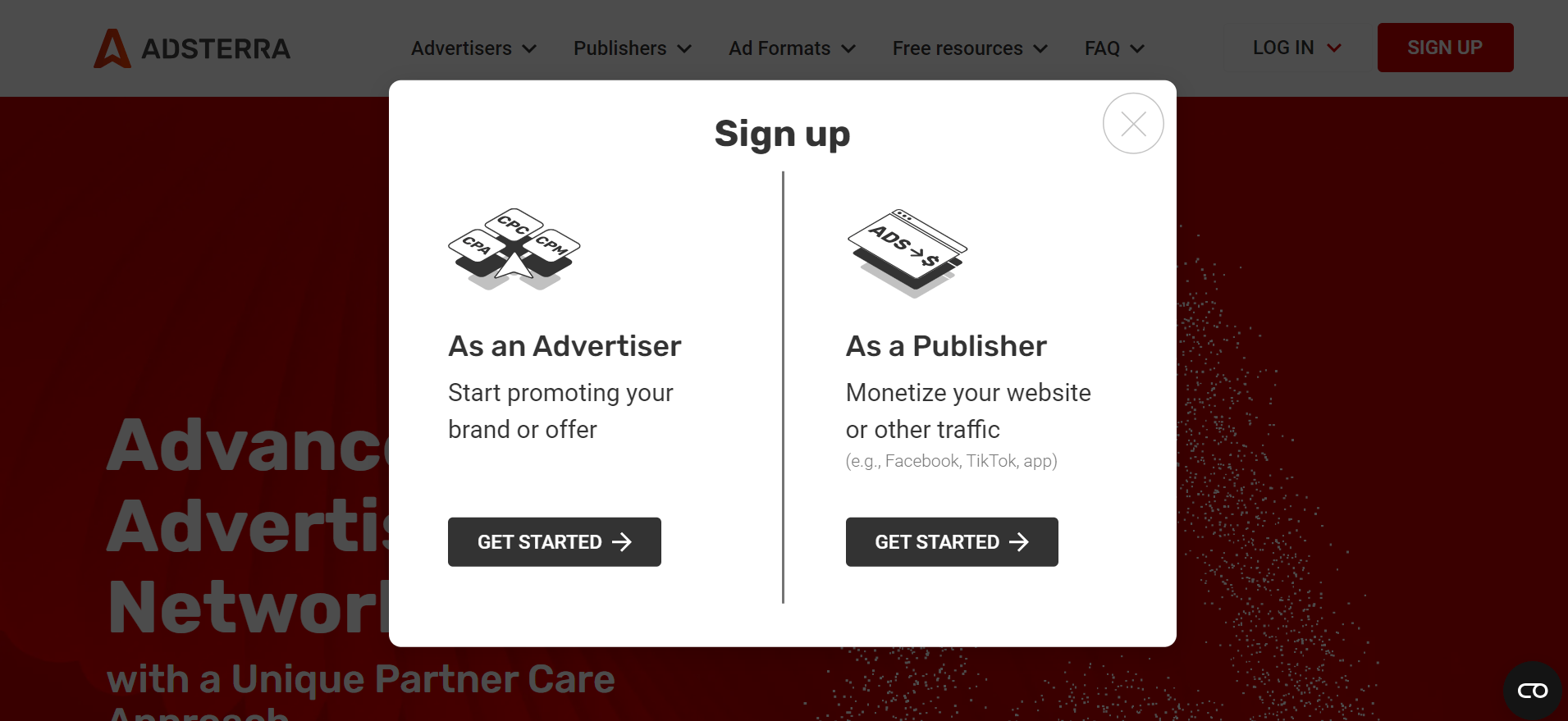
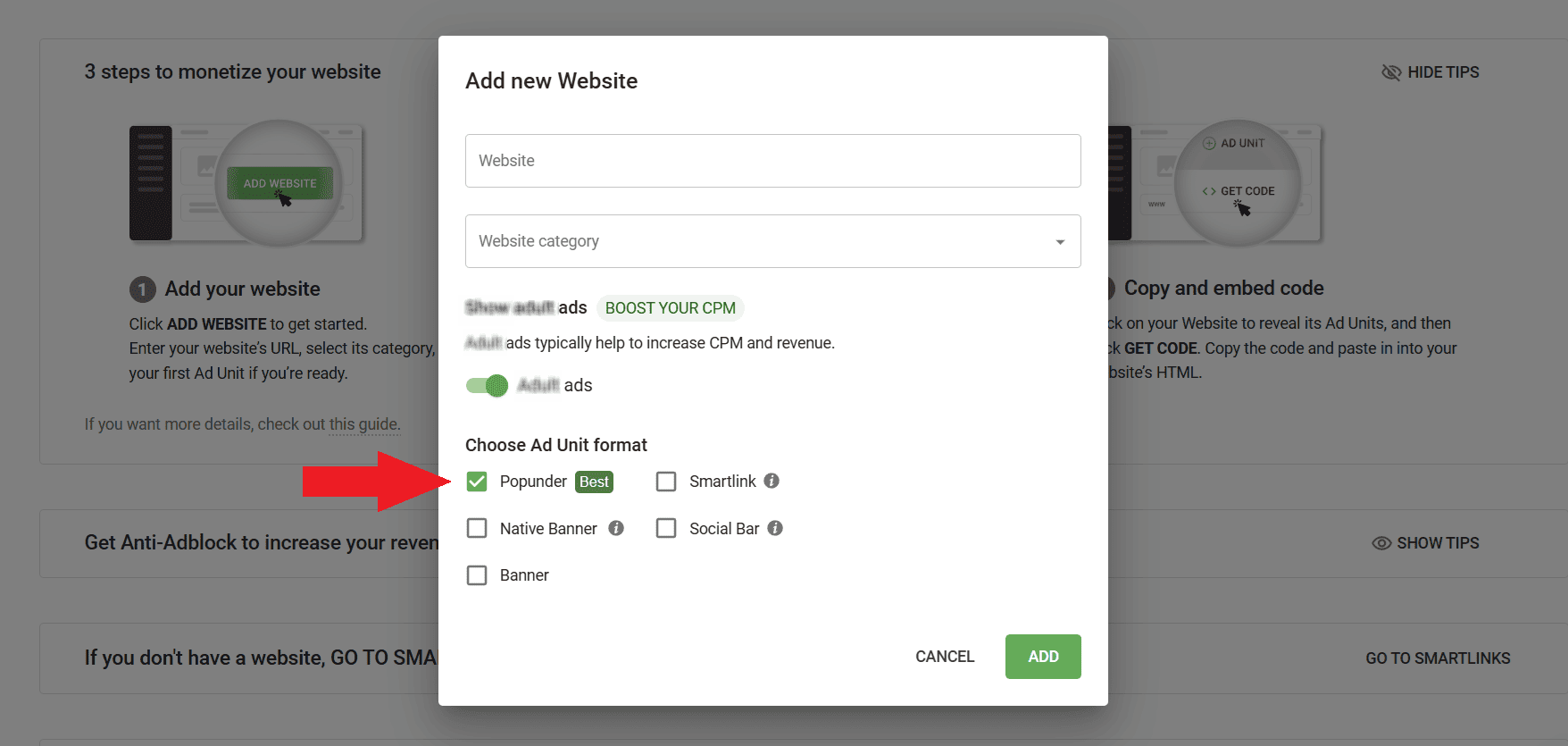
- From your account, click ADD WEBSITE.
- In a new window, fill out all necessary fields and select Popunder. We recommend allowing all ad types (turn the toggle ON).
- Click ADD.
- Now, we will need a couple of minutes to verify and approve your website. The next step is to get and copy your Popunder script.
Add your website or mobile app/APK today to start getting passive income!
Step 2. Get Adsterra Popunder ad code / script
- On your Websites page, you can check whether your website and Popunder code have been approved. If you see the status Approved, click All codes — Get code. And then copy the code.
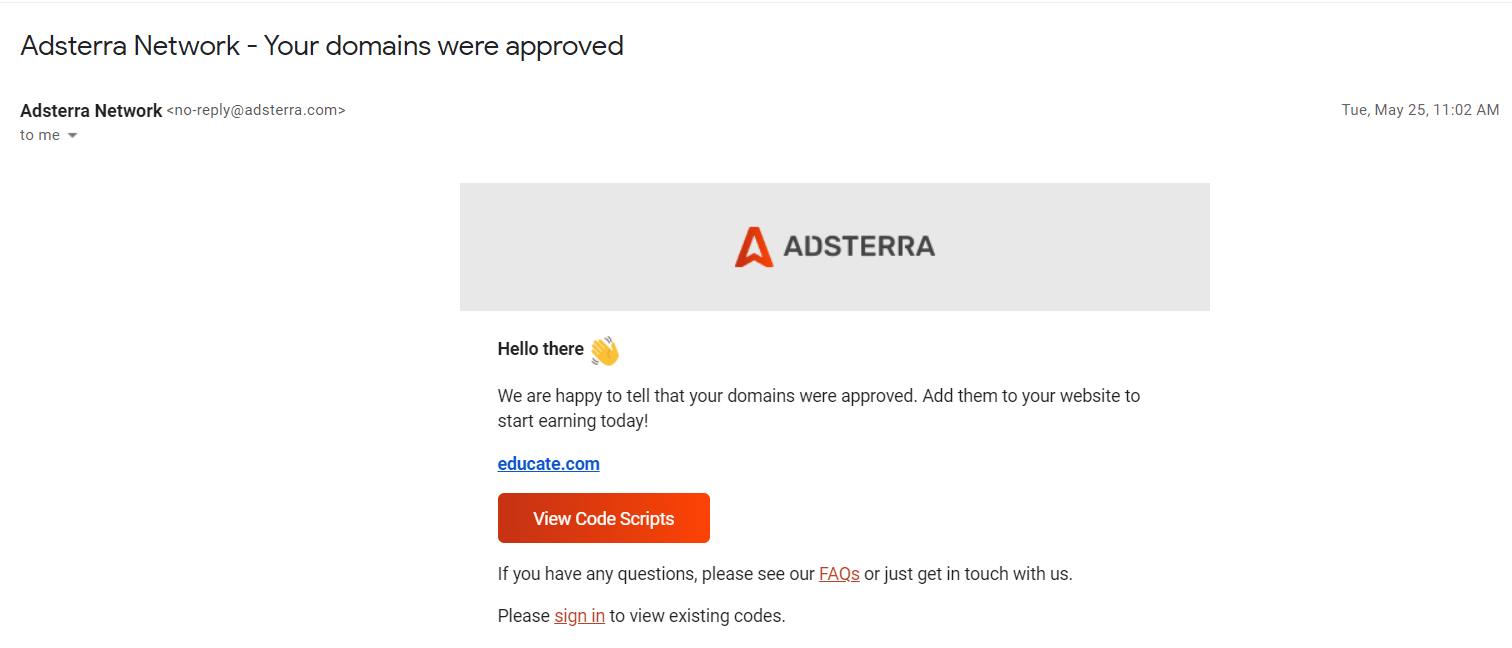
- There is one more way you can get the code. Check your inbox and find our email (subject: Adsterra Network — Your domains were approved). Follow the link to copy the script.
Step 3. Put Popunder on your website and get paid
Now you’ve got a Popunder script copied to the clipboard. It’s time to find out where to place it. There are too many website building platforms to describe the ad code installation on each of them. But usually, the flow is the same… and pretty easy-to-run.
Put a Popunder code on static HTML pages
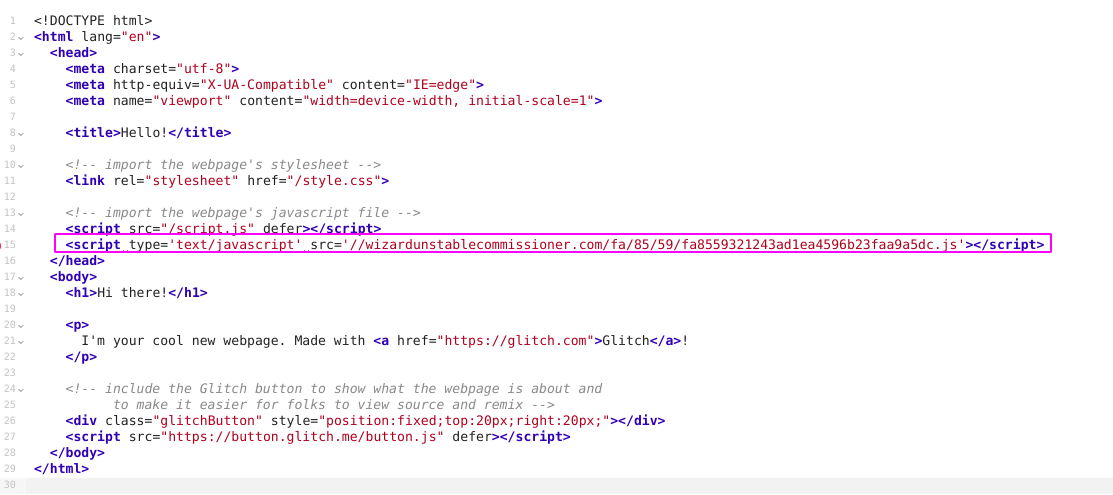
If you don’t have any CMS to edit the website source code, you will have to open the HTML view and paste the code before the closing “</head>” tag. Popunders are the only ads that must be placed between the two “<head>” tags.
Place a Popunder WordPress code with the Theme Editor
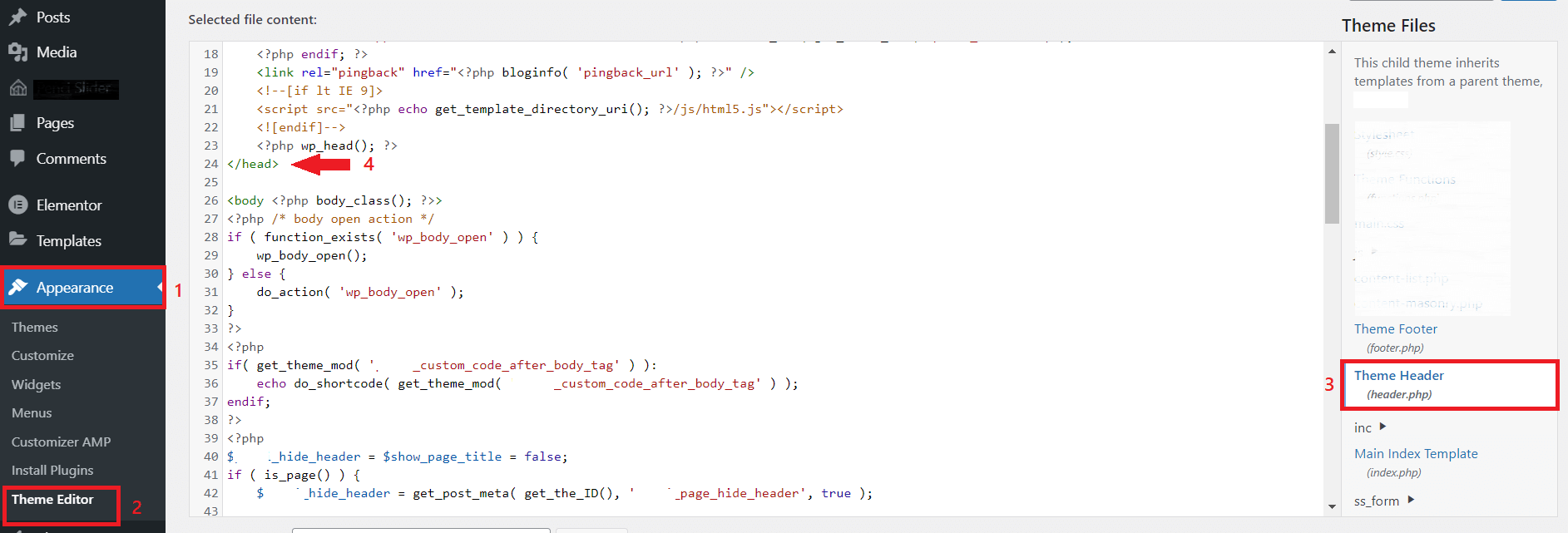
On a WordPress-based website, you will also need to place the code in the “<HEAD>” section. The easiest way to find it is to edit your WP theme. Let’s see how you can do it.
- From your Admin panel, click Appearance, and select Theme Editor.
- On the Theme Editor page, you need to find the Theme element to paste your Adsterra Popunder code. All elements are listed in the Theme Files field.
- To place a Popunder code, choose the element that contains the “<HEAD>” tag. Usually, it is the Theme Header file. Open it and paste the code snippet before the closing “</HEAD>” tag.
An alternative, safer way to open the header of the website is through theme customization. Check if this option is available. Click Appearance → Customize. In the list of theme elements, find one that contains the words “header.” There must be an option to add a custom code inside the “<HEAD>” tag. But we recommend you read your theme’s provider documentation first.
Add a Popunder WordPress code using a plugin
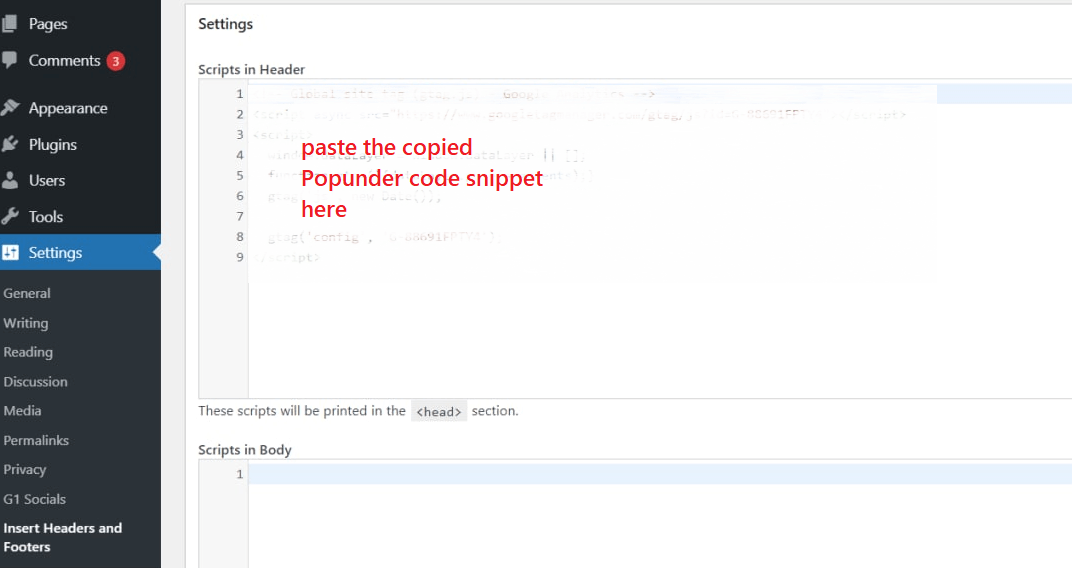
Sometimes, it is much easier to use a WP plugin to seamlessly add any code to the website’s header and footer. One of those is Headers and Footers.
To activate it, you need to navigate to the Plugins tab and click Add new. Type in the name of the plugin we recommend or find an alternative. Then, click Install now and Activate after the installation is finished.
The plugin will appear in your Settings tab. Click on it and choose your plugin to simply paste the Popunder code.
Add a Popunder script to Blogger
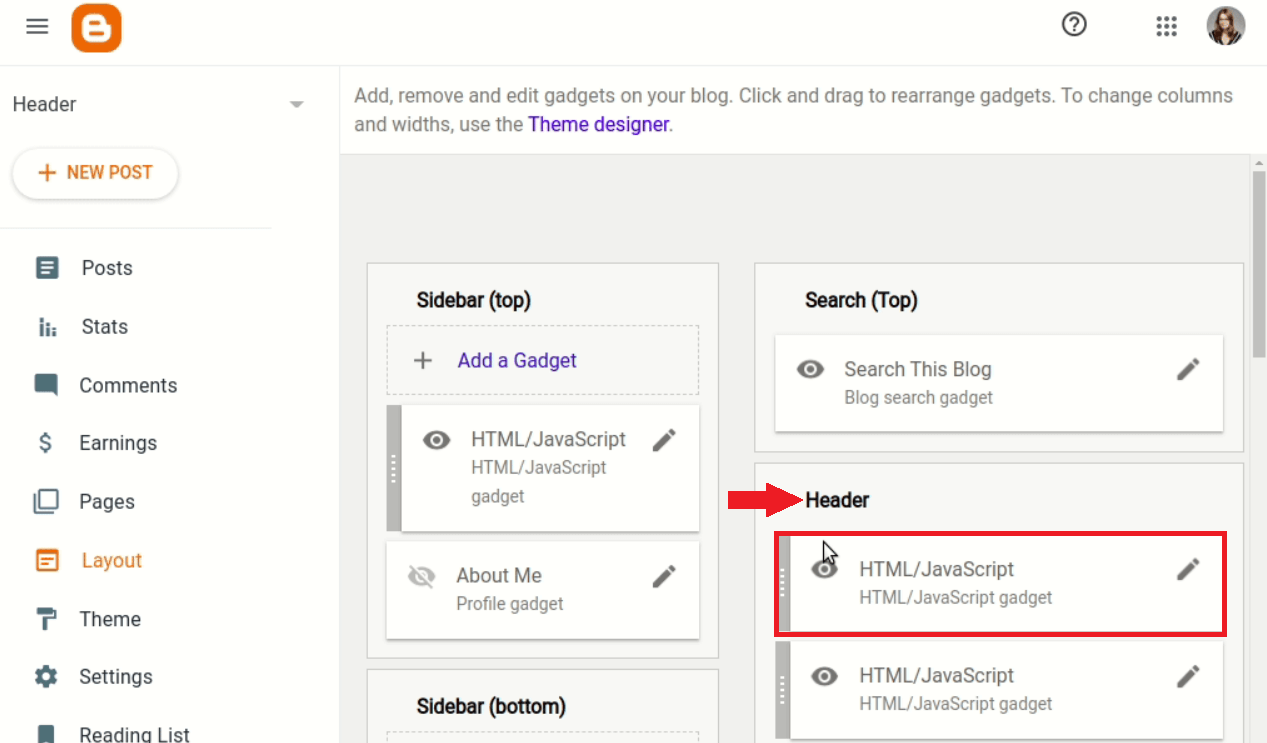
Blogspot or Blogger is a free platform for running blogs, and many publishers use it to monetize traffic. To put an Adsterra Popunder here, you will need to find the header part. It is better to use the visual editor tool.
- Navigate to Layout and click Add a gadget.
- Select HTML/JavaScript gadget from the list and the Edit icon.
- Paste the code snippet into the Content field and click Save. Make sure the gadget you chose is in the Header part. You can drag and drop gadgets between various parts of the layout.
Ending up this section, we would like to highlight that hundreds of insights and answers are waiting for you in the Adsterra Helpcenter. Here you will find the recommendations for choosing the suitable ad unit, or learn how to put ads with Elementor.
If you’re using CloudFlare, Adsterra Popunder ads may not work on Chrome and other browsers: we have a ready-to-use solution to that.
How to maximize your Popunder ad revenue
To maximize revenue from popunder ads, publishers monitor their analytics and adjust settings based on user engagement and performance. Let’s discuss the most actionable strategies.
Combine Popunders with other formats
Popunder ads can be combined with other ad formats to enhance overall revenue without overwhelming users. We recommend to pair them with Push Ads or Native Banners. Both of these combinations don’t affect the page load speed and look friendly to users. Push ads look like notifications and generate massive clicks. Native Banners don’t look like ad content but as a part of the original content helping improve user engagement.
Start monetizing mobile traffic effectively
Popunder ads are compatible with a wide range of devices, including desktops, tablets, and mobiles, making them versatile for publishers. Use statistics reports to find out which traffic dominates: device and OS filters.If you notice mobile traffic sending the highest CPM, try to boost it by adapting your site’s theme and layouts for mobile users, or by structuring the content for smaller screens.
Divide top-revenue and top-CPM traffic
Segment your traffic by the highest-earning countries (Revenue) and the most demanded (CPM). You sometimes notice that quality traffic from India, Bangladesh, Pakistan, or Nigeria is paid the same as Tier-1 ad views because of higher volumes. Also, you can see that when CPM is higher, your Revenue can be lower because of fewer people having viewed and converted. Balance these metrics, and your gains will grow.
Top website niches for profitable Popunder monetization
The most profitable niches for Popunder monetization are those connected with entertainment, video content, and news. As of our benchmarks (publishers’ sites added to Adsterra), we notice the top-10 winning niches:
- Movies
- News
- Streaming
- Online tools
- Music
- File converters
- Anime and games
- Downloads
- Books
Some website niches are sensitive to ads, and we recommend testing any advertising format before running it full blast. Those niches are yoga and wellness, religion, parenthood, and any paid content (available on subscription).
Getting started with Pop ads: Before you start earning money
- Verify site’s compliance with network policies
- Register as a publisher
- Add your traffic source to an ad network
- Generate a Popunder script
- Deploy the Popunder script to production
- Enable payouts and check withdrawal thresholds.