When launching paid campaigns, coming up with fresh creative ideas is often one of the most time consuming parts of the process. Building every concept from scratch takes time, while testing random hypotheses can quickly eat into the budget.
A more practical approach is to look at what other media buyers are running right now. Competitor research helps you follow market trends, see how advertisers present similar offers, and understand which ideas keep appearing across different campaigns.
The goal is not to copy competitors’ ads. Simply downloading competitor creatives from an ad spy and relaunching the same ad rarely makes sense. Every creative was built for a specific funnel, prelander, offer, payout structure, traffic source, and audience. Copying the visual alone does not recreate the conditions behind the original campaign.
Competitor research serves a different purpose. It helps you understand which topics and pain points advertisers are using, which ad formats appear in a particular GEO, and which offers are currently receiving paid traffic.
We thank our friends and colleagues from TYVER for creating this expert material for our readers. In this guide, they explain how to analyze competitor ads, what elements to look at, how to identify recurring patterns across multiple advertisers, and how to turn those observations into original ideas for your own campaigns. Enjoy!
Why Analyze Competitors’ Ads Instead of Copying Creatives?
Directly copying competitors’ ads and landing pages from ad intelligence tools rarely makes sense in the long run. Even if you recreate someone else’s funnel in detail, you still do not know the commercial conditions behind it.
The first issue is offer economics. The team whose ads you found may be working on individual terms, with a higher payout per lead, a private volume bump, or a direct agreement with the advertiser. A campaign that makes sense under those conditions may not work with the standard payout available through an affiliate network because the economics are different.
The second issue is creative fatigue. When several media buyers start running the same ad to the same audience, users see it more often and gradually stop responding to it. CTR can fall as the creative becomes more familiar.
There is also no way to understand why an ad produced a particular result if you simply copy every element. Was the main factor the ad copy, the image, the headline, or the opening frames of the video? Without separating those variables, it is difficult to run a useful split test, eliminate weaker elements, and improve the funnel.
This is why media buyers use ad spies and other ad intelligence tools for market research rather than direct copying. Competitors’ ads can show which offers are receiving attention in a selected GEO, which formats other teams are using, such as UGC videos, unboxings, static banners, or teasers, and which audience pain points they put front and center.
Those findings can then become input for your own campaigns. You can take an angle you noticed and rebuild it around your own setup: use a different visual, write new ad copy, test alternative headlines or opening scenes, and adapt the funnel to your own offer terms.
What to Look for in Competitors’ Ads
To understand the logic behind a creative, break it down into separate elements, from the first seconds of exposure to the CTA. The goal is to analyze ads as a set of individual components rather than treat the whole creative as one finished idea.
The first 2 to 3 seconds or the headline
In video ads, the opening is particularly important. If the first frames do not catch attention, the user may simply keep scrolling. Look at how the hook is presented. It may be text at the top of the screen, a sudden action, a direct question, or a close view of the problem. In static ads and competitor display ads, the headline and main image perform a similar role.
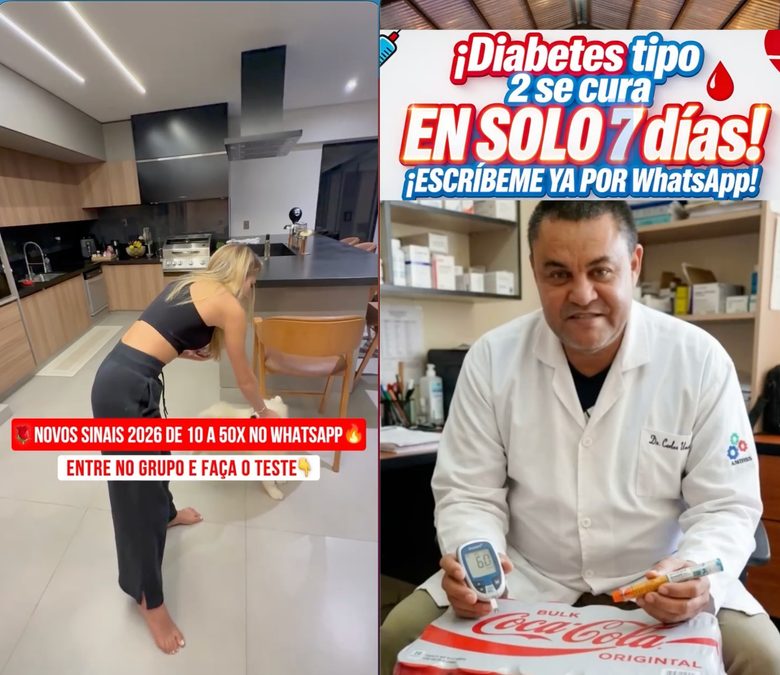
Creative format
The ad format shows how the advertiser presents the offer. Common examples include UGC videos, unboxings, interface screencasts, static banners with product imagery and text, and short teaser creatives.
Core message
Look for the main idea behind the ad copy and voiceover. In ecommerce, for example, the message often focuses on a specific everyday problem, savings, or a discount. In iGaming, competitors’ ads may focus on a first deposit bonus, free spins, emotions around a slot win, or analysis before a match.
CTA and button
The call to action indicates the next step in the funnel. Buttons such as “Buy” or “Order” usually lead directly to landing pages with an order form. Softer options such as “Learn More” or “Continue” are often used when traffic first goes through a prelander, quiz, or article.
How long the ad has been active
The date range helps you understand how long a campaign has been running and how long ads run before they are stopped. Active ads that appeared for only one or two days are generally less useful for research because the advertiser stopped them shortly after launch. Creatives that stay active for one or two weeks deserve more attention.
A longer run does not prove that an ad is profitable. It simply makes the approach more interesting as a reference for further analysis.
When several ad variations exist, compare them carefully. Multiple versions of the same ad can show which elements the advertiser is changing, but they do not reveal which version performed best unless actual performance data is available.
How to Find Competitor Ads and Analyze Multiple Ads from the Same Advertiser
The exact workflow varies from tool to tool, but in most ad intelligence platforms research starts with keywords. These may include offer names, specific health problems, everyday situations, CTA phrases, or wording used in ad copy.
Broad searches often produce a lot of irrelevant results. To find competitors’ ads that are actually related to the campaign you are researching, narrow the search by domain or Fan Page whenever the tool allows it.
Search by Page and Domain
Once you find a relevant ad in an ad spy, copy the landing page URL or the name of the Fan Page running it.
Depending on the tool, you can continue with the competitor’s brand, Fan Page, or domain. Searching for the competitor’s domain or page can reveal other creatives connected to the same advertiser and makes it easier to see how many ads are running around the same campaign.
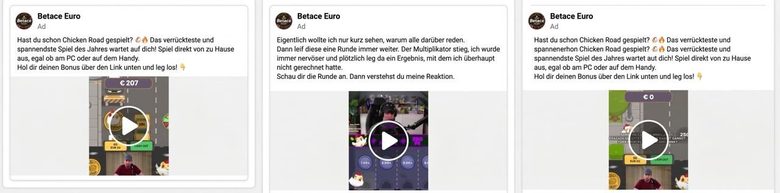
Instead of judging one isolated creative, compare several versions from the same advertiser. If you see many near identical versions, the advertiser may be pushing the same approach into different ad sets.
That alone does not prove profitability, but it gives you more context than a single ad and helps you see how the campaign is structured.
Follow the User Journey
After finding the advertiser’s ads, open the destination and go through the entire funnel.
Check where the user lands after the click. It may be a direct landing page with an order form, a news style prelander built around a story, a quiz, or another intermediate page.
This helps you understand how the advertiser moves the audience from the initial ad toward the target action, such as a lead, purchase, or deposit.
Analyze Split Tests
Looking at several creatives from one advertiser can also reveal what they are testing.
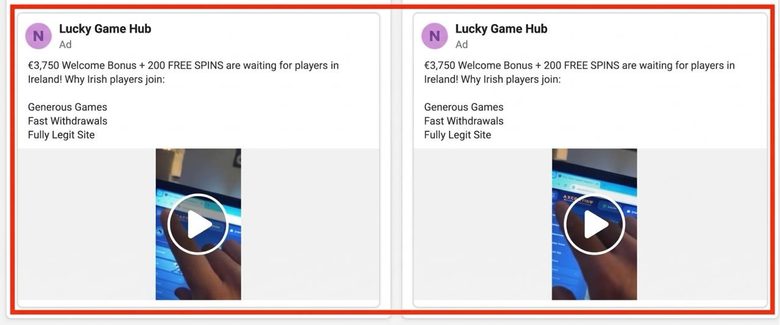
Pay attention to the individual elements being changed. The advertiser may test:
- Different opening scenes in the first 2 to 3 seconds of video ads;
- Alternative text overlays;
- New headlines on static banners;
- Different CTAs;
- Different background images.
Comparing these multiple variants helps you understand which parts of the creative the advertiser is trying to improve.
It does not tell you which version performed best unless you have access to performance data, but it does show the structure of the test itself.
How to Find Recurring Patterns Instead of Copying Individual Creatives
When researching competitors’ ads, it is more useful to look at the wider picture in the auction than to focus on one isolated example.
The goal is to identify patterns that appear across multiple competitors in the same GEO.
Build and Sort a Creative Sample
Start by collecting around 20 to 30 ads for the selected offer or vertical. Instead of trying to recreate individual banners or videos, group them by the type of angle they use:
- In iGaming: recurring approaches may include local trust triggers, such as payout notifications designed around familiar banking apps like Kaspi, Revolut, or Pix. Other examples include news style content with clips from local TV and recognizable public figures, streamer reactions to wins, or demonstrations of crash games such as Aviator and Plinko.

- In nutra: non-mainstream verticals such as hypertension or male performance offers often use visual associations. Examples include rusty pipes as a metaphor for blood vessels, wilted plants or hoses, simple home remedy narratives based on baking soda, garlic, or herbs, and clips featuring recognizable local doctors or medical TV hosts.
- In digital currency: advertisers may use news stories involving scandals around local politicians or billionaires, TradingView charts, wallet balance screenshots, or funnels that move users into Telegram channels with trading signals.
Sorting competitor creatives this way makes it easier to see which themes and triggers media buyers are using to present the same type of offer.
Look for Overlap Across Different Advertisers
The main goal of competitive analysis is to identify common elements across campaigns from different advertisers.
If a creative appears on only one Fan Page, it may simply be one of several experimental ads. If three or four different advertisers in the same country use similar approaches, comparable wording, or similar hooks in the opening seconds of their videos, that pattern is worth noting.
This still does not prove that the approach is profitable or guarantee that it will work in your own campaign. It simply gives you a stronger basis for forming a test hypothesis than one isolated ad would.
Looking at multiple competitors also helps separate a recurring market pattern from a single advertiser’s test. That distinction matters in competitive intelligence research because competitor data without context can be easy to overinterpret.
Record the Approach, Not the Original Asset
Before preparing your own creatives, save useful observations in a spreadsheet, notes, or a swipe file.
The goal is not to save someone else’s source material for reuse. Record the structure instead:
- The hook used in the first 2 to 3 seconds or in the text overlay, for example “Claimed a 500 FS bonus” in iGaming;
- The main problem or proposition used to lead the user toward the offer;
- The CTA and next step in the funnel, whether it is a direct action such as “Claim Bonus” or “Order with Discount,” or an intermediate step such as “Join the Channel.”
A simple swipe file gives you a clear list of approaches that can later be turned into original ad creatives, new video cuts, or briefs for a designer.
How to Turn Competitor Research into Your Own Creative Ideas
Uploading someone else’s ad from an ad spy without changing it is one of the easiest ways to waste a test budget.
Competitor creatives should be used as references only. Take the angle you found and rebuild it completely around your own campaign.
Rebuild the Hook and Visual Sequence
If iGaming ads in your GEO frequently use streamer reactions to big wins, do not reuse the same footage.
Find fresh clips featuring streamers who are popular in that specific market, add your own text, and create an animated push notification styled after one of the major local banks.
For a news style angle, you can work with the same type of recognizable public figures, but rewrite the script from scratch and create a new voiceover with AI tools.
The same principle applies to nutra. Look for different clips from local TV programs or recent interviews with relevant doctors instead of reusing footage from competitors’ ads.
If the angle relies on a visual analogy, such as hypertension or joint problems, use a clear everyday comparison of your own. For example, you might show buildup being cleaned from a rusty water pipe or a squeaky door hinge being lubricated.
The idea is to keep the underlying approach while rebuilding the actual creative from scratch.
Rewrite the Copy Around Specific Pain Points
Text overlays and descriptions should also be written from scratch!
Instead of broad promises, focus on a specific everyday problem or a clear action:
- For hypertension offers, focus on recognizable symptoms: “Does your vision go dark when you stand up quickly?” or “Do you notice ringing in your ears in the morning?”
- For digital currency, instead of generic promises of easy money, focus on a clear action: “Guide: How to launch the bot and receive the first signal in five minutes.”
These are examples of how the message can be structured. They are not claims that any specific wording will produce a particular result.
Prepare a Batch for Split Testing
For every angle you find, prepare three to five creative variations.
To understand which change affects the campaign metrics, change only one element at a time.
- For video ads, keep the main part of the video unchanged but test three different hooks in the first two seconds or three different versions of the opening text overlay.
- For static ads, keep the same headline but test three different background images or product angles.
If you change the headline, footage, and audio track at the same time, you will not be able to tell which change affected CPC or conversion rate.
Keep the Creative and Landing Page Consistent
The message from the ad should continue directly on the first screen of the prelander.
If the creative focuses on a specific deposit bonus, a quote from a particular doctor, or a story about getting out of debt, the user should see the same message and supporting visuals immediately after clicking.
A major disconnect between the ad and the landing page can increase bounce rates and waste paid clicks.
How to Adapt an Angle to Different Ad Formats
An idea found in an ad spy does not have to remain in the original traffic source.
For example, an angle first seen in Facebook Ads can be adapted to an ad network such as Adsterra. Depending on the source and GEO, ad networks may offer different traffic costs and moderation requirements from large social platforms.
The important part is to separate the underlying idea from its original execution and rebuild it around the mechanics of the new ad format.
Push and In Page Push
Push formats do not provide enough space for a long story or a full video, so the message needs to be reduced to an icon and two short lines of copy.
- Icon. Use recognizable visual triggers such as system notification symbols, messenger logos, or an incoming notification styled after a local bank.
- Headline and text. Keep the main idea short.
For iGaming, the copy may focus on a specific bonus: “150 FS added to your account. Activate today.”
Social Bar
Social Bar is Adsterra’s interactive format that displays widgets over publisher content. Namely, it can look like In-Page Push, Interstitials, custom widgets, or even chat bubbles.
Unlike classic browser push notifications, Social Bar works across operating systems, including iOS, without requiring the user to subscribe to browser notifications.
Its dynamic elements also allow ideas from social media to be adapted into interactive formats.
- In iGaming, a static concept can become a small interactive mechanic, such as a wheel, a choice between three bonus boxes, or an animation showing funds being added to the balance.
- In nutra, the format can be used for a simulated dialog asking about symptoms or an incoming message from a specialist.
- In digital currencies, it can show animated trading signals or performance charts.
Native Ads
Native ads appear inside content on publisher sites, so the creative should fit the environment rather than look like a conventional advertising banner.
- Image. Instead of polished promotional artwork, use more natural images built around curiosity. These may be everyday objects or visual processes. For digital currency and iGaming, they may include amateur style photos, screenshots of receipts, or emotional reaction shots.
- Headline. The copy can be structured like a news story or a personal experience rather than a direct sales message.
For example:
- “Doctor Shares a Simple Approach to Blood Pressure…”
- “Local Resident Finds a Way to Deal With Debt…”
The exact wording still needs to comply with the rules of the traffic source and the offer being promoted.
Popunder (OnClick)
With Popunder traffic, the user goes directly to the landing page after clicking on a publisher site.
There is no intermediate banner, so the first screen of the landing page carries most of the responsibility for keeping the user’s attention.
- If the original Facebook angle is built around a celebrity news story, the prelander should immediately show a prominent regional media style headline, a photo of the person featured in the story, and the current date.
- If the funnel uses a quiz, the first question should be visible immediately without requiring the user to scroll.
Why Adapted Approaches Can Be Easier to Test in Adsterra
Moving an idea from social media to an ad network changes the technical setup of the campaign and can remove some of the infrastructure normally required for certain social traffic sources.
No Farming or Extra Account Infrastructure
With Adsterra, campaigns are launched from one advertiser account.
Media buyers do not need to buy antidetect browsers, warm up King accounts, maintain batches of proxies, or build complex cloaking setups just to keep multiple advertising accounts running.
This also removes the risk of losing an entire group of social ad accounts because of an account freeze or a platform algorithm update.
Fast Moderation
On Facebook, a campaign may be sent for manual review or rejected because of policy issues.
Adsterra’s ad moderation takes up to around one hour on average. Usually, it takes even less so your campaign has high chances to be launched in undr 10 minutes.
This makes it possible to submit a batch of hypotheses and make changes to launched creatives without waiting through the account review process typical of some social platforms.
Direct Publisher Traffic and AdBlock Technology
The network works with more than 36,000 direct publishers across over 240 GEOs.
Adsterra also uses its own technology for serving formats such as Popunder and Social Bar when ad blocking software is enabled.
Accessible Testing Threshold
The minimum deposit is $100.
Campaigns can use CPM, CPC, or CPA pricing models depending on the available format and campaign setup, which gives advertisers more flexibility when choosing how to buy traffic for a test.
These characteristics do not mean that an adapted angle will automatically perform better. They simply provide another environment in which media buyers can test their own versions of ideas found during competitor research.
Tools for Finding and Analyzing Competitor Ads
Affiliate marketers generally use three types of sources for competitor research: public ad libraries, dedicated ad intelligence tools, and the internal analytics available inside ad networks.
Public ad libraries are useful for reviewing current paid ads and basic market research. More advanced intelligence tools become useful when you need archived creatives, technical filters, deeper competitor data, or a broader view of ads across several campaigns.
Public ad libraries and specialist competitor ad libraries serve different research needs, so there is no reason to treat one as a complete replacement for the other.
Meta Ad Library and Google Ads Transparency Center
Meta Ad Library and Google Ads Transparency Center are official public ad libraries that provide access to advertising running across their respective platforms.
Both offer free access without a subscription. You can search ads by Fan Page name or keywords, review the creative and ad copy, and see when a campaign started running.
For ads targeting users in the European Union, both platforms may also show additional transparency information required under the DSA, including approximate impression ranges and basic demographic data such as age, gender, and regional distribution.
These free libraries are useful for basic competitor research before you move on to specialist tools. The Meta Ad Library is useful when you want to view competitor ads on Meta platforms, see competitors’ Facebook ads, or compare ads on Facebook and Instagram.
There are limitations.
Outside the EU, the same detailed reach information is generally not available. Inactive ads and creatives removed after moderation may also disappear from public results, which means ads blocked shortly after launch can be difficult or impossible to find later.
Search options are also more limited than in specialist ad intelligence tools. You cannot filter ads by tracker macros, URL parameters, or server IP addresses.
Downloading video ads and images may also require manual work through the page source or browser extensions.
Google Ads Transparency Center is another official source for advertiser research.
It can be used to review Google Ads associated with a particular advertiser and compare the creatives currently available through the Transparency Center.
For basic competitive intelligence, this is usually enough to understand what type of Google Ads an advertiser is running and how its messaging changes across creatives.
For deeper Google Search research, including paid keywords or Google Search Ads, separate search intelligence tools may be needed. The Transparency Center is useful for creative research, but it does not replace tools designed specifically for search ads and keyword analysis.
Additional Platform Libraries
If a competitor is active outside Meta and Google, other platform libraries can provide extra context.
For TikTok, the TikTok Ads Library provides public campaign information that can be useful when the platform is relevant to the advertiser you are researching. The TikTok Commercial Content Library offers another source of public commercial content, while Creative Center can help with broader creative trends.
For LinkedIn Ads, LinkedIn Ad Library provides a similar way to review sponsored content and advertiser activity in B2B markets.
These sources are supplementary. There is no reason to check every platform for every advertiser. Use them only when the competitor actually has relevant activity on those channels.
Dedicated Ad Intelligence Tools: Tyver
Unlike basic public ad libraries, dedicated competitor ad intelligence tools are built for deeper creative research and the specifics of affiliate marketing.
Tyver adds more than 4 million new ads to its database per day across 140 GEOs, with results updated every few hours.
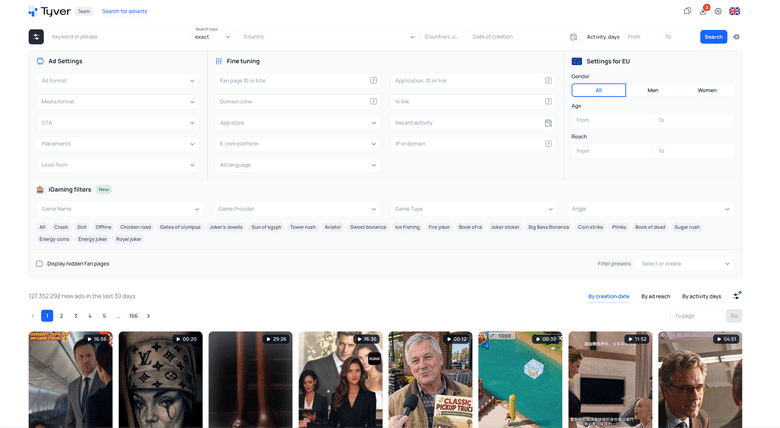
Archived creatives
The service keeps ads in its database even if Facebook moderation removes them only a few hours after launch. This allows media buyers to monitor competitor ads after they disappear from public sources and see fresh competitor creatives that may no longer be available in Meta Ad Library.
This is particularly useful for tracking ads that were active only briefly before disappearing from public results.
The fact that an ad was archived does not indicate that it was profitable. It simply gives researchers access to a broader sample of ad activity.
iGaming section
Popular slots and crash games such as Aviator, Plinko, and Gates of Olympus are organized into separate categories. Instead of manually collecting keywords for every game in multiple languages, you can select the game and target GEO to get a more relevant affiliate sample.
URL and IP filters
To reduce irrelevant ecommerce results, users can search URLs for affiliate related elements such as pixel or technical tracker tags.
Tyver also supports search by server IP address. If a team launches different campaigns from several accounts but hosts them on the same infrastructure, the tool can help surface ads connected to that setup.
Apps and PWAs
Filters for Google Play and the App Store can be used to find creatives leading to specific apps.
For PWA campaigns, results can also be narrowed using CTA buttons such as Download or Play Game and URL fragments such as fbclid.
Demographics and creative data
For some Tier 1 and Tier 2 countries, ad cards include audience distribution by age and gender. This helps compare the targeting settings competitors are using in different markets.
Creatives can also be downloaded directly from the platform or processed through the built in uniquifier.
Compared with basic ad libraries, a dedicated competitive intelligence platform gives you more ways to track competitor ads, organize competitor data, research competitor display ads, and compare creatives from different campaigns. It also makes it easier to view competitor display ads across different GEOs without researching advertisers one by one.
The purpose is still research. The presence of an ad in the database does not prove that the campaign is profitable or that the same approach will work under different conditions.
Ad Network Analytics: Adsterra Traffic Chart
After finding an idea and preparing your own creative version, the next step is to check whether the chosen traffic source has enough inventory for the planned test.
Adsterra’s Traffic Chart shows daily impression and click volumes by GEO, operating system, and format, including Popunder, Social Bar, In-Page Push, and Native.
This allows you to estimate the available paid traffic for an offer before funding the account. The tool also shows recommended and average CPM or CPC bids for the selected targeting. These figures can be used as a reference when setting an initial bid and estimating ad spend for the test.
Traffic volume and bid data do not indicate that a particular creative will work. They simply help media buyers understand the available inventory and plan the technical side of the campaign.
Conclusion
Directly copying competitors’ ads from an ad spy is one of the fastest ways to waste a test budget.
A creative that has been running for a long time may already be familiar to part of the audience in the target GEO, which can contribute to creative fatigue and lower CTR. The original advertiser may also be working with a higher affiliate payout that makes the campaign economics very different from yours.
The real value of competitor research lies in identifying patterns across the market rather than copying individual assets.
If three or four advertisers in the same GEO use similar hooks, formats, or messaging, that gives you something worth investigating. It does not guarantee the same result in your own campaign, but it can provide a more informed starting point than a completely random idea.
Take the pattern apart and rebuild it around your own campaign. Find different video footage, write original ad copy around the audience’s pain points, or adapt the concept to other formats such as Push, Social Bar, or Native.
The goal is to build your own ads based on patterns you find in the market, not to copy competitors. Competitor research should help you turn real advertising activity into better informed hypotheses for testing rather than rely on random assumptions.
FAQ
How Can You Find Competitor Ads for Free?
The easiest place to start is with public ad libraries. Meta Ad Library and Google Ads Transparency Center both offer free access and allow you to search by advertiser, page, or keyword.
They are useful for checking current creatives, ad copy, launch dates, and general ad activity before moving on to paid intelligence tools.
Does a Long Running Ad Mean the Campaign Is Profitable?
No. A longer run can make an ad more interesting for research, but it does not give you access to the advertiser’s costs, payouts, conversion rate, or profit.
Treat the duration as one signal among many, not as proof that the campaign works.
How Can You Find More Ads from the Same Advertiser?
Once you find one relevant creative, search by the advertiser’s Fan Page, landing page domain, or other available identifiers.
This can help you find multiple versions of the campaign and compare how the advertiser changes hooks, headlines, visuals, CTAs, and landing pages.
What Is the Difference Between Public Ad Libraries and Ad Intelligence Tools?
Public ad libraries are usually free and provide direct access to advertising data from the platform itself.
Dedicated ad intelligence tools are designed for deeper competitive analysis. Depending on the service, they may provide archived creatives, more advanced filtering, technical search options, and additional competitor data that is not available in free libraries.
What Should You Compare When Looking at Several Versions of the Same Creative?
Focus on the variables that actually change.
For video ads, this may be the opening hook, text overlay, or first few seconds. For static creatives, compare headlines, backgrounds, product angles, and CTAs.
Changing or comparing one variable at a time makes the structure of the advertiser’s test easier to understand.
How Should You Use Recurring Competitor Angles Without Copying Them?
Save the structure, not the asset itself.
If the same type of hook or message appears across multiple competitors, record the underlying idea in a swipe file and rebuild it with your own footage, script, copy, design, and landing page.
The recurring pattern can give you a direction for testing, but it does not guarantee the same result in your campaign.
Can an Angle from Facebook Ads Be Adapted to Other Traffic Sources?
Yes, but the execution needs to change with the format.
A video angle from Facebook Ads may need to be reduced to a short headline and icon for Push, rebuilt as an interactive concept for Social Bar, or moved almost entirely onto the first screen of a landing page for Popunder traffic.
The idea can stay similar while the creative mechanics change.
When Is It Worth Using a Dedicated Ad Spy Instead of a Free Library?
A dedicated ad spy becomes more useful when basic platform search is no longer enough.
For example, you may need archived ads, URL or IP filters, app and PWA research, broader competitor data, or a way to track competitor ads after they disappear from public results.
At that point, specialist intelligence tools can save a lot of manual research time.