Looking into the growth of the digital advertising market in Indonesia, which is expected to expand even more by 2029, we put together the Indonesia Digital Advertising Guide for advertisers. It’ll be useful for marketers and affiliates, seeking to effectively reach one of Southeast Asia’s largest and fastest-growing digital audiences.
With a mobile-first population and thriving commerce ecosystem, Indonesia has a rapidly progressing digital economy and offers significant opportunities for brands across industries. Indonesia no doubt deserves advertisers’ attention with:
- 280+ million population
- young, active demographics
- mobile-first internet usage
- expanding middle class
- growing e-commerce
- high social media engagement
We will cover everything you need to know about the digital advertising environment, consumer behavior, and tips on how to run advertising campaigns in Indonesia, when buying Indonesian web traffic.
If you are ready to start running advertising campaigns in Indonesia today, then start doing it with maximum precision with Adsterra ad network: 20+ targeting options, such as region-country-city-accurate geotargeting, device and browser targeting, OS and language targeting, etc. With the three-tier anti-fraud technology and transparent reports, it’s easy to make an efficient investment into advertising.
Understand Indonesian digital consumers
You might wonder what makes Indonesian consumers different. Well, success in this market requires more than simply streamlining existing campaigns strategies to the Indonesian audience. Advertisers need to understand local consumer behavior, cultural nuances, and preferences, as well as the country’s evolving regulatory landscape.
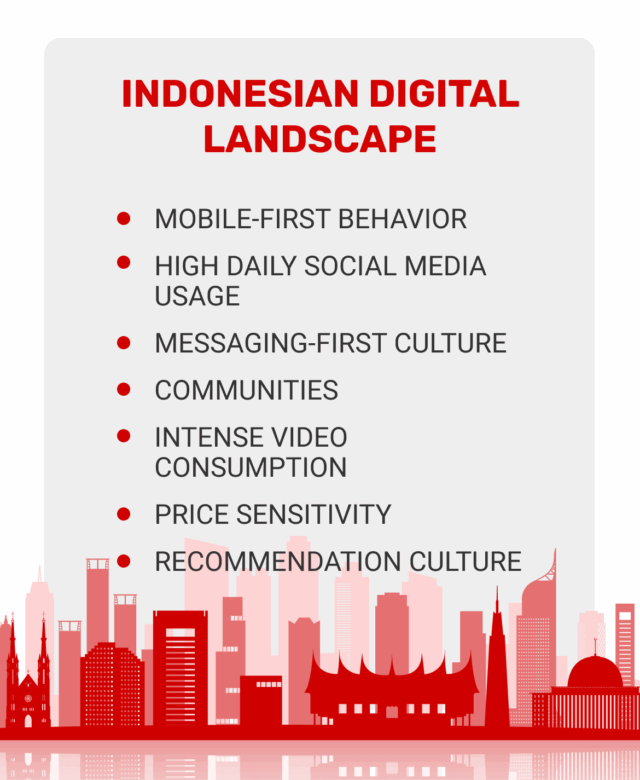
Indonesia hosts some of the world’s busiest internet users. For brands to connect with their audience in a meaningful way, they need to understand unique digital and purchasing behavior. From mobile-first browsing to community-driven decision-making, several characteristics set Indonesian audiences apart from those in many other markets.

Head of CPM at Adsterra
Expert tip
Indonesia isn’t a market where you can just copy and paste campaigns from other regions. The brands that really succeed are the ones that understand local traditions, lucky colors and numbers, and the everyday phrases that resonate naturally with the audience.
1. Mobile-first behavior
Smartphones are the primary way most Indonesians access the internet. Consumers use mobile devices to browse the web, purchase items, view videos, and make online purchases.
Tip: Given the importance of mobile experience, consider designing mobile-first campaigns, including responsive websites, fast-loading landing pages, and ads tailored to small screens. Choose creatives and texts that are well-suited on smaller screens. Native notification-like ads can come here naturally to the audience without disruption:
Social Bar ads
The intuitive and interactive Social Bar ads grasp attention, engage, and convert, but do not irritate the audience. You can test every skin of Social Bar and out of 20+ different creatives for your ad campaigns to prioritize the best performing ones for your product or offer.
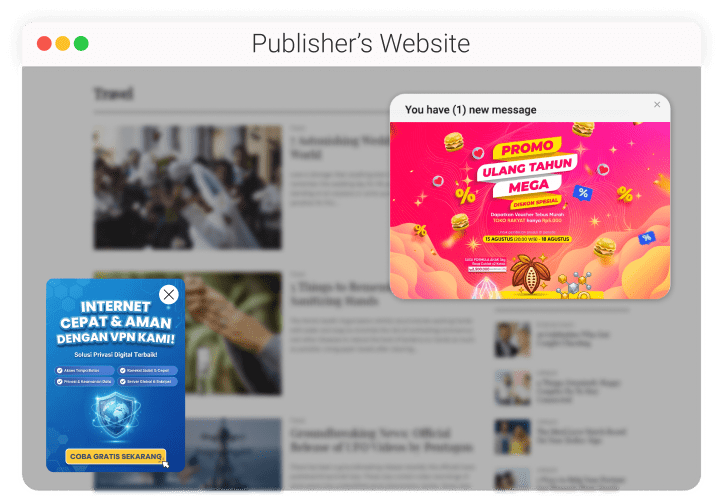
Interstitial ads
When you want to be more noticeable in your campaigns for the holiday period or special events, you can try Interstitial ads. They remind and draw attention in the way popup ads do, but have the subtlety of push notification ads, which is what you need to reach successfully your mobile users in Indonesia.
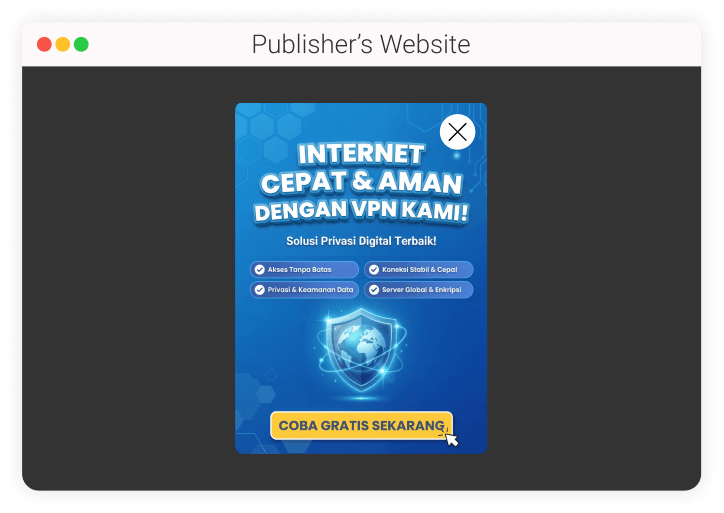
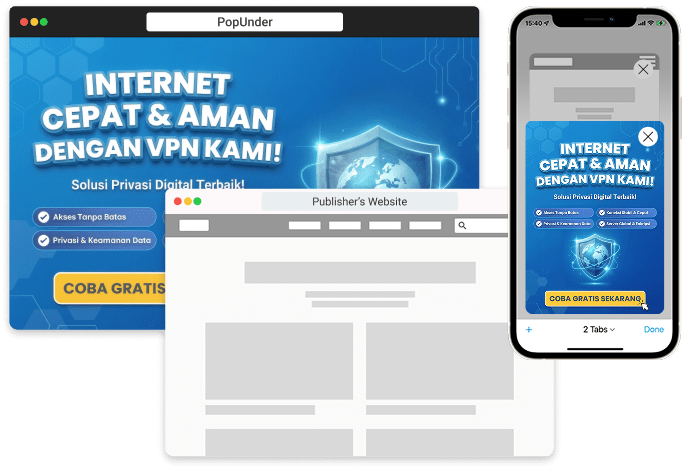
Popunder ads
For higher volumes of mobile and desktop users, advertisers can apply the evergreen and indispensably perfect for some niches Popunder ads. They appear under the main window when the user browses and do not interrupt the moment. However, once the user is complete with the tasks, Popunder is there to be consumed easily on the screen.
2. Long daily social media usage
Most Indonesians use social media channels like TikTok, Instagram, Facebook, and YouTube for a few hours each day. Social media is one of the major channels to discover products or engage with content.
Tip: Create a smart social media-related strategy, considering content and advertisements tailored to attract users.
3. Messaging-first culture
Apps like WhatsApp provide consumers with an important channel of communication that can be used not only for communicating but also for making queries or purchasing goods.
Tip: Introduce the concept of conversational marketing through customer service and sales support on messaging platforms.
4. Importance of communities
The decisions made by consumers regarding buying products are highly influenced by their family, friends, communities, and social circles. Consumers have trust in recommendations from their own networks and communities.
Tip: You can encourage users to join communities through user-generated content and referrals, giving the audience the most genuine, first-hand feedback for their decision-making.
5. Price sensitivity
With a large variety of offers, Indonesian consumers are rightfully value-conscious and frequently compare prices before making a purchase. Promotions and special offers often influence buying decisions.
Tip: Focus on highlighting discounts, freebies, bonus offers, time-limited deals, and combinations for improving click-through and conversion rates.
6. Strong influence of recommendations
Social proof in the form of online reviews, endorsements from influencers, and word-of-mouth references is vital in establishing trust. Authentic social proof often has a great impact alongside traditional advertising.
Tip: You can mention customer reviews, partner with trusted local influencers, and encourage satisfied customers to share their experiences to strengthen brand credibility.
Whether you’re focused on user acquisition, performance marketing, or brand awareness within the Indonesian digital market, with Adsterra ad network you’ll have access to CPM, CPC, and CPA pricing models, various payment options, S2S tracking, and detailed analytics to maximize conversions.
Localization for Indonesia is more than translation
Successful advertising in Indonesia goes far beyond translating campaign copy into the Bahasa Indonesia language. Effective localization means adapting your message to the country’s cultural, linguistic and social context so that it feels authentic to local audiences.
Language
- Bahasa Indonesia
- local slang
- regional dialects
- local proofreader
Although Bahasa Indonesia is the national language and is spoken throughout the country, using expressions that the audience can relate to can create an emotional connection and make the campaign more engaging.
Companies also need to take into account the diversity among different regions in Indonesia since the preferences of consumers can differ in other parts of the country. It’s a good idea to use a local proofreader for your translated ad copy or creatives.
Visuals
- family-oriented imagery
- diversity
- local contexts
Visual images and creatives have their major significance. Ad campaigns that include diverse Indonesians, family environment, and local situations prove to be more powerful than those that have a universal appeal. Family and community play an important role in the life of an average Indonesian. Hence, campaigns based on unity and common experience prove to be very powerful.
Messaging
- trust
- affordability
- value
- promotions
The message you create should also be in line with the values that people in Indonesia hold dear. Among others, trustworthiness, authenticity, affordability, and value for money are some factors influencing their purchases. Promotional deals, discounts, and time-sensitive offers are well-received by the majority of consumers.
Religious and cultural sensitivity
- Ramadan
- Eid
- local holidays
Finally, advertisers must keep in mind the cultural and religious aspects of Indonesia. Being the largest Islamic nation in the world, Indonesia gives a lot of significance to religious festivals like Ramadan and Eid al-Fitr, which happen to be some of the busiest times for consumption and digital activities. Aligning campaigns with national holidays and major shopping events can further strengthen relevance and improve campaign performance.
Key Indonesian holidays & media buying opportunities
| Holiday / Event | Typical Date | What It Means | Marketing Recommendations |
|---|---|---|---|
| New Year’s Day | January 1 | National holiday marking the start of the year. | Launch New Year promotions, fitness, travel, finance, and lifestyle campaigns. Focus on fresh starts and new goals. |
| Chinese New Year (Imlek) | January–February | Celebrated by Indonesia’s Chinese community, particularly in major cities. | Use festive red and gold visuals where appropriate. Promote gifts, retail, food, and travel offers while avoiding cultural stereotypes. |
| Ramadan | Varies | Indonesia’s most important religious season, with increased online activity and shopping throughout the month. | Increase budgets before and during Ramadan. Focus on family, generosity, convenience, and evening mobile usage. Avoid insensitive messaging. |
| Eid al-Fitr (Lebaran) | Varies | The biggest holiday of the year, marked by family reunions (mudik), gift-giving, and celebrations. | Launch campaigns weeks in advance. Promote fashion, food, travel, fintech, e-commerce, and gifts. With attention to family, togetherness, and gratitude. |
| Nyepi (Balinese Day of Silence) | March (varies) | Hindu New Year observed primarily in Bali. Most businesses and internet services on the island pause for the day. | For ad campaigns for Bali, adjust campaign schedules accordingly. Respect the reflective nature of the holiday. |
| Labour Day | May 1 | National public holiday. | Retail promotions and leisure campaigns perform well during the long weekend. |
| Vesak (Waisak) | May–June | Buddhist holiday celebrated nationally, with major events at Borobudur Temple. | Use respectful messaging. Suitable for travel and cultural campaigns. |
| Eid al-Adha | Varies | Major Islamic holiday emphasizing charity and community. | Highlight generosity, family values, food, and charitable initiatives where appropriate. |
| Independence Day | August 17 | One of Indonesia’s most celebrated national holidays, featuring community events and patriotic activities. | Use national colors (red and white), limited-edition campaigns, contests, and community engagement. |
| Maulid Nabi | Varies | Important Islamic observance. | Keep messaging respectful and avoid overly promotional or humorous creatives. |
| Christmas | December 25 | National holiday celebrated by Indonesia’s Christian communities and the wider retail sector. | Promote holiday shopping, gifts, travel, food, and year-end sales with inclusive messaging. |
| National Online Shopping Day (Harbolnas) | December 12 (12.12) | Indonesia’s largest online shopping event, driven by e-commerce platforms. | Increase budgets, use countdowns, flash sales, vouchers, free shipping, and mobile-first creatives. Highest-converting periods for digital advertising. |
| Double-Date Shopping Festivals | 2.2, 3.3, 4.4, 5.5, 6.6, 7.7, 8.8, 9.9, 10.10, 11.11, 12.12 | Monthly promotional events led by major e-commerce platforms: Shopee, Tokopedia, Lazada, and TikTok Shop. | Prepare campaigns several weeks in advance. Emphasize discounts and limited-time offers to maximize conversions. |
Best practices
- Organize Ramadan and Eid campaigns 4 to 8 weeks in advance since the level of competition and cost of advertising increase significantly.
- Set larger budget for 11.11, 12.12 (Harbolnas) and prior to Eid when shopping is at its peak online.
- Create localized advertisements that highlight the importance of being a family, community, and togetherness, not success by oneself.
- Check campaign timing regarding Islamic holidays since dates can be confirmed only close to them.
Common mistakes international advertisers make
Let’s look into a few unfortunate mistakes to avoid while running advertising campaigns for Indonesia.
- Simply translating English ads
Even experienced international advertisers can struggle to achieve strong campaign performance in Indonesia if they rely only on strategies that have worked in other markets. One of the most common mistakes is simply translating English-language ads without properly localizing the message for Indonesian audiences. Effective campaigns reflect local language, cultural nuances, and consumer expectations rather than using direct translations.
- Ignoring local holidays
As we’ve mentioned earlier, local festivals and seasons are important. Advertisements that do not consider shopping times like Ramadan, Eid al-Fitr, and other national holidays will be losing an excellent chance to connect with the customers during peak online activity time.
- Underestimating mobile optimization
Another key aspect that most of the brands miss out on is that of the importance of mobile optimization. Given the nature of Indonesia being a mobile-first country, it is imperative that the landing pages and websites be responsive and mobile-optimized.

Head of CPA, Adsterra
Expert tip
Prioritize fast-loading creatives and landing pages. With Indonesia’s mobile-first audience, even a 1-2 second delay can tank your offer’s visibility and conversion rate. Compress assets, minimize redirects, and test load speed on mid-range mobile devices – not just high-end phones – since that’s where most of your traffic will come from.
- Using overly direct messaging
The way messages are sent is important. Too direct and aggressive advertising could prove less effective than those which emphasize trustworthiness, value, and the formation of lasting relationships with customers. Indonesians tend to be receptive to genuine and community-centered communication.
- Focusing only on Jakarta
Another common misconception is treating Jakarta as representative of the entire country. While the capital remains an important commercial hub, Indonesia is a vast archipelago with diverse regional markets, varying purchasing power, and different cultural preferences.
Advertisers should consider regional micro-targeting, which is sometimes accessible, as it is with Adsterra, and adapt campaigns for region, cities, and towns.
- Treating Indonesia like a single homogeneous market
One of the most significant errors is to look at Indonesia as being uniform. Advertisers who realize how diverse Indonesia is and create their advertising campaigns in such a way that they will work effectively for certain segments of the population. It is much more likely that this approach will produce efficient advertising.
Set up your ad campaign for Indonesia and reach high-converting audiences through 36,000+ direct publishers using top-performing, intuitive, non-intrusive ad formats, like Social Bar ads, with 33% higher CTRs than alternative ad formats.
Media buying strategies for Indonesia
Paying attention to the market specifics, let’s point out the key digital advertising strategies to effectively run ad campaigns in Indonesia.
1) First of all, choose an ad network with robust anti-fraud measures, clear advertising policies, and strong security systems to protect your campaigns from invalid website traffic and ad fraud.
2) Begin by using broad targeting, testing various types of settings, sites, OS, carriers, and locations within Indonesia (regions, cities, the capital, etc.) and later narrow down your targeting based on their performance. You should give each campaign at least three to five days to be analyzed, and then allocate your budget to the best-performing ones.
Head of CPM at Adsterra
Expert tip
The biggest wins in Indonesia usually don’t come from spending more, they come from testing more. Small improvements in targeting, creatives or landing pages add up quickly and often outperform aggressive scaling.
3) And of course, budget management, daily limits, refining your targeting, blacklists and whitelists updates are also on your to-do list. Due to fluctuations in publisher inventory, you can conduct tests periodically and update your lists accordingly.
4) Work closely with your ad network account manager to identify proven website traffic sources, gain performance insights and uncover optimization opportunities that can improve the results of marketing campaigns.
Head of CPA, Adsterra
Expert tip
Stay closely connected with your Adsterra account manager and support team. Indonesian traffic is highly competitive now, so don’t optimize in a vacuum – regularly benchmark your eCPM against winning bids in the auction. Your account manager can flag when you’re losing placements to competitors and help you adjust bids before performance drops.
5) You can try a few proven tools for your ad campaigns that help advertisers launch, optimize, and scale ad campaigns. For example:
- CPA Goal – Adsterra’s flagship optimization tool. It uses advanced algorithms and rule-based automation to optimize CPM and CPC campaigns toward a target number of conversions. It automatically removes underperforming placements based on spending and conversion rules, reducing manual optimization.
- Smart CPM – An automated bidding algorithm that adjusts bids in real time to win high-value placements while staying within your maximum bid, helping advertisers spend more efficiently.
- Multi-event tracking feature documents useful activities within one campaign for better analysis of the sales funnel and better decision-making regarding budget distribution.
- Traffic Estimator – Predicts your competitive bids, the amount of available website traffic, impressions, and clicks prior to running a campaign to make it easier to plan test, budgets, and bids.
- Custom Bid – Allows increasing your bids manually for those placements that work best for you to gain better control over your campaigns.
- Traffic Chart – Provides statistics on the amount of website traffic you receive by GEO, device, OS, advertising formats, and traffic types.
Run your ad campaign for Indonesia and benefit from the dedicated Partner Care Program. Adsterra always provides the strategic guidance, optimization recommendations, and helpful, responsive support to help you achieve your campaign goals.
Learning from real examples
There are a few digital advertising approaches that advertisers and publishers use to create marketing communication with local audiences in Indonesia. Here are a few case study examples.
Free app distribution case study
A mobile app developer focused on users from Indonesia, Vietnam, and other Asian countries used the localized user path and Smartlinks to monetize their free apps and earned more than $50,600 in one month through 11 million ad views. Including one million views and $4,000 from Indonesia.
Local news publisher case study
An Indonesian local news publisher demonstrated the value of hyperlocal content by focusing on regional news, localized headlines, and community interests rather than national stories. The localized content strategy attracted a loyal audience, increased repeat visits, and created more opportunities for geographically relevant advertising campaigns.
Regulations for digital advertising and privacy in Indonesia
In order to carry out any digital advertising campaign in Indonesia, it is advisable for advertisers to get acquainted with the current legislation in this area. In addition to legal necessity, this will also ensure the trust of Indonesian consumers in light of the growing concern about privacy issues.
The protection of personal data has been enhanced by the implementation of the Personal Data Protection (PDP) Law in 2022, fully enforced in 2024, which sets the norms for the gathering, processing, storing, and transferring of personal data. Advertisers should make sure that they have appropriate consent of users, treat customer data carefully, and cooperate with partners who respect all privacy laws.
Consumer protection is yet another area that should be considered. All advertising claims have to be accurate, true, and non-deceptive. Information on promotional activities, discounts, and pricing should be transparent, and all terms and conditions should also be stated clearly.
Along with national regulations, advertisers are expected to adhere to the advertising codes and practices that regulate digital marketing campaigns. They should also show respect towards Indonesian culture and religion in their campaign messaging, especially during important festivals and religious events.
Key areas for advertisers buying Indonesia traffic
To run an effective ad campaign in Indonesia, advertisers need to consider the mobile-centric nature of the country’s population, diversity of culture, and evolving technology landscape.
The focus should be stressed on providing mobile-first experiences, creating localized content instead of merely translating content. It’s also important to support the cultural and retail events in the planning and implementation of ad campaigns and measuring the performance on the basis of actual business goals.