
With the rise of AI, LLM, and zero-click trend, publishers need more ways to be visible, seen and heard. But as a publisher, you don’t need merely more urls on your website. You need helpful pages that attract repeat views and create pure monetization opportunities.
That’s where programmatic SEO comes in. It makes all the business sense for the publisher, as it orchestrates the process of building SEO pages at scale. Although Artificial Intelligence has made programmatic SEO easier to build, it has made the competition tougher. And in this guide, we’ll look into the main components of how to do programmatic SEO, minimize obstacles and maximize monetization.
Whatever content production you choose: programmatic SEO, content scaling, or production of individual pages, you can always monetize your traffic with a high-converting ad mix with the Adsterra ad network. You can easily access the network of 16K+ advertisers and 230K+ new ad campaigns per year.
What is programmatic SEO and how does it differ from traditional SEO?
Programmatic SEO (pSEO) is an SEO approach that automates content creation process and aims at content scaling. The process begins with recognizing scalable search demand, matching keywords to structured data, building optimized pages out of templates, and constant monitoring of indexing, ranking, traffic, engagement, and page quality.
The core elements of programmatic SEO cover:
- keyword patterns,
- structured data,
- programmatic SEO template for pages,
- automated page production,
- internal linking,
- indexation control and metrics monitoring.
How programmatic pages differ from writing posts one by one?
| Entity | Traditional SEO writing | Programmatic SEO |
|---|---|---|
| Writing flow | Individual creation / editorial guidance | Automated / partially automated (data+templates+scale) |
| Keyword research | “Vetted”, specific keywords | Keyword batches of similar patterns |
| Page volumes | Tens to hundreds | Hundreds to thousands to tens of thousands |
| High-yielding content | Guides, articles, reviews, thought leadership | Directories, comparisons, statistics, locations, profiles, databases |
| Human supervision | Manual | Planning, strategizing, automation, tuning |
| Publishing speed | Slow | Very fast |
| Technical orchestration | Low/medium | Medium/high |
| Publisher focus | Authority | Scalable search entries |
What are the benefits of programmatic content SEO compared to traditional SEO methods?
- Efficient creation of hundreds or thousands of website pages vs manually writing them.
- Lower cost of producing content, faster publication.
- Broader coverage of long-tail keywords and easier updates of content with automated templates.
- Transformation of structured datasets into scalable search traffic.
However, the result is attainable only with unique and valuable content, data points, and automation practices.
When a programmatic build is worth it for a publisher (and when it is not)
It is worthy to use programmatic search engine optimization when a publisher is able to recognize specific search queries which are similar but require different responses. The best cases for programmatic SEO include the repetition of search queries combined with structured data: locations, pricing, stats, events, product details, ratings, profiles, comparisons, etc.
It becomes especially appealing when developing each webpage manually is too costly. A publisher may come up with 10,000 relevant combinations of keywords but have enough resources to develop just 100 pages. pSEO can help in such a situation.
Programmatic SEO does not make sense for the sake of the volume itself. Think of alternatives if your keyword variations have no demand, or your pages end up featuring similar content without being unique, or it costs more to maintain accuracy than what you get from the traffic.
What you need before you build a programmatic blog system
Before investing in your blog or website with your sleeves rolled up, investigate if the project can accommodate programmatic SEO:
- Keyword research. Long-tail demand for supporting hundreds or thousands of pages.
- Data. Credible data which make each page unique.
- Template. An appropriate template which meets the search without looking like AI/bot written.
- About-programmatic SEO tools and platform. Reasonable technical and data maintenance effort.
- Revenue baseline. Realistic monetization possibilities through advertisements, affiliate programs, subscription, etc.
How to build programmatic pages step by step?
The main focus of how to set up programmatic SEO is not in maximizing the urls number, but in creating an approach that consistently turns trustworthy data into monetizable, content-valuable search entries.
1. Identify scalable keyword patterns
Long-tail keyword phrases can be vetted through various research tools, including Ahrefs, Semrush, or Google Search Console. For instance, “car diagnostic code + model + year”. Pay attention to those phrases which have high search volume and unique angles for their answers.
2. How to find suitable data sources for programmatic content generation?
Consider using publicly available data sets, repositories, reports from the industry, past data from your own website, and paid industry-specific APIs. Some websites that can assist you in identifying structured data are archives built for civic transparency, educational social networks for data scientists, internet library databases. Among them are Google Dataset Search, Data gov, Kaggle, etc. Be on the lookout for accuracy, freshness, and usage rights before publishing.
3. Organize your data.
How to structure a database for programmatic SEO content? Design your database using tools like Google Sheets, Airtable, or PostgreSQL with each data block being a potential page. The database should include a unique ID, target keyword, url slug, page title, description, structured data, images, internal links, and last updated date. Divide your reusable templates from your page data. Set up a validation process to ensure you don’t have duplicate urls, missing pieces, or outdated content.
4. Design a reusable page template
Select an appropriate page layout design which includes fields for necessary information. Utilize headings, tables, internal links, metadata, and structured data. Manually check sample pages first.
5. Automate page generation
Tools like WP All Import, Whalesync, Webflow CMS, and custom-built Python scripts may be used to link structured data with publication platform (CMS). WordPress REST API and Webflow CMS API are examples of services which provide APIs for automated search engine optimization data and enable automated content creation and updates. And as per usual, AI can help with writing and automation but human supervision is important.
6. Launch, monitor and improve.
Release the small initial set. Measure indexation, clicks, engagement, and conversions using Google Search Console and GA4. Expand the templates that work well while refining and eliminating underperforming pages.
The tools publishers use to run a programmatic SEO
There is no requirement for a single all-in-one platform for programmatic SEO. Let’s name some of the tools designed for programmatic SEO content automation, keyword research, structured databases, and CMS integration that publishers can use to create programmatic SEO pages.
| Tool | Main function |
| Ahrefs / Semrush | Find keyword patterns, search demand, and competitors |
| Google Sheets / Airtable | Organize keywords, datasets, metadata, and page-specific information |
| WP All Import | Import structured data into WordPress pages and custom fields |
| SEOmatic | Generate SEO landing pages using datasets and templates with pSEO course available |
| Whalesync | Synchronize structured data with supported CMS platforms |
| Webflow CMS | Create dynamic pages from CMS collections |
| Python + CMS APIs | Generate, validate, publish, and update pages programmatically |
| Screaming Frog | Audit generated urls, metadata, canonicals, and internal links |
| Google Search Console / GA4 | Monitor search performance, indexation, and engagement |
Some programmatic SEO tools are integrated through plugins, CSV uploads, API, or automation services. For instance, WordPress publishers can integrate Google Sheets with WP All Import to auto-populate page templates. Webflow publishers can integrate Airtable via compatible synchronizations, while big publishers can create their own integration using the CMS API.
Beginners can use Google Sheets, WordPress, and WP All Import, while publishers interested in no-code automation can try SEOmatic or Webflow. Websites with complex data sets can try Python, PostgreSQL, and a headless CMS.
Regardless of the software used, automating the process should result in less repetitive publishing work without any loss of accuracy and value of the content.
What metrics should I track to measure the success of a programmatic SEO strategy?
Since the point is “how many” out of your many pages are indexed, obtain organic traffic, satisfy visitors, and create value, here is what you can measure:
Indexation rate. Percentage of pages Google indexes among the generated pages. Look into crawl budget, that is how many pages bot can and wants to crawl on your site, since the daily and other limitations exist.
Organic impressions. Is your programmatic content gaining search visibility?
Organic clicks & sessions. Simply the traffic generated by programmatic pages.
Keyword rankings. Particularly how many long-tail keywords rank in the top 10.
CTR. Are your meta titles and snippets attractive enough to click on when pages rank in the search results?
Engagement. Sessions, time on page, pages per session, return visits.
Conversions. Newsletter subscribers, affiliate clicks, purchases, etc.
Revenue. Page RPM, eCPM, or total ad revenue.
Cost of production and maintenance. Compare costs of development, data, content, updates with traffic volumes and revenue.
With any traffic volume and number of pages, it’s easy to track metrics in your publisher’s dashboard, when partnering with an ad network. Use your metrics and expert advice from Adsterra Partner Care support team for your best business decisions in real time.
Will programmatic SEO get a site penalized by Google?
Programmatic SEO itself does not pose any risk for the penalties from Google. However, the scaled content that is intended to cheat search engines and have no value is dangerous for the publisher’s website. Google calls it “scaled content abuse”, describes it in the Google Search Central and downgrades such content.
How publishers turn SEO programmatic traffic into ad revenue
Programmatic SEO can generate thousands of visitors on many long-tail-keyword pages and you need to think of how to monetize it better. The options are wide enough. You can set your eyes on the ones that suit your online business.
For instance, Adsterra allows monetizing all this distributed traffic up to a single impression and click, through various ad formats such as Popunder, Social Bar, Native Banners, Display ads, Smartlink, etc. Publishers can monetize their traffic regardless of GEO, device, and traffic volume and without being limited to use just one ad format.
Programmatic SEO examples that earned traffic and revenue
Let’s have a look at the latest Adsterra’s case studies of successful programmatic SEO implementations and ad monetization.
Case 1: Automotive website
- Niche. Automotive diagnostics and repair guides (OBD2 diagnostic-code reset guides for Brazilian car owners).
- Programmatic SEO. 2,500+ keyword combinations targeting diagnostic codes, car models, and years.
- Scaling. 15-20 pages per week, after creation of 20 manual pillar articles.
- Tools: WP All Import plugin, Google Sheets, AI.
- Traffic. 290,000 monthly visitors.
- Traffic sources. Mostly Google organic search, direct, YouTube.
- Monetization. Adsterra Native Banners, Popunder and Social Bar were added.
- Earnings: $732.87 in the initial monetization period.
- Content strategy. Publication of 15-20 pages per week, unique technical content and topic-specific internal linking.
“Using the WP All Import plugin for WordPress, Leandro, a publisher from Brasil, knew dumping hundreds of pages at once would scream “thin content” to Google and probably trigger penalties. Leandro manually reviewed and improved the first 30 pages, then refined the prompt to improve the AI output.”
Source: https://adsterra.com/blog/niche-automotive-website-case-study/
Case 2: Image-search website
- Niche. Image search, wallpapers, tattoos, visual inspiration.
- Programmatic SEO: Thousands of long-tail-keyword-based image pages, each with its unique description and meta description and tags.
- Scaling. Through automation and generation of tens of thousands of pages per month with manual content creation. Instead of targeting high-search-volume and high-competition keywords (e.g., “wallpaper”), Setiawan created micro-keyword pages like anime dark wallpaper iphone, cute wallpaper pink, etc.
- Traffic. Around 500,000 – 1,000,000 per month.
- Traffic source. Google Images, Bing Images, Pinterest, Direct Traffic
- Monetization. Adsterra Banner ads with 70% CPA/30% CPM ratio.
- Revenue. Around $4,000-$5,000 per 30 days.
- Content strategy. High-volume visual traffic, automated page generation, keyword targeting, and internal linking.
“Setiawan, Adsterra publisher from Indonesia, developed fully human-written content from the AI outline, adding supportive information, image details, download options, and more.”
Source: https://adsterra.com/blog/programmatic-seo-website-promotion-case-study/
How to start monetizing your programmatic SEO pages?
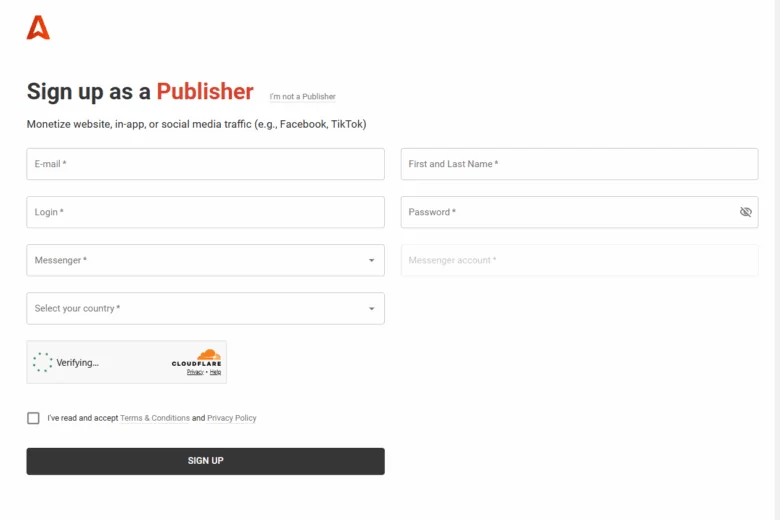
Step 1: Set Adsterra publisher’s account
Register as a publisher. The site approval process is smooth. You can choose out of broad payouts settings, including in your local currency.
Step 2: Add your website and get a quick site approval
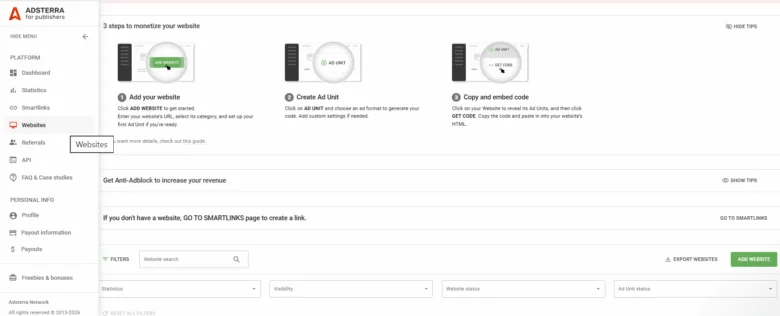
Click ADD WEBSITE. Wait a few moments and get your website Active.
Step 3: Get the ad code for your page(s)
Go to Websites and tap GET CODE. Copy the ad code or link (in case of Smartlink) from your dashboard and paste it to your website.
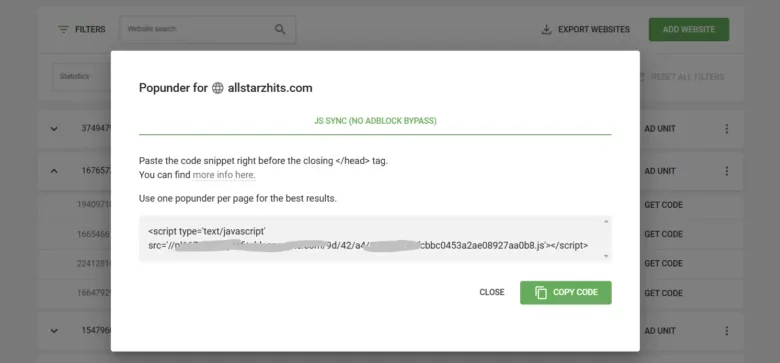
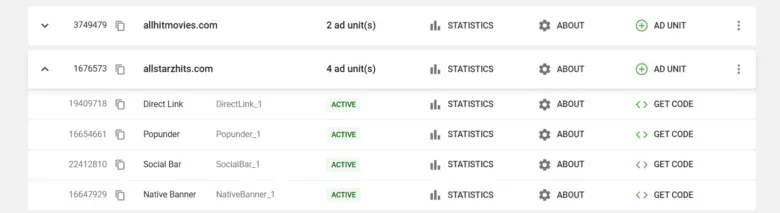
To achieve 100% ad fill rate with high-quality ads, either opt for a single ad format or an ad combination. For example, you may select Popunder and another type of ad from several intuitive ad formats for publishers:
- Social Bar ads, Adsterra’s proprietary, innovative ad format with up to 33x higher CTRs compared to web push ads. You can choose from its skins: Interstitials, In-Page Push Notifications, Icon Notifications, or Custom Widgets.
- Native Ads that blend with your content as an editorial piece.
- Smartlink (Direct Link), a simple url that has a thousand ads behind the smart algorithms and carefully shows the ones relevant for your audience.
Wrap-up
With the pSEO set off, first think keywords patterns, structured relevant data points, SEO strategy programmatic tools, and control metrics. Next, choose your publisher monetization strategy. Introduce monetization opportunities such as ad placements, Smartlinks, affiliate links, one at a time and measure again. You can start your monetization journey with Adsterra’s caring supervision and offered monetization opportunities any time with any amount of pages or traffic volume.
Programmatic SEO: FAQ
Can programmatic SEO improve local search rankings effectively?
Yes. Programmatic SEO can be helpful to achieve better rankings in the local searches by developing informative pages that are meant for particular cities, regions, or even neighborhoods. This process requires unique local data, relevant search intent, proper internal linking, and useful content, not just proper names substitution and farming content sustainably.
Can you give me an example of programmatic SEO?
Travel companies generate destination pages of hundreds of thousands of cities by simply using a database and programmatic page template. These pages will combine specific data like sights, climate, costs, and travel options into a single page for each city. This is not manual work, but an automated process of scaling relevant content for targeted queries.
What are the common challenges when implementing programmatic SEO?
Issues that arise when implementing programmatic SEO include sourcing trustworthy data, developing useful templates, preventing the creation of shallow pages, indexing, and managing large amounts of urls due to evolving information. However, the main frightening obstacle is technical SEO challenges. Handling templates, internal linking, canonical tags, sitemaps, and integration with CMS involves careful consideration and sometimes a developer’s helpout.