
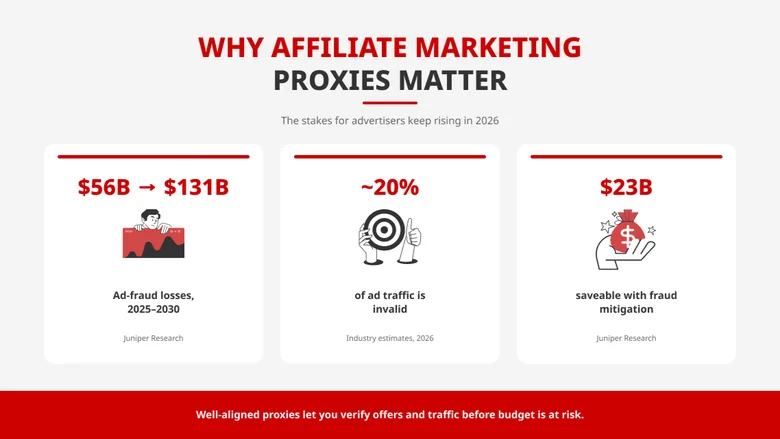
Affiliate marketing proxies are the quiet layer that keeps profitable campaigns honest in 2026. They route your request through a real local IP address, so a platform shows you what a local user sees. That lets you verify offers, prices and creatives before you spend.
The reason is simple. The value of an offer depends on the geo of the traffic, not on where you sit. This guide covers the proxy types that matter, how to test them, and how the top proxy providers compare. Dexodata sits at the center of that comparison. Get the proxy layer right and the rest of the funnel gets easier.
Meanwhile, if you need quality traffic for your affiliate offer, you can register with the Adsterra ad network within minutes. You immediately access vetted traffic from 45K+ publishers, the Unique Partner Care Program for expert advice, and ad formats with 33% higher CTRs than industry alternatives, like Social Bar ads.
What an affiliate marketing proxy is
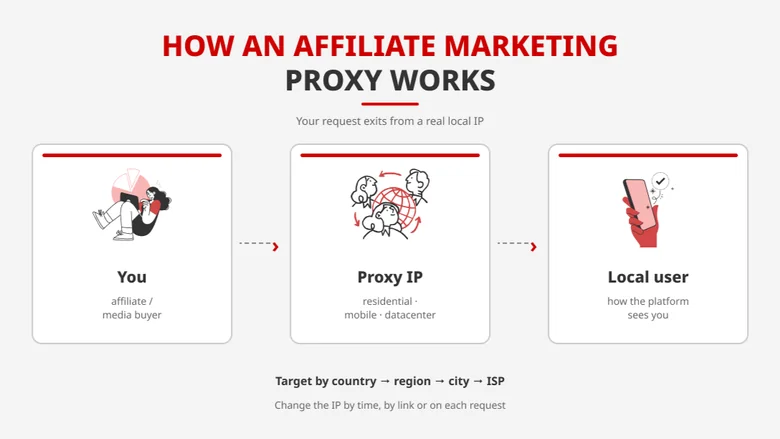
A proxy is a middle server that sends your request through a different IP address. An affiliate marketing proxy does this with IP addresses that look like real local users. The platform then sees a local resident, not a foreign visitor from another country. In effect, the platform judges the IP address, not you.
Here is a quick example. Say an offer pays for users in Berlin. You pick a residential proxy server in Germany and narrow it to Berlin. The page then loads with the local language, currency and price. That is exactly what you need to check before you buy traffic.
Why affiliates and media buyers use proxies
In short, proxies turn risky guesswork into controlled, testable steps. Here are the everyday jobs they handle for affiliate teams.
Proxies for affiliate marketers cover research, verification and monitoring. New to paid traffic? Start with affiliate marketing basics. Then add proxies to check every market you buy.
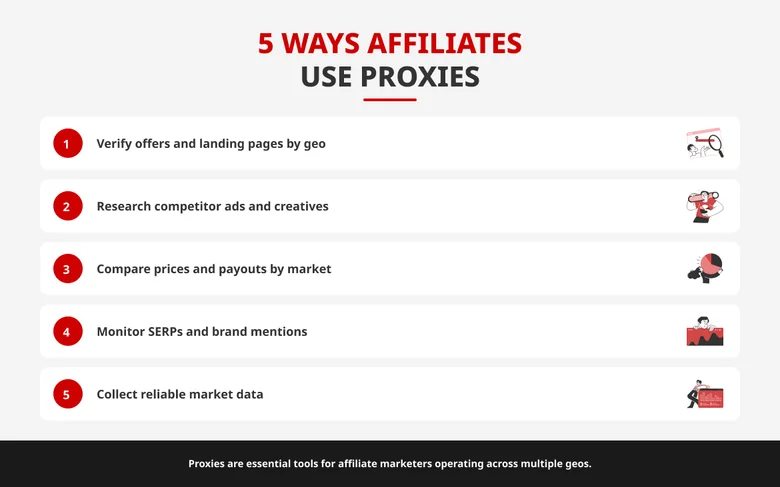
Verify offers and landing pages by geo
Many offers pay only for specific target geos. A proxy lets you open the landing pages as a local user would. You confirm the language, the price and the full click path before you spend. This is the core of affiliate testing and ad verification.
A quick geo check catches broken pages, wrong prices and paused offers early. It is far cheaper than learning the same lesson from a live campaign.
Research competitor ads and creatives
Media buyers study rival ads to spot winning angles. A local IP address shows the same creatives and offers real users see. You can check rival landing pages and SERPs from the target country, without regional bias. That intelligence shapes your own angles, offers and creatives.
Collect reliable market data
Accurate market data keeps your optimization grounded. A local IP means your data has no regional drift or blocks. Reliable numbers lead to sharper media-buying decisions. Good proxies for affiliate marketing turn guesswork into measured checks.
Once an offer checks out, it needs quality traffic. Adsterra delivers 36B+ ad impressions monthly across 248 GEOs. Advertisers reach real users with Popunder and Social Bar ads. Set up a campaign and put your verified tests to work.
The proxy types that matter for affiliate campaigns
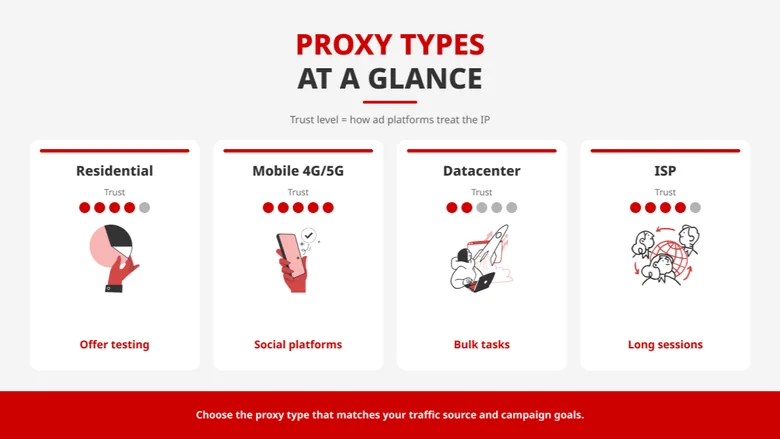
There are several proxy types, and each one suits different tasks. They vary in trust level, price and resistance to anti-fraud systems. Pick the wrong proxy type and even a great offer can stall. The four proxy types below cover almost every affiliate workflow.
Residential proxies
Residential proxies use IP addresses from real homes and public Wi-Fi. Each residential proxy server carries the address of a real household. That trust makes residential proxies the default choice for offer testing and ad verification. Rotating residential proxies also power large-scale web scraping and SERP checks. For most affiliate testing, residential proxies are the safest starting point.
Mobile proxies
Mobile proxies run on 4G and 5G carrier networks. Their IP addresses carry one of the highest trust levels with anti-fraud systems. A single mobile proxy server rides a carrier IP shared by many real people. That is why they are a strong pick for strict social platforms and hard geos. They cost more than residential proxies, so save them for the toughest checks.
Datacenter proxies
Datacenter proxies are based on hosting providers. A datacenter proxy server is easy to spin up in bulk for monitoring and internal tools. They are affordable, which helps on large, low-risk jobs. But platforms spot hosting-based IPs more easily, so treat them with care. A datacenter proxy server pool is the cheapest way to run bulk monitoring at volume.
ISP proxies
ISP proxies sit between residential and datacenter proxies. They are hosted addresses tied to a provider, so they hold a stable identity. An ISP proxy server keeps one address across a long session. ISP proxies pools are usually smaller than residential networks, so they suit steady, single-identity work.
How to verify a geo-targeted offer before you spend
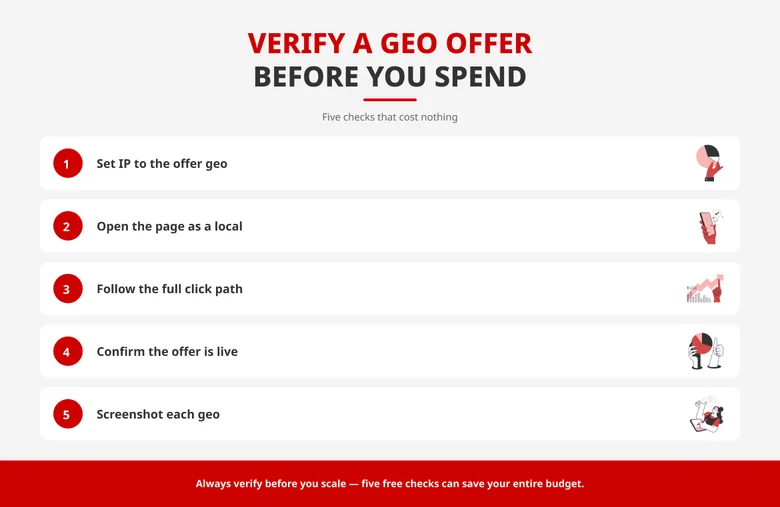
Offer verification is where proxies pay for themselves fastest. Set the proxy IP to the offer’s exact geo. Then verify a geo-targeted offer the way a local user would.
Open the landing page and confirm the language, currency and price. Follow the full click path to the point a conversion is recorded. Watch for paused offers, wrong device rules or hidden caps. Then screenshot the result for each market before you scale. Repeat the check for every geo you plan to buy, not just the first. A five-minute check saves the budget a broken offer would burn.
Matching proxy type to your traffic source
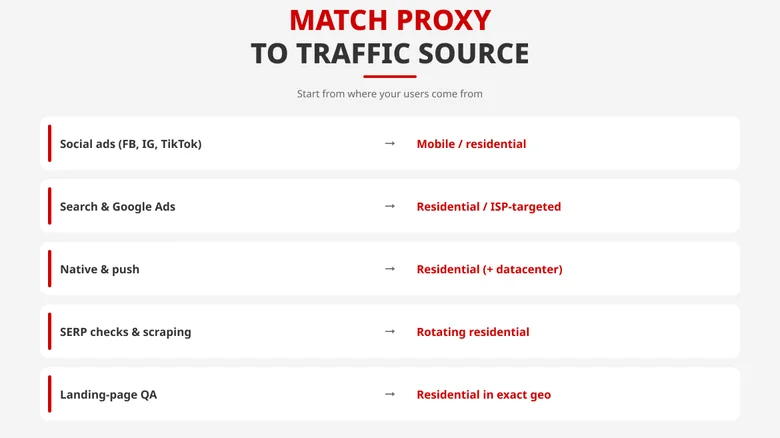
Your traffic source should decide your proxy type. Start from your best traffic sources for affiliate marketing, then pick the network.
The best proxy type depends on what you need to verify, the platform you are testing, and how closely the request must resemble a real user in the target GEO.
For social-platform checks, residential or mobile proxies are commonly used because their IPs originate from consumer or carrier networks. Mobile proxies may be worth testing when a platform is particularly sensitive to IP reputation, but they are usually more expensive.
For search-engine and paid-search checks, residential or ISP proxies can provide a stable local IP for reviewing localized SERPs, landing pages, prices, and ad experiences.
For large-scale SERP monitoring or data collection, rotating residential proxies can help distribute requests across multiple IPs. Datacenter proxies may be cheaper for lower-risk monitoring tasks, although some platforms identify hosting-provider IPs more easily.
For native, push, or other paid-traffic campaigns, there is no universal “best” proxy type. Choose based on the GEO you need to reproduce, the platform’s restrictions, session stability, cost, and the results of a small test.
Whatever the traffic source, the most important check is that the proxy resolves to the GEO your offer actually targets. Test the IP type, location accuracy, failure rate, and platform behavior before scaling.
How to test a proxy before you scale
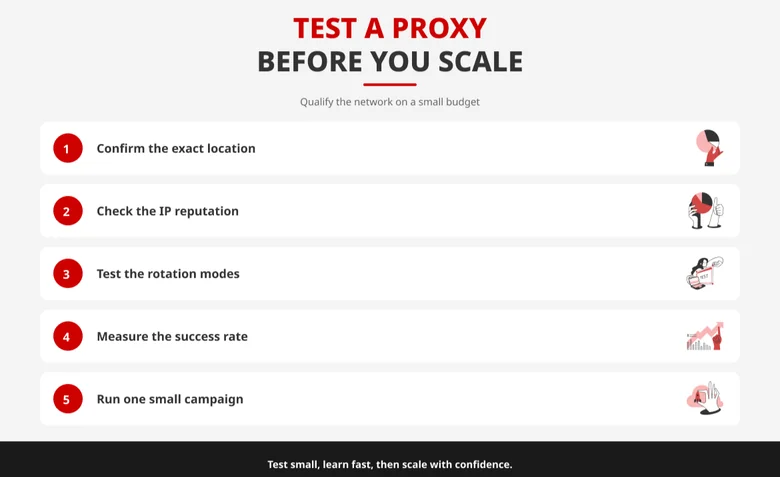
Never scale on a proxy you have not tested. Qualify the network on a small budget first. A cheap test run tells you more than any spec sheet.
Confirm the IP resolves to the exact country, region and city. Check that the IP is a residential or mobile address with a good reputation. Test the rotation modes: by time, by link and on each request. Measure failed connections and blocks across a batch. Then run one small live campaign and read the results before you scale. Note any proxy server that resolves to the wrong city or carries a poor reputation.
The best proxies for affiliate marketing in 2026
The best proxy provider is subjective, and it depends on your needs. The figures below come from Dexodata’s compare proxy providers review, so you can weigh each option fairly.
Dexodata
Dexodata is an advanced proxy ecosystem that combines routing technology, precise geotargeting and full control over traffic. It offers residential, mobile and datacenter proxies with high performance. All IP addresses are obtained with user consent and comply with KYC and AML standards. The pool covers more than 1 million whitelisted IPs across 100+ countries. The compact size means every address is verified before it ships.
You target by country, region, city and ISP, with flexible IP rotation. Pricing is pay-as-you-go on a tokenized balance, with no monthly fees. The reported success rate is 99.95%, and the free trial has no time limit. An API, WireGuard and Xray support, and a built-in firewall with allowlists and blocklists round out the toolkit. It supports SOCKS and HTTP(S) protocols, and every proxy server address is dynamic, so IPs rotate to avoid interruptions. You can automate the whole flow through the API, from IP selection to rotation.
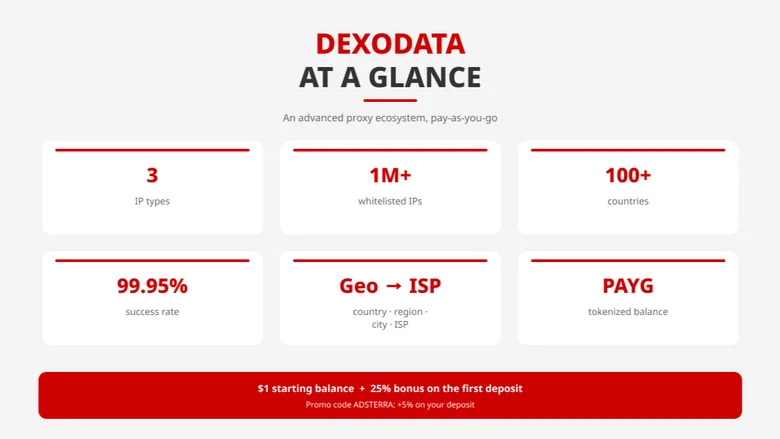
Test residential, mobile and datacenter IPs on a free $1 balance. Target by country, region, city and ISP, and rotate the IP by time, by link or on each request. Find the promo code with a +5% bonus on your proxy deposit and many other bonuses in your advertiser’s account.
Bright Data
Bright Data is a large proxy provider suited to businesses that need a robust setup with detailed analytics. It covers 150+ million IP addresses across 195+ countries. The platform emphasizes compliance and deep configuration tools, with ISP proxies in the mix. It reports a 99.95% success rate and supports pay-as-you-go across all proxy types. Pricing sits at the premium end, so it fits well-funded teams. For heavy scraping and analytics, few networks match its scale. Its analytics suit teams that track performance in fine detail.
Oxylabs
Oxylabs focuses on enterprise and large-scale data collection. It offers APIs for e-commerce, SEO and SERP data across 175+ million IP addresses. Its residential proxy server pool is among the largest on the market, with a 99.95% success rate. Its coverage and documentation are strong for technical teams. Pay-as-you-go covers residential and mobile proxies, though the entry point suits larger teams. It is a proven choice for SERP and e-commerce data at scale.
Decodo (formerly Smartproxy)
Decodo, formerly Smartproxy, focuses on flexible access and automatic traffic top-ups. It maintains 125+ million IP addresses across 195+ countries. Standard proxy protocols and a friendly dashboard make proxy server setup approachable. The reported success rate is 99.86%, close to the market leaders. Pay-as-you-go covers residential and mobile proxies, which fits most affiliate workflows. It balances price and features for growing affiliate teams.
NetNut
NetNut offers a broad choice of countries with 85+ million IP addresses. Its pricing is subscription-based, without a pay-as-you-go option. That suits steady, predictable workloads more than small tests. It draws on a large residential proxy server pool for stable sessions. The reported success rate is around 99%, a step below the leaders. The subscription model rewards consistent, high-volume use.
IPRoyal
IPRoyal targets general data collection, social media tasks and automation. It offers 32+ million IP addresses across 195+ countries. Pay-as-you-go covers residential proxies, though the trial excludes them. The pool spans 32+ million IP addresses with a 99.7% success rate. It is a reasonable entry point into paid proxy servers for smaller teams. The lack of a residential trial does make upfront testing harder.
Others in the top 10
Four more networks round out the top 10. SOAX offers fine-grained targeting on a subscription model, without pay-as-you-go. Webshare runs a developer-friendly setup with a free tier and bulk IP lists. ProxyEmpire adds pay-as-you-go billing with rollover data for unused bandwidth. Rayobyte owns its datacenters, giving it direct control over IP space and rotation. Each fits a niche, from free tiers to fully owned datacenters.
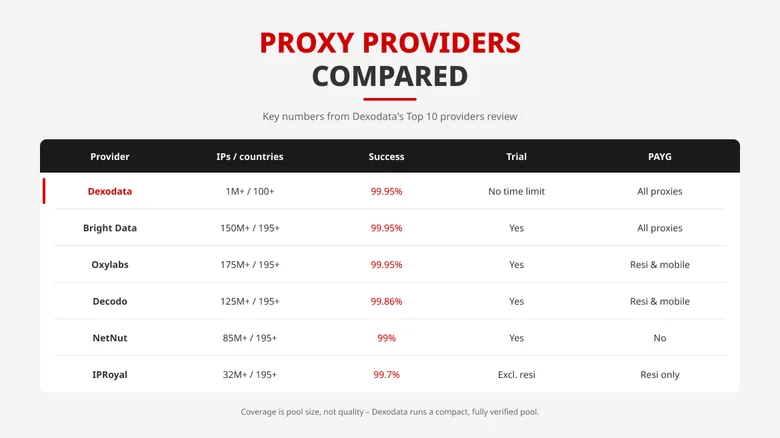
Coverage is pool size, not quality. Dexodata runs a compact, fully verified pool, so every address can be checked before it ships. Larger pools win on raw scale, but a verified pool wins on trust for affiliate work.
What else to consider when choosing proxies
Raw IP counts are not the whole story. Quality-of-life features and pricing often decide the winner. Dexodata, for example, adds a few practical touches for affiliate work.
- Prepaid traffic from 100 MB, so you can start small.
- Charges for inbound or outbound traffic, which can cut costs up to two times.
- No monthly fees, so you can change pricing models anytime.
- A free trial based on credit, with no time limit.
- A lifetime referral program that lowers your commission rates.
Dexodata also runs a standing offer for new users. You can check the current terms on the Dexodata bonus program before you deposit.
None of this replaces a real test. But these details often separate a good proxy provider from a merely large one.
What to look for in a proxy partner
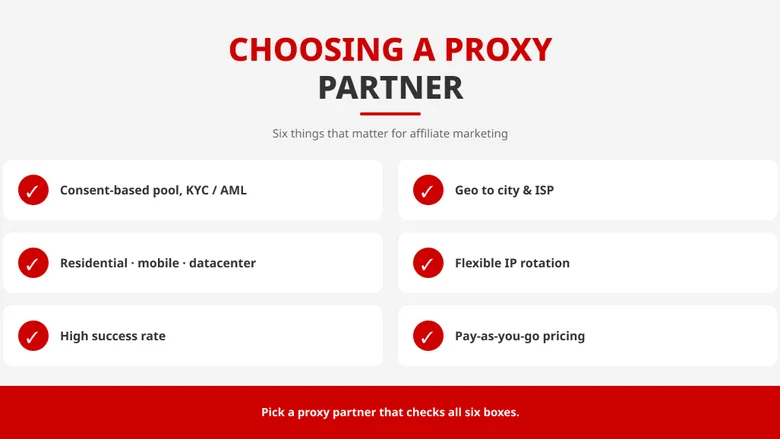
Not every proxy provider fits affiliate marketing. The best affiliate marketing proxy services combine trust, coverage and control. Use this scorecard to compare your options and keep your checks accurate.
Look for a consent-based pool that follows KYC and AML standards. Check geo granularity down to country, region, city and ISP. Confirm the network covers residential, mobile and datacenter IPs. Flexible rotation and a high success rate keep your pipelines healthy. Pay-as-you-go pricing and real support round out a strong partner. Ask how the provider sources its proxy servers and whether the pool is consent-based. Weekend and after-hours support matters when a check fails mid-campaign.
Run quality traffic on Adsterra
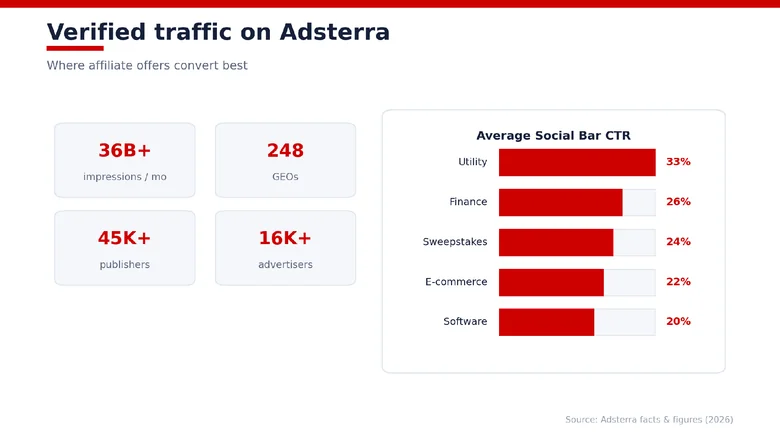
Verified offers and quality traffic work best together. Once an offer passes its geo checks, it needs a trusted ad network. Adsterra connects you with real users across 248 GEOs and 45K+ direct publishers. Social Bar CTRs run up to 33% in the Utility vertical, with strong engagement across verticals.
Pair verified tests with Adsterra tools like CPA Goal optimization and advanced targeting options. Verified offers keep your budget on real users while Adsterra keeps your traffic honest.
Affiliate marketing proxies FAQ
What are the risks of using a proxy site?
Public proxies can be slow, shared and unsafe. Their IP addresses may already carry a bad reputation. That raises the risk of blocks and leaked data. A reliable proxy provider with a consent-based pool removes most of that risk. Stick to a provider that vets its pool and publishes clear policies.
How do I choose reliable proxies for affiliate marketing?
Reliability and trust matter more than raw pool size. Look for a high success rate and a consent-based IP pool first. Test the success rate on a small batch. Then confirm the network holds up under your real load. A consent-based pool with clear KYC and AML standards is a strong signal.
What are the essential features of a proxy service for affiliate marketers?
The essentials are geo targeting, IP-type coverage and rotation control. You want residential and mobile proxies with country, region, city and ISP targeting. Compliance, a high success rate and transparent pricing complete the list. Dexodata covers these in one pay-as-you-go ecosystem. SOCKS and HTTP(S) support and a dynamic IP pool are worth checking too.
Do I need residential or mobile proxies for affiliate testing?
Both work, and the choice depends on the platform. Residential proxies are the safe default for most offer testing. Mobile proxies help on strict social platforms and harder geos. Many affiliate teams keep both on hand. Test a small batch of each before you commit a budget.
How do I verify an offer in another country?
Set the proxy IP to the country, region and city the offer pays for. Open the landing page and follow the full click path as a local. Confirm the language, currency and caps match the offer. Screenshot the result before you scale spend. Keep a short checklist so every geo gets the same review.
Are public proxies safe for affiliate marketing?
Public proxies are risky for real campaigns. They are shared, unstable and often already flagged. For affiliate marketing proxies you can trust, use a paid, consent-based network. The small cost pays back in reliable data and accurate checks. The time you lose to blocks usually costs more than the proxies.
The bottom line
Proxies are no longer optional for serious media buyers. They verify offers, research competitors and keep your data reliable. Start with a small test, match the proxy type to your traffic source, and scale what works.
Weigh the providers on coverage, success rate and pricing, with Dexodata as a compact, verified option. Then send your verified traffic to Adsterra. The right setup pays back in fewer wasted clicks and sharper data. Get this foundation right and affiliate marketing proxies become your quiet edge in 2026.