
Edi earns from posting local news, generating massive page views and ad impressions. He’s going to unveil his tactics for revenue generation and mistakes he made trying to earn bigger. You’ll learn why the Politics topic can become a financial trap for news-makers, and how Edi managed to hit $11,000 monthly revenue.
Earning from posting local news in Indonesia: Core data
| Category | Value |
|---|---|
| Niche | Local News (Economy, Society, Culture, Politics) |
| Daily pageviews (two websites) | 3,000,000+ |
| Main traffic sources (countries) | Indonesia (ID), the United States (US) |
| Average Smartlink CPM | $0.3 |
| Average Native Banner CPM | $0.2 – $0.7 (volatile rates) |
| Monthly revenue — Month 1 | $1,400 (Native Banner only) |
| Monthly revenue — Month 7 | $11,500 (Smartlink added) |
Disclaimer
The story was translated by the Adsterra Content team. We had to depersonalize web screenshots and erase sensitive data to protect the publisher’s privacy. We tried to keep the copy authentic but may have misinterpreted local names or slang. Please be tolerant of this.
Background: Why Indonesian news niche differs
I want to start this story with an uncomfortable truth: Indonesian news and politics traffic is both an opportunity and a trap.
The opportunity is obvious. Indonesia is the world’s third-largest democracy, and we are intensely engaged with economy and political news, especially during regional elections (Pilkada), parliamentary sessions, and national policy debates.
The trap is also real. News content containing politics often get flagged if you post biased opinions or veer into propaganda. Buzzing has become a part of our lives, and if you want to monetize with an ad network, keep away from this.
Adsterra’s editor note: Buzzing is a content distribution technique becoming popular across Indonesia and Southeast Asia. Individuals and teams are paid to create and share political propaganda online. Buzzers promote candidates and parties, often creating havoc and disinformation.
Why choose a global ad network
Adsterra is a monetization platform for global traffic. They accept news, entertainment, gaming, and all sorts of traffic unless it violates their terms of inappropriate content. When I applied in early 2024, they reviewed my sites, confirmed the content was legitimate journalism, and approved my domain. No grey-zone categorization and no money cuts that slashed my effective CPM (eCPM). Just clean rates for clean news traffic.
Adsterra’s editor note: Inappropriate content is (but not limited to) the content which promotes violence, discrimination, illegal activities, aimed at political ends, both party political advertising and political advocacy…
My news website background and audience
I run two sites. The first covers Central Java political news and municipal governance, and it’s very local and niche. The second is a broader Indonesian current affairs site that covers national-level news: ministry announcements, parliamentary decisions, and Indonesia’s foreign policy posture. The national affairs site gets more raw traffic, but the local site gets more engaged traffic with longer session durations.
Political news traffic is heavily weighted toward weekday morning hours (7–10 AM Jakarta time) when people check news before work, and evening hours (8–10 PM) during major political developments. Understanding this temporal pattern was critical to my ad format decision.
Earnings from posting local Indonesian news by country
Combined, my pages generate 30–35M monthly ad views. My audience is primarily 25–50 years old, predominantly male, mostly from Indonesian cities, but I also monetize the US, Malaysia, the UK, and Pakistan traffic.
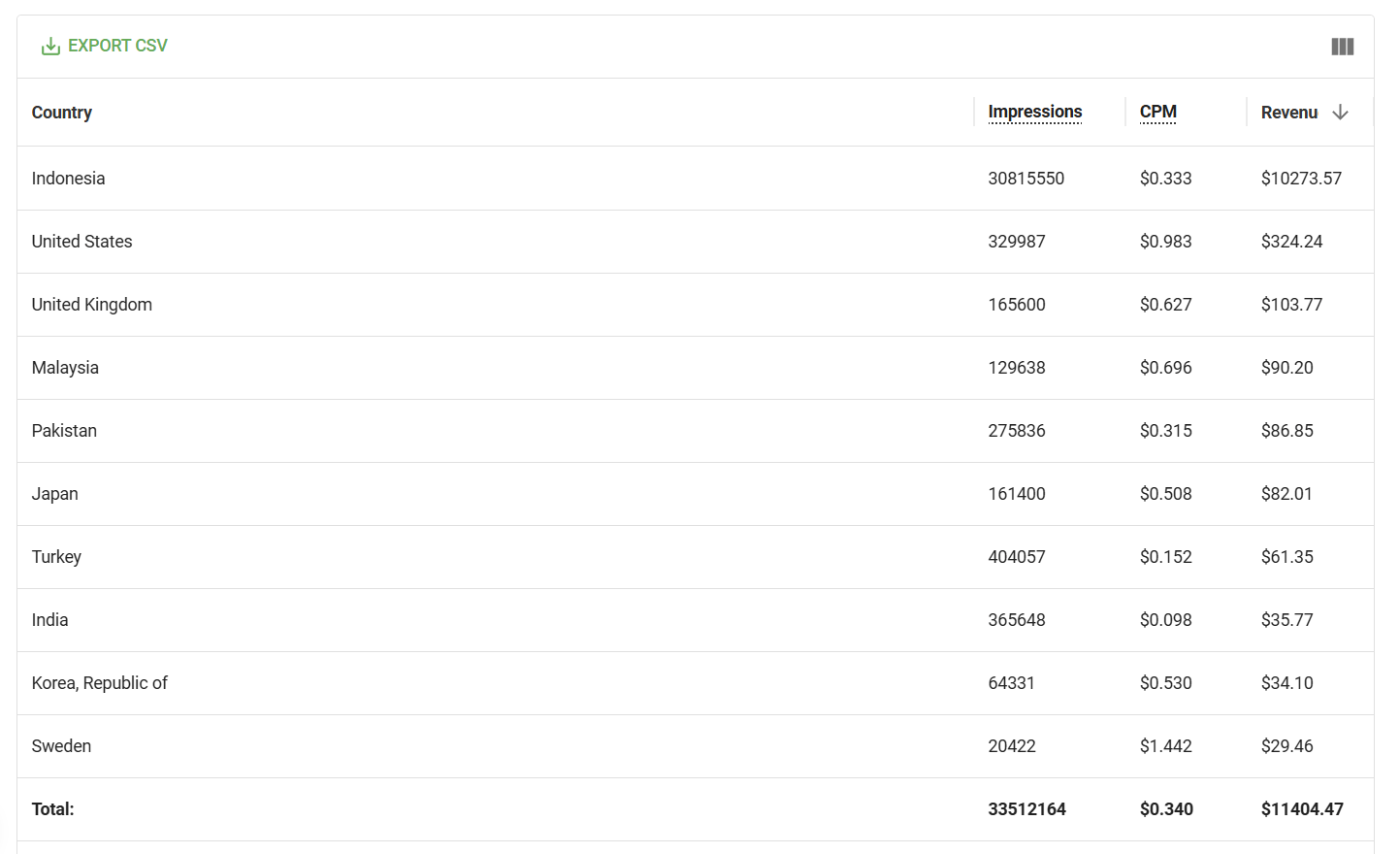
My readers access the sites on Android mobile devices, and mobile CPMs are usually higher. The desktop audience is smaller but proportionally more engaged — these are people who read my long-form analyses in full, not just the headline.
| Top countries | Impressions | CPM | Revenue |
| Indonesia | 30,815,550 | $0.333 | $10,273.57 |
| United States | 329,987 | $0.983 | $324.24 |
| United Kingdom | 165,600 | $0.627 | $103.77 |
| Malaysia | 129,638 | $0.696 | $90.20 |
| Pakistan | 275,836 | $0.315 | $86.85 |
| Japan | 161,400 | $0.508 | $82.01 |
| Turkey | 404,057 | $0.152 | $61.35 |
| India | 365,648 | $0.098 | $35.77 |
| Korea, Republic of | 64,331 | $0.530 | $34.10 |
| Sweden | 20,422 | $1.442 | $29.46 |
| Total | 33,512,164 | $0.340 | $11,404.47 |
Why I chose Smartlinks, not Pop Ads or Banners
Smartlink was the format I was most skeptical about before trying it. I assumed that news readers (they take content seriously) would resent anything that opens a new ad page while they are reading an important article.
The key insight my Adsterra account manager shared was that Smartlink for news content works well specifically because advertising is detached from the content and opens in a new tab. The same principle works on Pop ads, but they act too fast, when users hover any area on the page. Smartlink requires a click. But my manager stopped me from placing the Link inside articles’ content, as it could mislead readers. We agreed to include links in the service information below articles, sections between blog categories, and also on the main page in the Special Offers section.
Native Banners are something I started with. It seemed they were the most suitable for news readers. And they are, but I could only place them in the sidebar and between news categories.
Honestly, I can’t name the reason people clicked them less. But when I added Smartlinks, the situation changed drastically.
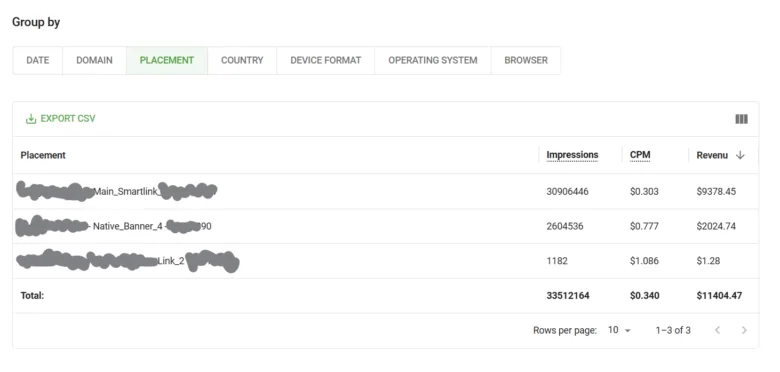
This screenshot clearly illustrates the difference in revenue performance between placements. Native Ads deliver higher CPMs (averaging $0.6 with a peak of $2), but Smartlinks ultimately generate more impressions, driving the overall revenue success.
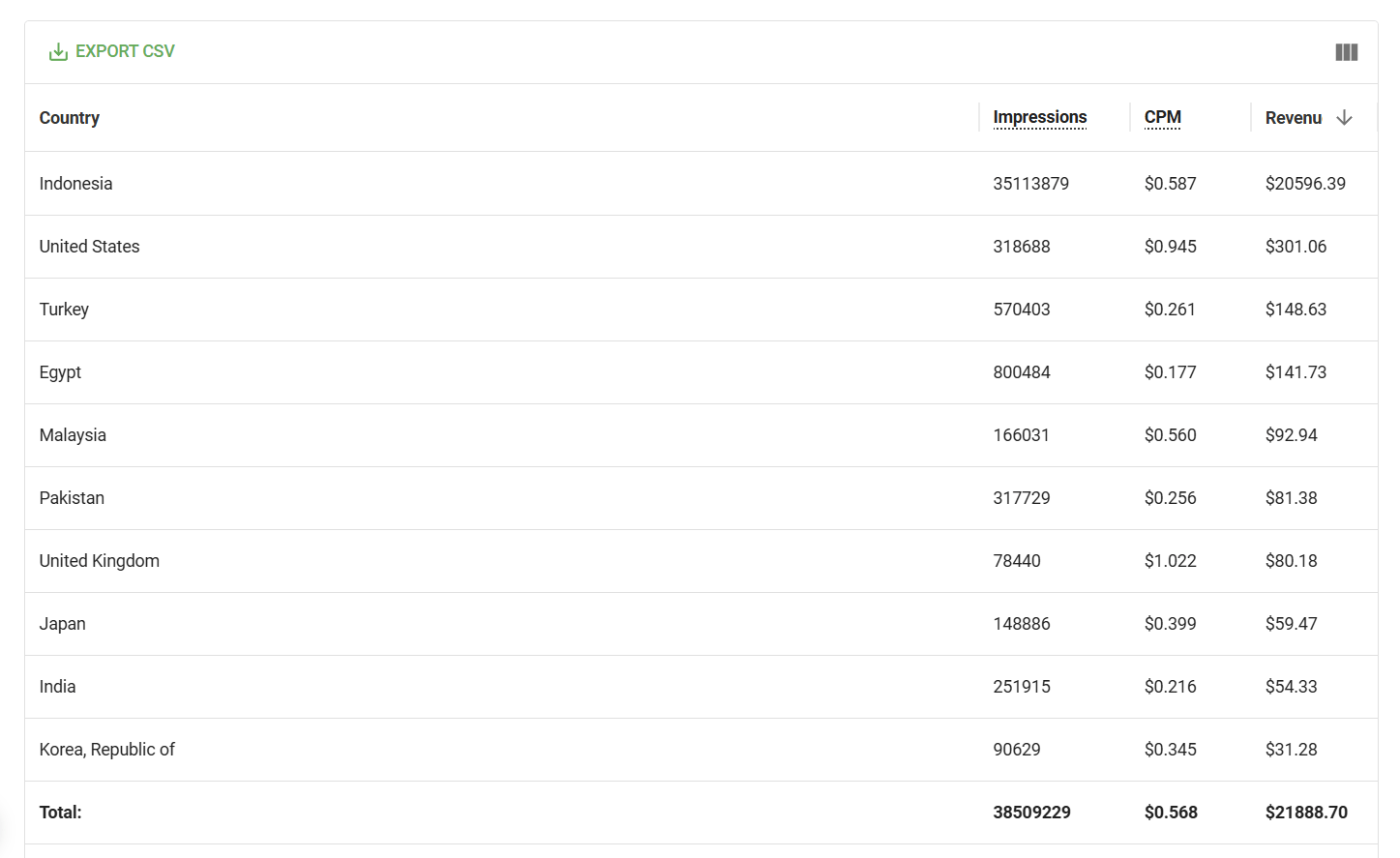
The election-season and major holidays peaks are very real. During Pilkada season and holidays, Indonesian CPMs rise because advertisers, including local businesses, target topically-engaged audiences. My September–October peak of $21,888 was almost 50% above my normal monthly average (the same was in May, the year before). This is a structural advantage of local news: predictable, cyclical revenue spikes tied to government public activities, society reactions, and special events.
Lessons I learned when developing a local news website
1. Build authority in a specific region or beat, not “all news”
There are hundreds of Indonesian national news aggregators. The sites that win are hyper-local or hyper-topical. My Central Java site dominates its niche because I’m covering certain municipal council decisions in detail. I heard from my friend’s son that teachers use them in civic education classes.
2. Invest in writer credibility
I publish with author bylines that include a short biography. For news in Indonesia, readers want to know who is writing. Anonymous political commentary is everywhere, and it’s trusted less. Even a simple author box with a photo and a two-sentence background creates trust signals that keep readers subscribed to your content. And that’s important for SEO (E-E-A-T).
3. Target the 6–9 AM and 19–21 PM windows
These are Indonesia’s peak news consumption windows. Publish your most important articles to be indexed before 7 AM WIB (draft them the evening before) and have your follow-up or analysis pieces ready for the evening window.
4. Focus on local elections as evergreen traffic engines
Indonesian Pilkada coverage generates search traffic for months after an election. People look up results, analyze outcomes, and read about incoming officials. This is evergreen traffic with a political trigger. Build archives of your election coverage with structured markup so they surface in search for the full post-election period.
5. Add NewsArticle schema
If your site publishes news (including political news), NewsArticle is strongly recommended for visibility, trust, and eligibility in search engines. Google News, AI Overviews, and Discover rely heavily on structured data. The platform requires you to include:
- Article type
- Publication date
- Author
- Headline
- Publisher
- Article’s topical category
The News niche is sensitive, and sites that use structured data can gain an advantage. Google prefers clear authorship and transparent publishing dates.
You can generate a NewsArticle schema using free tools like SchemaForge or other.
What can kill your earnings from posting local news
Never post AI-generated news and political commentary
Indonesian news readers are politics-savvy. AI-generated text on political topics tends to lack local specificity and misses cultural nuances of local political discourse. Being caught publishing inaccurate content destroys credibility permanently. WhatsApp users will spread this disgrace at the speed of light.
Avoid ad stuffing
A news site buried beneath ad units loses editorial credibility instantly. Indonesian political readers are educated and skeptical, they tend to consider you’re a content farm or else, not journalism. Start with one format, ensure your bonuses haven’t soared, and add formats slowly.
Don’t ignore compliance
Under Indonesia’s ITE law, news publishers face genuine legal risk, especially when republishing unverified claims concerning political figures.I’ve personally seen news sites shut down, not because of ad policy violations, but because of content violations. My advice: When in doubt, quote from official government sources only.
Evaluate the language opportunity
Even though older Central Javanese people speak Javanese daily, they overwhelmingly consume news, especially political news, in Bahasa Indonesia. Most of the content I publish is in Bahasa. But I discovered that adding the author’s comments and summaries in Javanese increases trust among older audiences.
Always create About Us and Contacts pages
Indonesian news readers want to know who is running a political site, especially in an environment of buzzing and misinformation. A strong, credible “About” page with verifiable information about your team of authors increases both user trust and your Google E-E-A-T signals. The same for the Contacts page: include your business email, support contacts, and official address.
How to prepare content if you want stable results
Making money from posting local news is a production system, not just editorial instinct. Here’s what my weekly content management looks like. This will help you coordinate your business and earn from posting local news steadily, not sporadically.
One thing I’ve found essential: I take Saturdays completely off from publishing. The traffic dip on Saturdays is real, but the editorial quality improvement from having one rest day per week is also real. Sustained quality over time is a revenue strategy, not just an ethical commitment.
| Tip | Strategy | Comment |
| High-Value Content | Write personal long-form analyses (1,200-1,800 words, 3x/week) on evergreen political topics (legislation, governance, figures) for sustained search traffic. | Produce 3 weekly, long-form, evergreen analyses personally for competitive advantage and SEO. |
| Operational Efficiency | Use a part-time researcher to monitor official government channels and provide raw news summaries, then rewrite them to maintain editorial voice. | Outsource news monitoring to a researcher; rewrite summaries for editorial control (saves ~4 hours/day). |
| Publishing Rhythm | Publish 3 articles/day on the local politics site and 4-5 articles/day on the faster-moving national affairs site. | Maintaining a high publishing frequency allows you to increase changes to get cited by Google Discover |
| Authority & SEO (E-E-A-T) | Strictly cite every factual claim with linked official documents or verified press releases. | Source citation (official documents) is essential for journalistic integrity and SEO (E-E-A-T). |
| Work-life balance | Take Saturdays completely off from publishing, accepting the traffic dip for essential editorial rest and long-term quality improvement. | Such publishing breaks are necessary to avoid burnout and planning new pet projects |
Looking ahead
I’m planning a third site focused specifically on Indonesian environmental policy. That’s a growing area of public concern as Indonesia navigates its commitments on deforestation and palm oil regulation. The audience is totally different: younger, more urban, with a higher international traffic component from NGOs, researchers, and international media. That Tier 1 component should push CPMs higher than my current averages.
Adsterra has been the right partner for this journey. Fast payouts that meet my expectations, responsive support, and no blurred conditions of usage. For an Indonesian news publisher who spent 14 months years getting burned by AdSense suspensions, that reliability is not a small thing.
The Indonesian media market is growing fast, and publishers who build quality infrastructure and credible editorial voices today will be the ones capturing the most valuable audiences (and the highest CPMs) as that growth accelerates.