
You’ve probably heard that content farms make a lot of money while generating content fast in bulk. But the questions remain. Are content farms bad? Should you create a content farm as a publisher? How to make an AI content farm? If content farm examples are so effective, is there a way to do it sustainably and ethically?
In this article, within our own research on the topic, we select and analyze creators’ feedback, reviews, firsthand experience, original case studies, and real-world examples. We explore open-source forums, social networks, and accessible projects from publishers that monetize their content with Adsterra ad network.
We put together anything relevant we could find on content farming on the web, starting as far back as 15 years ago. We also attach a checklist for those willing to scale content and monetize profitably.
What is a content farm and why are publishers talking about it again?
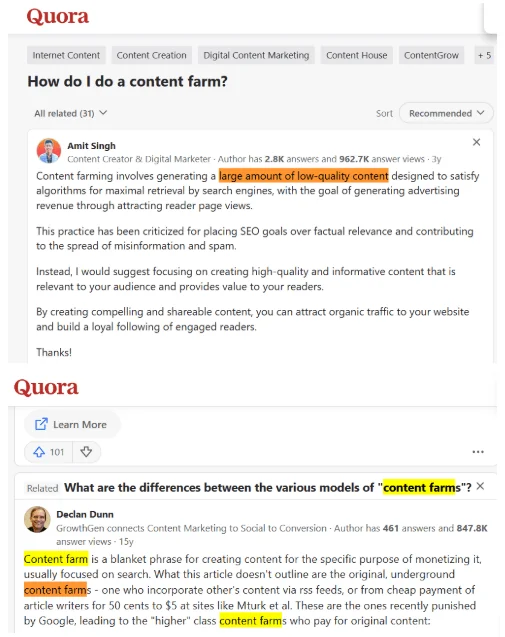
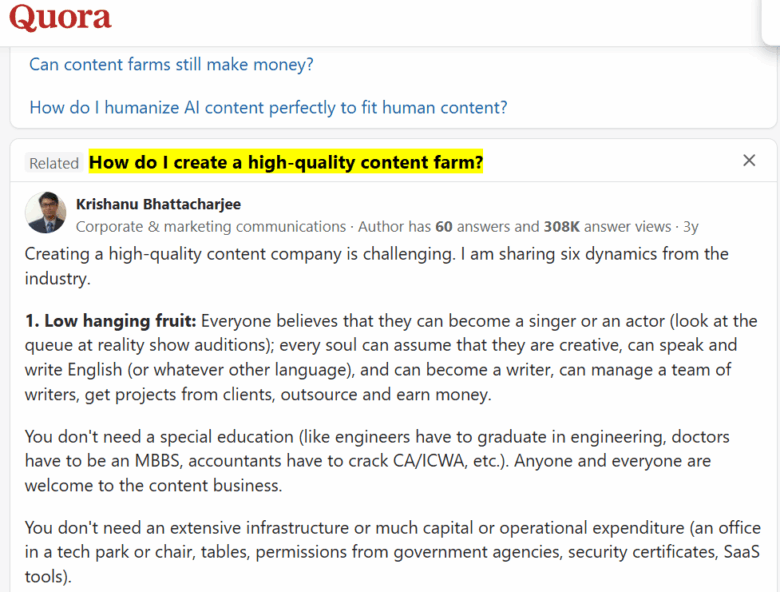
The definition of content farms, also known as content mills, is not a new notion. Forums and social media started buzzing about it over a decade ago, as you see on the Quora post example above.
So what does a content farm mean in simple terms?
Content farm meaning usually refers to a website or an account (channel) on social media where low-quality content is produced forcefully to gain web traffic and profit through advertisements. Despite being legal, content farms tend to be sanctioned by major search engines, like Google, since their existence lowers the quality of search results.
Posted by Matt Cutts on content farms, Principal Engineer, Google search and search engine spam, back in January, 2011
“In 2010, we launched two major algorithmic changes focused on low-quality sites. Nonetheless, we hear the feedback from the web loud and clear: people are asking for even stronger action on content farms and sites that consist primarily of spammy or low-quality content.”
The essence of the content farming scaling method is creating an impressive amount of content with many indexed pages or engaging posts that draw traffic through search engine results, artificial intelligence (AI) search engines, or social networks.
At this point, you might wonder how content farms relate to content scaling and programmatic SEO? Is there a significant difference?
Let’s compare.
Content farm vs content scaling
A content farm focuses on quantitative traffic generation and monetization at all costs, often using repeated or low-quality content. It emphasizes traffic over value to the readers. On the other hand, content scaling is a broader notion. According to Jasper.AI, “content scaling refers to expanding your content creation process of creating high-quality content pieces quickly and efficiently. It’s not a simple case of churning out more pieces just because you can, it’s about increasing output while still focusing on the quality of each piece, optimizing every word, and creating content that ties into customer needs and your overall business goals.”
Content farm vs programmatic SEO
While content farms create large volumes of low-value content for traffic and advertising revenue, programmatic SEO “refers to the creation of keyword-targeted pages in an automatic or near automatic way”, as highlighted by Ahrefs, and is a more narrow approach than content scaling. Publishers use automation, templates, tools, and data to create scalable pages that deliver unique, extra value for specific user needs.
Curiously enough, another point of view offered by Launchmind on Programmatic SEO vs AI content platforms states that it’s effective to combine “programmatic logic for keyword targeting and page architecture, while using AI content generation to fill those pages with substantive material.”
If you want to monetize your content or website, it doesn’t matter how big your readership is today. You can join Adsterra for free to put high-converting ads and start earning revenue right now, growing gradually as you go. Moderation takes under 10 minutes, and you are ready to go.
The evolution of content farms: from demand media to AI-powered machines
As Statista reports, global internet traffic is growing exponentially and has more than doubled since 2020. In this environment, content farms used to turn to low-cost writing marketplaces, producing tons of content across different content farm models, as we can gather from an old post from Quora cited below that discusses in detail the content farm’s numerous models.
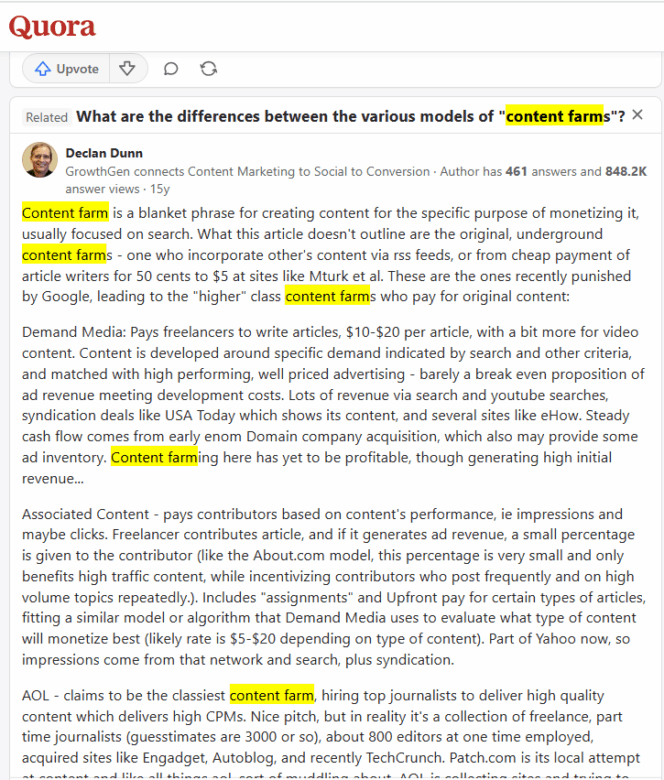
Now, AI-powered tools make it possible to run a content farm and allow content scaling by one publisher, and it has changed the scene drastically.
And we’ll talk about a variety of content-generating tools from a practical point of view in a minute.
Pros, cons, and real revenue potential of a content farm. Is it worth it?
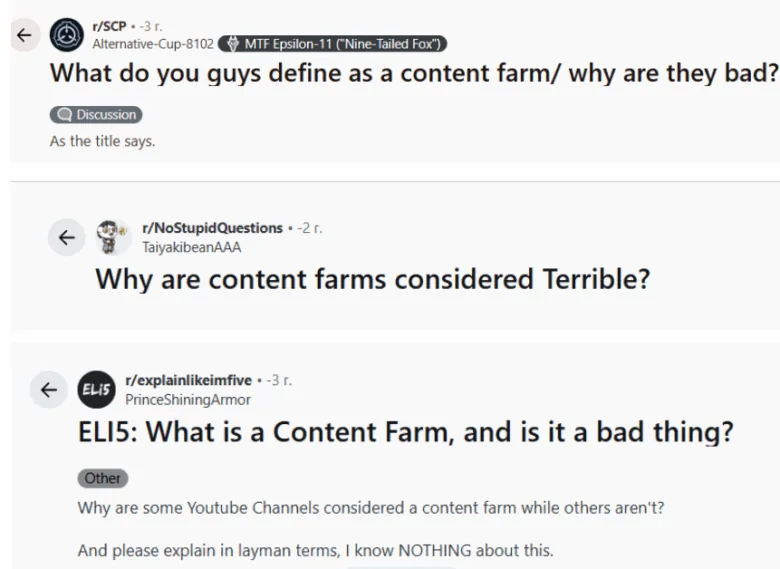
Looking into the advantages and disadvantages of content farming gives you understanding of what to avoid when expanding your content creation:
Pros
Things you can achieve when farming content:
- Gain higher SEO positions in Google and other search engines.
- Get into the Google Discover feed and enjoy occasional, huge traffic spikes to monetize.
- Achieve large streams of traffic and massive audience (but usually, it’s general, non-niche target audiences).
- Get more impressions and clicks (highly possible, without quality engagement).
Outcome: the strategy may result in quick gains, but it will not provide long-term, consistent traffic, and consequently, a stable revenue source.
Cons
- Contents don’t usually offer anything new or authentic.
- Contents may be repetitive and shallow.
- Present outdated or copied material.
- Present no new data, practical angle, or value.
- Vulnerable to quality updates and penalties.
- Random monetization: intrusive, excessive ads that overwhelm users.
Outcome. All the points eventually lead to a downgrade and loss of visibility in the search results, and to not being cited in AI Overviews or other AI search engines, which tend to skip such content. Your pages, site, or social media account can be penalized or banned.
Ethical side of content farming. How to build something sustainable?
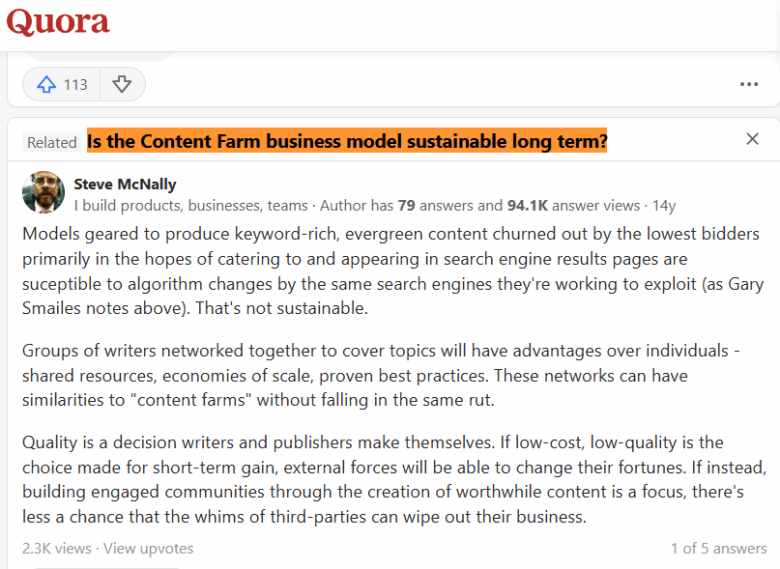

Content creators employ different tactics of growing content as content scaling, content farming, programmatic SEO, or traffic diversification when running a few pages, blogs, or websites at once on various niches. This way, creators can lower their risk of being too much dependent on a certain audience or platform and gain wider coverage as well as higher traffic volumes and higher ad revenues.
So, how can volume align with quality? Can the perks and pros of content farming be matched with value to the reader?
While scaling and using one of the available tactics for content growth, pay attention to the so-far-immortal best practices. Always emphasizing to publishers and site owners the importance of E-E-A-T (Experience, Expertise, Authoritativeness, and Trustworthiness), Google refers to the Scaled content abuse policy and Guidance for using AI for scaling content.
Cited from Scaled content abuse policy
“Scaled content abuse is when many pages are generated for the primary purpose of manipulating search rankings and not helping users. This abusive practice typically focuses on creating large amounts of unoriginal content that provides little to no value to users, no matter how it’s created. Usually, applying content stitching, using generative AI tools without adding value, hiding the scaled nature by little or no sense to a reader, but containing search keywords, scraping feeds SERPs for no-value pages.”
Spam content farms vs. high-quality content farms. Key differences

For you as a publisher, it’s valuable to keep in mind the difference between spammy content farms vs. large, quality content sites, embarking on a journey of growing content.
Let’s single out differences.
- First, from the point of view of how content is created, optimized, and presented.
- Secondly, we highlight points related to revenue, brand, risk, and long-term success.
Table 1. Operational Strategy. Spam Content Farms vs. High-Quality, Sustainable Content Farms
| Category | Spam Content Farms | Quality Content Sites / Sustainable Content Farms |
|---|---|---|
| Main Goal | Maximize clicks and short-term ad revenue | Build long-term audience trust and sustainable revenue |
| Content Quality | Low-quality, untrustworthy, repetitive, or copied content | Useful, original, researched, and relevant content |
| Publishing Strategy | Publish massive amounts of content quickly | Publish consistently with quality control |
| SEO Approach | Keyword stuffing, spam tactics, search manipulation | Ethical SEO focused on user intent and experience |
| Use of AI | Heavy automation with little or no editing | AI-assisted workflows with human review and fact-checking |
| Audience Relationship | Treat users as traffic numbers | Build community, loyalty, and audience trust |
| User Experience | Excessive pop-ups and other ads, clickbait | Clean design, readability, scannability, and helpful navigation |
| Traffic Sources | Often dependent on one platform or search engine | Diversified traffic from SEO, social media, newsletters, and communities |
Table 2. Business and Revenue Outcomes. Spam Content Farms vs. High-Quality, Sustainable Content Scaling
| Category | Spam Content Farms | Quality Content Sites / Sustainable Content Farms |
|---|---|---|
| Revenue Focus | Aggressive ads and fast monetization | Balanced monetization: combos, intuitive ad formats, ad types with higher CTRs by default |
| Credibility | Low trust and weak reputation | Strong authority and professional reputation |
| Content Lifespan | Viral or disposable content | Evergreen and regularly updated content |
| Scalability | Fast but unstable scaling | Sustainable and controlled scaling |
| Risk Level | High risk of penalties, demonetization, or traffic loss | Lower long-term platform and algorithm change risk |
| Brand Value | Weak or disposable brand identity | Strong brand recognition and audience retention |
| Legal/Ethical Risks | Higher risk of plagiarism, misinformation, or deceptive tactics | Focus on transparency, sourcing, and compliance |
| Monetization Style | Short-term ad exploitation | Multiple stable revenue streams |
| Long-Term Sustainability | Often unstable and short-lived | Built for long-term growth and resilience |
If you’re on your content monetization path, Adsterra can offer an effective ecosystem. What is it? Access a network of 16,000+ advertisers with over 230,000 new ad campaigns, advanced ads with strong CPMs and a 100% fill rate. There is also Anti-AdBlock technology that boosts revenue by up to 35% and dedicated 24/7 support through Partner Care Program for every publisher.
How to make a sustainable content farm in 8 steps? Checklist, main focus, common mistakes
Now let’s move on to the practical side of it. Of course, it is for you to decide what kind of content growth strategy you pursue for your online business and monetization. We’ll view a step-by-step process of how to build an effective, large content system that, when being scaled, doesn’t turn into a spammy content farm.
With special attention to:
- Quality content that can be trusted with all-around value to the user.
- Maintaining a smooth user experience.
- Suitable for monetization with several ways that we also uncover below, with goals and common mistakes.
- Publishers’ successful examples that generate high content volumes and revenue, with the user in mind, that we also highlight below.
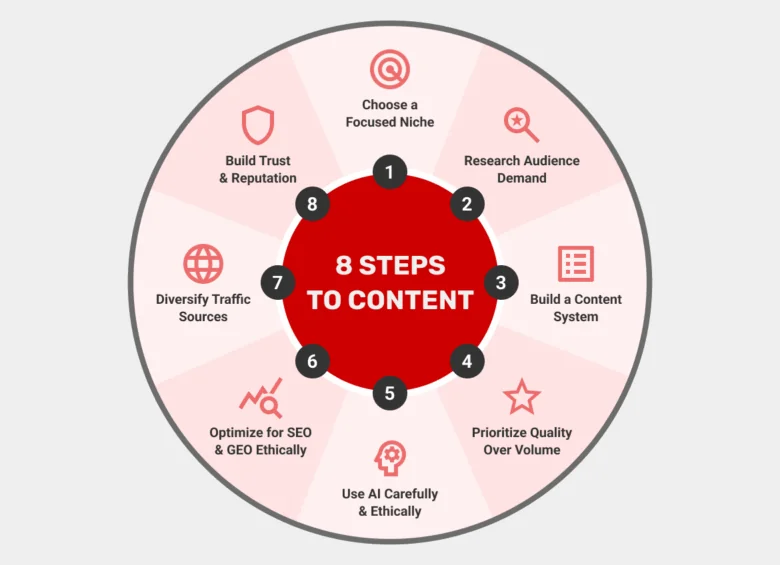
1. Choose a focused niche
Pick a topic with long-term interest and monetization potential, among them are Technology, Finance, iGaming, Sports, Books, Lifestyle, News, Anime, Streaming, Movies, Education, Fitness, Travel, etc. A focused niche helps you build authority and relevancy in one topic before setting off on your content marathon.
Your Goal is to build expertise, attract a loyal audience, and become recognizable within a specific subject area. To share unique expertise and offer solutions to the readers.
Common Mistakes. Trying to cover too many unrelated topics, chasing trends without long-term demand, and a lack of focused content that can support engagement and personalized offers for monetization.
Useful Tools:
- Google Trends helps you see long-term topic interests.
- Exploding Topics lets you find niches before everyone else does.
- Reddit and other forums to see what audiences are talking about word for word.
2. Research audience demand
Make the most of Google Trends, Ahrefs, or Semrush to find questions that people search for often. Aim for topics with consistent traffic instead of just quick-to-fade trends.
Your Goal is to create content people are already actively searching for and ensure consistent traffic growth through time.
Common Mistakes. Targeting keywords that are too competitive and only selecting keywords with high volume, ignoring target audience intent, or relying entirely on temporary trending topics.
Useful Tools:
- Ahrefs for keyword research and competitor analysis.
- Semrush for SEO (search engine optimization), search trends, and competitive analysis.
- AnswerThePublic for discovering common audience questions.
3. Build a content system
Create templates and workflows for articles, videos, or posts. Look closely into Google’s new policies and recommendations, as well as programmatic SEO best practices, and how the SEO and GEO (generative engine optimization) world evolves. It’s also worth organizing content production stages: topic research, outlines, writing and editing, SEO optimization, publishing, monitoring, while turning to project management tools.
Another overlooked area of content production is efficient updating of the old content. Consistency matters more than publishing huge amounts at once. As older content loses rankings, you need to refresh articles regularly with updated information, better formatting, and improved sources, within your flexible but consistent flow.
Your Goal is to develop an effective production pipeline with user-first content. It allows regular publishing without burnout, chaos, penalties and bans.
Common Mistakes. Lacking organization, publishing inconsistently, skipping editing, or focusing only on quantity without a repeatable workflow. Ignoring research stages to achieve content uniqueness, authenticity, and value. Abandoning old content, allowing outdated information to remain published. Ignoring analytics and performance data.
Useful Tools:
- Notion for content planning and workflow management.
- Trello for editorial scheduling and task tracking.
- Buffer for social media planning, scheduling, and analyzing content.
- Airtable for organizing a content database.
4. Prioritize quality over volume
Avoid filler content, publish information that is accurate, worth consuming, and readable by a human and by a machine. Search engines increasingly reward expertise, originality, and user satisfaction.
Your Goal is to build trust, improve retention, gain backlinks, maintain long-term search rankings, search visibility, accuracy, and relevance.
Common Mistakes. Mass-production of low-value articles, copying competitors, using clickbait headlines without fulfilling the promise, or creating content exclusively for advertising revenue.
Useful Tools:
- Grammarly for editing, content writing clarity, readability, check for AI texts and plagiarism.
- Hemingway Editor for simplifying and improving readability.
- Surfer SEO for optimizing content quality for search intent, AI visibility, also for plagiarism check and preliminary ideation.
5. Use AI carefully and ethically
AI can quicken research, drafting, summarizing, and formatting, however, many times said, humans still play a vital role. The material needs to be reviewed for clarity, ensure info’s accuracy, and add personal angles, experience, and insights. Humans have to check all the facts, quotes, and stats to keep from sharing false info. While Google says AI content isn’t automatically breaking rules, creators shouldn’t cut corners.
Your Goal is to boost productivity while maintaining quality and originality.
Common Mistakes. Publishing raw AI-generated text without review, spreading inaccurate information, or creating repetitive and generic, thin content.
Useful Tools:
- ChatGPT for drafting and brainstorming.
- Claude for long-form summarization, editing, and content tasks.
- Perplexity for AI-assisted research with citations.
Cited from Hubspot.Startups
“Content marketing is using AI tools to create text for a range of content types, from emails and newsletters (47% of users) to text-based social media posts (46%), video-based social media scripts (46%), and blogs and long-form content (38%).” And the numbers are soaring.
6. Optimize for SEO and GEO ethically
Use relevant key phrases naturally where they belong per SEO historically: in titles, headings, and content. Improve page speed (Core Web Vitals), mobile usability, internal linking, clear structure, and helpful answers. Avoid spam tactics like keyword stuffing, scaling without adding value, or copied articles.
Your Goal is to improve visibility in search engine results and AI engine citations while maintaining a good user experience.
Common Mistakes. Over-optimizing for key phrases, using deceptive, black-hat SEO tactics, ignoring technical performance, or prioritizing algorithms over readers.
Useful Tools:
- Google Search Console for monitoring the search performance of your site and pages.
- Yoast SEO, WordPress SEO optimization plugin.
- PageSpeed Insights for checking and improving site speed and usability.
- Google Analytics for monitoring content performance.
- Ahrefs Site Audit for identifying SEO issues.
- Screaming Frog for crawling and analyzing your website pages.
Cited from Google new resource for optimizing 2026 and AI optimization guide:
“Apply SEO best practices to generative AI search: Continue prioritizing foundational SEO best practices, such as building a clear technical structure and creating unique, valuable content; these are the foundation for visibility in generative AI search experiences (and Google Search overall).
Create non-commodity content that’s helpful, reliable, and people-first: Focus on developing unique, expert-led content that provides value beyond common knowledge.
Prioritize effective SEO strategies over “AEO (Answer Engine Optimization)/GEO (generative engine optimization) hacks”: For Google Search, you can ignore tactics like “chunking” content, creating unnecessary AI text files (like llms.txt), or pursuing inauthentic mentions.
Explore agentic experiences: Stay informed about emerging technologies that allow AI agents to interact with your site, such as browser agents and new protocols.”
7. Diversify traffic sources
It’s wise not to depend on search engines one for all. Diversifying content distribution for more exposure is a smart move. You can try building your audience through social media, emails, forums, videos, or partner sites. This way, your business stays stable if algorithm changes hit search engines.
Your Goal is to reduce dependence on a single platform and create multiple audience entry points.
Common Mistakes. Relying entirely on the Google traffic, trying to get to AI citations mechanically without adding value and neglecting community building.
Useful Tools:
- Mailchimp for email newsletter management.
- Discord for building and managing communities.
- Quora and Reddit for building or participating in niche forums and communities.
8. Build trust and reputation
Here, it’s a good idea to use clear authorship, do your best to cite reliable sources, and avoid misleading tactics. Maintain transparency: sustainable media businesses survive because audiences trust them. Apply monetization methods to support and even enhance user experience.
Your Goal is to create long-term credibility and audience loyalty that survive the same platform or algorithm changes as we mentioned earlier.
Common Mistakes. Hiding sponsorships, publishing misinformation, or sacrificing credibility for short-term traffic.
Useful Tools:
- Trustpilot for managing public reputation and reviews.
- Medium for growing authority-focused thought leadership.
- LinkedIn for building professional credibility and networking.
Expert tip by Patel, Online Entrepreneur and Blogger
“Balancing user experience with website ad revenue is what you aim for. Too many ads can drive away readers, on the other hand, too few ads might not generate enough income for you.”
Cited from SEO Case Study Combining Content Strategy and Ad Monetization
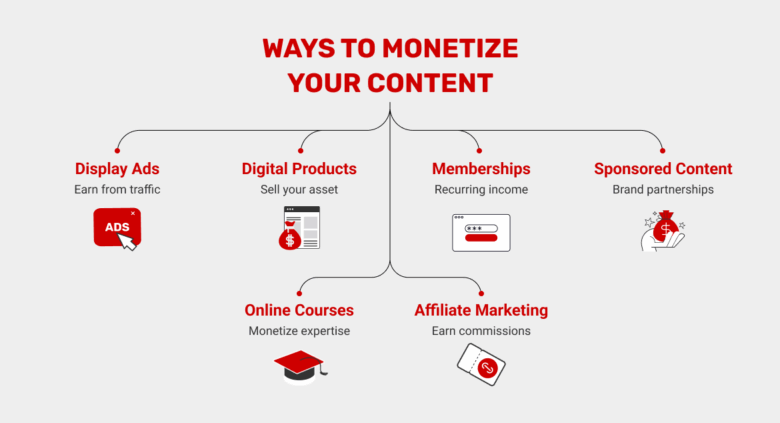
Ways to monetize your high-quality content farm
What next, then?
You have your content machine well-tuned, oiled, and harmonized to all aspects. Here, comes the monetization level.
Let’s look into monetization ways you can apply to your high-quality content mills with examples, direct goals, and common mistakes to be cautious about.
1. Display advertising
Display ads are one of the most common monetization methods. You generate ad revenue when visitors view or click ads placed on your website, social media, or videos. One of the most accessible ways to display ads on your site or landing page is through partnering with an ad network.
Your Goal is to generate passive income from website traffic.
Examples: Banner ads, Sidebar ads, Popunders, 33%-higher-CTR ad formats, like Social Bars, In-Page Push, Interstitials, etc.
Common Mistakes. Advertising excessively without mixing different formats efficiently and applying best ad combos. Making the website sluggish, ruining the user experience.
Useful Tools (Ad Platforms): Google AdSense, Mediavine, Ezoic, Adsterra, Geniee International.
You can turn to Adsterra as your display ad network and true partner. It is free. You access 16K+ advertisers and media buyers that will compete to put ads on your site. You get a variety of payout options and there is no limit on your monthly traffic, meaning you can start earning right away.
2. Affiliate marketing
Affiliate marketing programs reward you with commissions for a product sold. You enter affiliate programs by recommending products or services through special referral links. You can check out referral programs as well as affiliate programs in our ultimate guide Best Referral Programs to Earn Money.
Your Goal is to earn income without creating products yourself.
Examples: product reviews, “best tools” lists, software recommendations, forum and community activity.
Common Mistakes. Promoting irrelevant or low-quality products, overloading content with affiliate links, or losing audience trust.
Useful Tools (Platforms): Amazon Associates, Impact, ShareASale.
3. Sponsored content
Here, brands may pay you to publish articles, videos, social media posts, or reviews promoting their products or services.
Your Goal is to create direct partnerships with companies for higher revenue opportunities.
Examples: sponsored blog posts, social media integrations, newsletter sponsorships.
Common Mistakes. Accepting unrelated sponsors, hiding sponsorship disclosures, or publishing overly promotional content.
Useful Tools (Platforms): Collabstr, Upfluence, CreatorIQ.
4. Memberships and subscriptions
Offer community access to exclusive content for recurring monthly payments. It can be checklists, exercises, breaking niche news, market research.
Your Goal is to create predictable recurring revenue.
Examples: private newsletters, premium forums, members-only videos and content.
Common Mistakes. Failing to consistently deliver value or overpromising exclusive content.
Useful Tools: Patreon, Substack, Discord.
Expert tip by Jon Dykstra, solopreneur & content creator with a focus on building digital assets, Fatstacks blogger
“My favorite way to monetize a website is via display ads. Yeah, I know… bottom of the food chain and all that, but it’s liberating. Display ads allow me to focus on publishing content on any topic I like.”
5. Traffic and revenue intensifiers
Apart from the monetization ways mentioned, you can try a few more, like selling digital products or online courses. Another thing you can do is to grow traffic with extra social media groups and activities or email newsletters to own your audience independently from algorithms.
Expert tip by Muhamma K., Blogger and Developer
My email monetization strategy focused on driving higher website traffic. It consisted of building user data, launching a series of campaigns, receiving feedback on my blog, growing readership, and placing Popunder ads for revenue. My core results to accelerate advertising revenues resulted in revisit rate growth by 30%, a 12% CTR boost, and a 20% boost in overall revenue.
Cited from A Fresh Approach to Email Monetization: A 20% Revenue Boost
Real case studies. Modern content farms that succeeded
Let’s conclude with a number of projects that have idiosyncrasies of content farms, but at the same time, where user experience and content value are supported and treasured.
Let’s have a look.
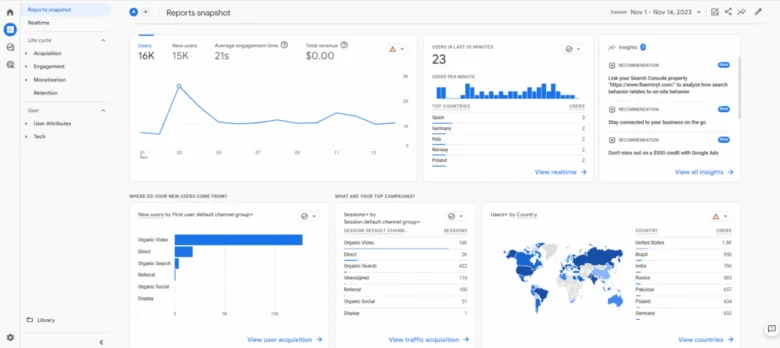
1. Case study example by Muhammad Bilal Asad, YouTube Content Creator
“My hard work paid off: publishing 2-3 videos daily led to 90+ uploads in the first month, 100-150 unique website visitors monthly. This marked a turning point, emphasizing the well mix between engaging video content and a well-visited online platform, setting my work for sustained growth.”
In the screenshot you can see the top traffic geos of Muhammad’s website.
Cited from How to Earn With Blog Site & Youtube x Adsterra
Next, we have the Google Discover strategy that goes hand in hand with generating heaps of content a day and looks very similar to farming content in meaning.
2. Case study example by Ramzan Jani, News blogger, Google Discover and SEO expert
“Our top GEO is Pakistan, and we publish in English. On average, we publish 20+ articles per day. That’s a pace that’s not for everyone, but for Discover, consistency beats perfection unless you forget about value for readers.”
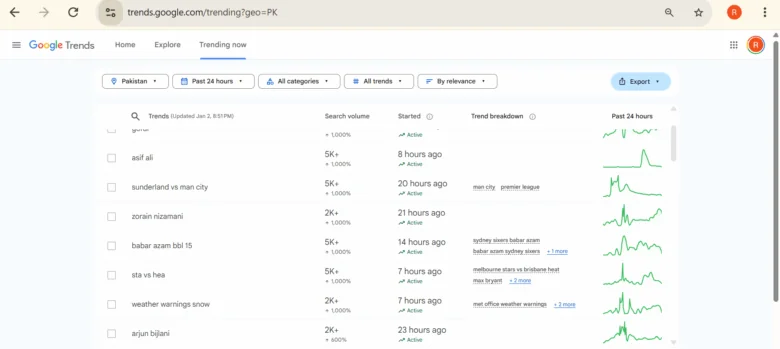
Cited from Google Discover Traffic Monetization: $1,000/Week Case Study and How to Make Money with Adsterra: Two Friends Made $2,700 Per Month
3. Case study example by Karan, News platform owner, SEO expert
“I publish consistently, about 4–7 articles a day in my niche. Google Discover needs to build a performance history on your domain before it starts surfacing your content regularly. Invest in outstanding featured images from day one (one of the most underrated factors for news sites). Expect 3–6 months of consistent publishing before Discover starts picking you up regularly. The first Discover win is the hardest, and after that, the algorithm has data to work with.”

Cited from How to Capitalize on Trending News ($7,000 Revenue Case Study)
4. Case study example by Adsterra Publisher
“I post comments 5 to 10 times a day in the X(Twitter) threads to direct users to my website blog. I have the user-friendly Social Bar ads placed that work nicely with desktop and mobile traffic.”
Cited from How I Monetize Twitter Traffic [$800 Daily Payment Proof]
Sometimes, you just have to apply other SEO and GEO best practices to increase your traffic instead of farming content creation non-stop.
5. Case study example by Patel, Online Entrepreneur and Blogger
“Rather than constantly creating new content, I developed a system to update existing articles every 4-6 months. These refreshes, like adding new information, improving examples, and enhancing readability, often result in significant ranking improvements.”
Cited from SEO Case Study Combining Content Strategy and Ad Monetization
Here is another real-world example where bloggers farm content seasonally. That said, they carefully maintain value for readers and preserve their trust.
6. Case study example by Zaeem Insha, News blogger, Google Discover and SEO expert
“During the Ramadan season, we published 8-10 tightly focused pieces per day. No long-reads stuffed with keywords, just pages that people actually needed. People kept coming throughout the day, with peak hours at 05 PM and +04 AM GMT+5. The advice is to treat utility pages like tools, not content farms.”

Cited from Ramadan Content Case Study: How Seasonal Website Made $5,500 in One Week
Once you grow your content and earn with Adsterra, we’re happy to hear and share your success story with the community on our blog. For each such story, we have prepared for you a real bonus.
How to make a content farm: FAQ
Are content farms illegal?
Content farms are typically legal. However, some of the actions associated with content farms might violate laws and platform policies. It may include copying of articles, pictures, and video clips without the rights holders’ consent, fraudulent advertising or scams that deceive users for views and financial gain, using SEO techniques that involve spam and other unethical tricks to boost search rankings, fake information dissemination that causes harm to people.
How does a content farm work?
Content farms work by generating loads of low-quality content fast using large amounts of freelance writers or AI tools and attracting the highest volumes. Then, traffic is monetized through various kinds of ads, which can appear abundant to users. Alternatively, publishers can well match content value with coverage of most users’ queries within the relevant field, use new tools to accelerate the process and monetize with advanced, intuitive ad formats used moderately, like affiliate links, smartlinks, and social bar ads.
How do content farms make money?
Content farms make money by placing affiliate links, smartlinks, popunders, in-push push ads, native banners, etc. Content farms stand for the production of a large volume of content, where the content volume is prioritized over quality, and it contains ads for content monetization. If it is a sustainable content farm that generates high-quality content, then it can also make money from sponsored content from brands, donations, gated exclusive content and subscriptions, merchandise, etc.