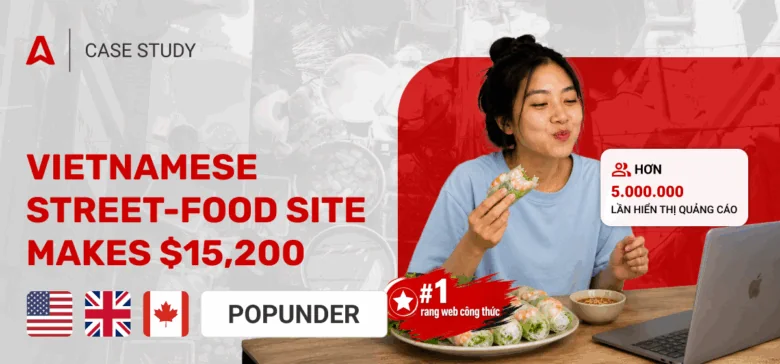
A Vietnamese recipe blog earns $15K monthly thanks to its owner’s ability to blend TikTok virals, street-food authenticity, and Popunder monetization. This story is told by Khôi, a publisher with a big soul and passion for numbers. He monetizes global traffic just like our publisher who makes a profit with a Japan nightlife website.
My name is Khôi, and I spent six years selling bánh mì, bún bò Huế, and cháo lòng from a cart outside a market in District 4. I don’t do that to tell you a story. I do that for hard numbers. The reason is that’s exactly how my mind works-everything is measured, you know the profit margin, and you’re constantly looking for possibilities.
Knowing the cost per portion, I learned to count the cost of impressions. My job taught me to think globally and to find the best audiences to sell to profitably.
If you ever wondered how a Vietnamese recipe blog can make $15K, the answer is to know the cost per portion and impression.
Disclaimer:
The story was translated by the Adsterra Content team. We had to depersonalize web screenshots and remove sensitive data to protect the publisher’s privacy. We tried to keep the copy authentic, but we may have misinterpreted local naming or slang. Please be tolerant of this 😉
How much does my recipe blog make?
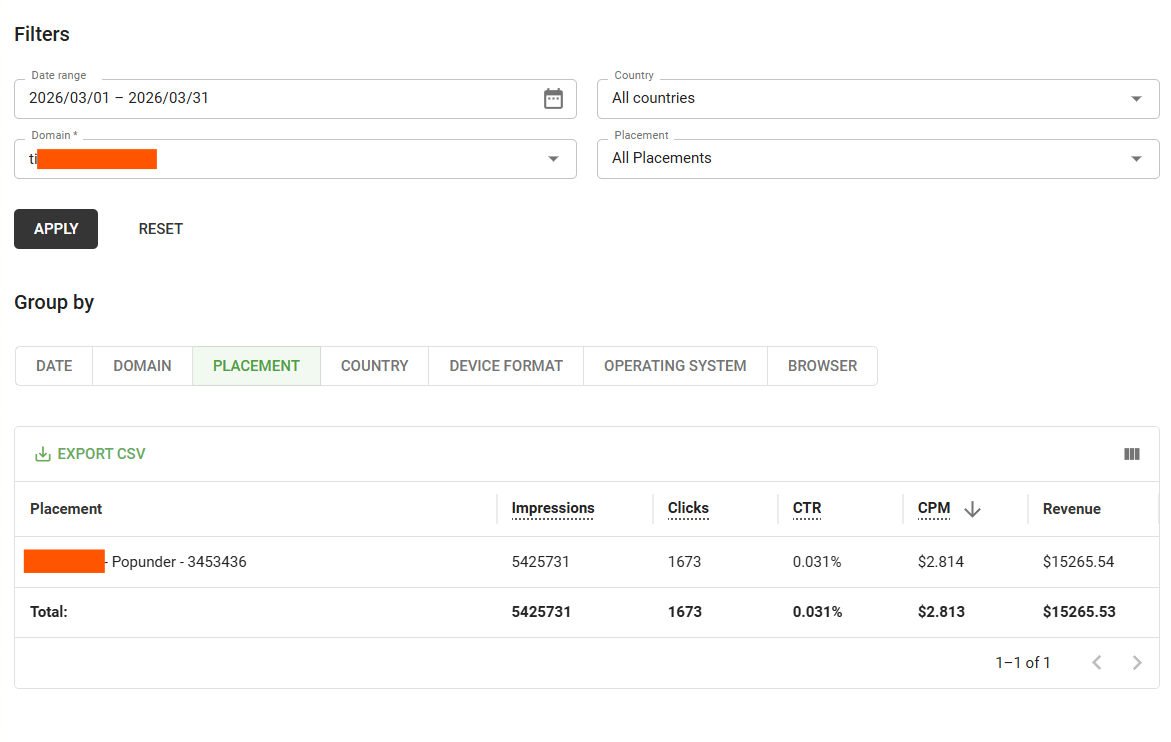
In March 2026, my blog generated 5,425,731 Popunder impressions and $15,265.53 in revenue at a blended CPM of $2.813, with Popunder placement. Below is the revenue proof from the Adsterra account.
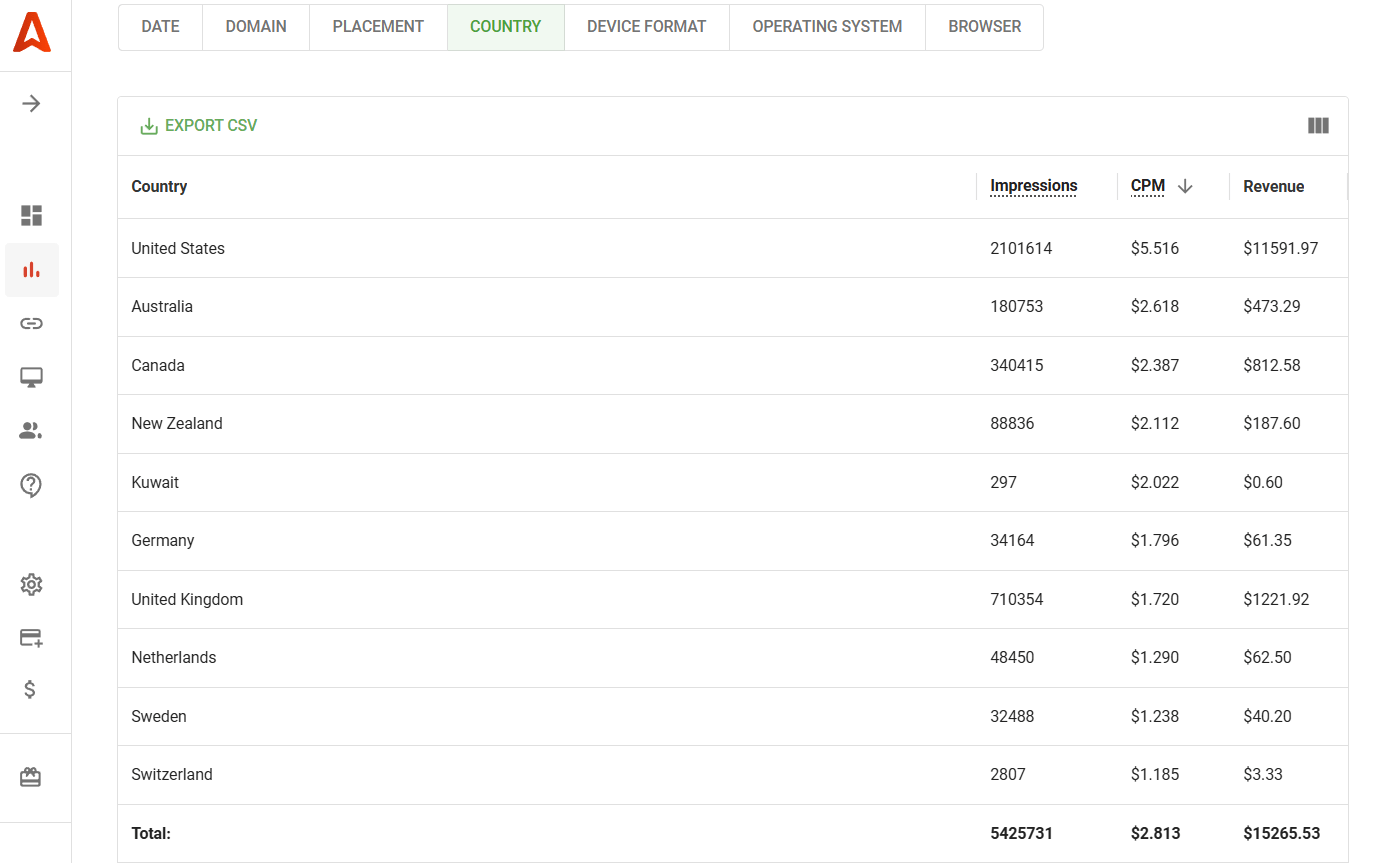
The United States sent me 2,101,614 impressions at $5.516 CPM, which alone generated $11,591.97. That’s 75.9% of my total monthly revenue from one country where I have never lived and where not a single person I know personally has eaten my food.
I will try to walk you through how it happened, why it keeps happening, and what I have learned about the mechanics of this kind of revenue.
Content strategy for a Vietnamese recipe blog
My blog publishes Vietnamese recipes. Not general “Asian cuisine” fusion for a Western cooking audience. I never adapt, soften, or ingredient-substitute versions of Vietnamese dishes. Only authentic recipes with real proportions, techniques, and ingredient names transliterated into English with sourcing guidance.
I cover dishes that most Vietnamese food content in English does not cover seriously. Examples:
- Regional variations of pho that differ between Hanoi and Saigon.
- Specific fat ratios in heo quay skin for crackling.
- Differences between the bánh mì bread in Ho Chi Minh City and the one sold in Vietnamese-American bakeries in California.
- How to properly prepare bún riêu cua so the crab paste forms correctly rather than dissolving into the broth.
These are the details that matter to someone who is genuinely trying to cook Vietnamese food, not someone who wants to put a hashtag #Vietnameseinspired on their Instagram dinner.
This level of specificity is not an accident; that’s my deliberate SEO strategy and traffic model.
The traffic model: long-tail search and TikTok
My traffic comes from two sources, and they work together in a way that I designed carefully.
Traffic source one: organic search (long-tail queries)
Most food bloggers try to rank for “pho recipe” or “Vietnamese food.” These are high-volume, extremely competitive queries dominated by sites with domain authority and publishing infrastructure I cannot match. I don’t compete with them. Google AI Overviews competes and eats them up.
My traffic model differs because I target queries like:
- “Authentic Vietnamese pho broth recipe with beef bones hours”
- “How to make hủ tiếu Nam Vang at home outside Vietnam.”
- “Bún bò Huế recipe with mắm ruốc where to buy USA”
- “Vietnamese caramelized ginger fish cá kho tộ clay pot authentic”
- “Bánh cuốn tráng miệng filling steamed rice rolls filling recipe”
These queries are searched by people who already know what they want to cook. They’ve already decided. They’re not browsing for inspiration but executing a plan just like me. People like this are explorers and adventurers; they are loyal to any side content if I give them what they need.
I target the highest-intent traffic and people who are ready for experiments. That’s why my Popunder CPM stays high: people eat ads the same way they grab recipes.
The high CPM for secret
I will explain the CPM connection directly: advertisers behind any network price your website based on the commercial value of the audience. If users are sensitive to ads or passively consume content for a few seconds and then leave (high bounce rate), you won’t get high CPMs.
My audience skews toward genuine cooks instead of passive food content consumption. I provide exceptional content, they read more, and they’re watching ads along the way. Ads are also relevant: Adsterra sends me apps, desktop games, and iGaming Popunders matching most of the US visitors.
That is why a food blog earns a $5.516 US CPM on Popunder: the search intent behind my traffic is exceptionally commercial, and the audience is loyal to ad content.
Traffic source two: TikTok (organic, no paid promotion)
I post short videos on TikTok showing the technique-intensive parts of Vietnamese recipes:
- The sound of properly rendered pork fat.
- Visual tests for when your caramel has reached the right color.
- The cross-section of a correctly assembled bánh mì sandwich.
These videos show the result and the key technique, then I say directly: “Full recipe with measurements and steps + the link to my blog.”
I have not monetized TikTok itself yet. I use it purely as a distribution channel of social media traffic. The account has no direct commercial integration; it exists solely to drive traffic to my blog, where the Popunder serves as the monetization mechanism.
Why TikTok?
I’m getting direct, high-intent traffic to my blog. These viewers who were just watching me make the dish will want to see the recipe, and when these visitors get Popunder impressions, they don’t mind too much. TikTok is a traffic amplifier, and my revenue goes up when traffic increases significantly.
Popunders are a primary way to earn from my blog
If you’re asking yourself how exactly a Vietnamese recipe blog earns, my answer is simple: I place Popunder on every page. It may sound aggressive, as if I were feeding users ads on every mouse hover. But it’s not. The optimization behind this works like this: users won’t see one ad twice per session, and they won’t see more than 3 different ads.
Popunders match my visitors’ behavior
Another reason for choosing Popunders is my blog audience. Food content lovers arrive with a specific mission: they want a recipe. They will land on the page, read through the ingredient list and method, save the page or take a screenshot, and then leave to cook. User sessions are brief and purposeful, averaging 2.5-4 minutes. For this user behavior pattern, Popunder is the correct format because the trigger timing can be aligned with the completion of the user’s primary goal.
I see exact metrics and revenues
The numbers from the Adsterra Popunders remain steady: what’s on my dashboard is what my payment is. That is what I demand of my business, and I do notice and hate being ripped off. Two networks I already found doing the same: inflating CPM and earning but not paying that amount, so I stopped working with them quietly.
My audience in numbers
I am Vietnamese, and all my recipes are Vietnamese. My knowledge comes from six years of commercial cooking. But my publishing language is English, my SEO targets English-language queries, and my revenue comes primarily from Tier-1: the United States, the United Kingdom, Canada, and Australia. These two things are not in conflict; they are a strategy.
Full country performance example
| Country | Impressions | CPM | Revenue |
| United States | 2,101,614 | $5.516 | $11,591.97 |
| United Kingdom | 710,354 | $1.720 | $1,221.92 |
| Canada | 340,415 | $2.387 | $812.58 |
| Australia | 180,753 | $2.618 | $473.29 |
| Mexico | 242,501 | $0.888 | $215.46 |
| New Zealand | 88,836 | $2.112 | $187.60 |
| Spain | 200,359 | $0.787 | $157.60 |
| South Africa | 193,657 | $0.479 | $92.70 |
| Netherlands | 48,450 | $1.290 | $62.50 |
| Germany | 34,164 | $1.796 | $61.35 |
| Total (all countries) | 5,425,731 | $2.813 | $15,265.53 |
The US accounts for 38.7% of my impressions and 75.9% of my revenue. The CPM is $5.516 versus the next-highest of $2.618 from Australia, which reveals that users from the US consume ads better (more views, more sales for advertisers).
The UK generates 13.1% of impressions, but has the highest CPM at $1.220, making it the biggest underperformer relative to its impression share. I’ve been discussing this with my Adsterra account manager. His reading: the UK visitors watch ads willingly but make fewer sales, and that’s specific to this season.
And the question most publishers will ask: how to monetize a Vietnamese recipe blog without targeting Vietnam? The answer is simple: my blog is written entirely in English. My content targets users who are searching in English for Vietnamese recipes. I target audiences who already know how to make these dishes; I target people outside Vietnam who want to learn.
This is a deliberate geographic inversion of what most Vietnamese food publishers do.
Strategic scaling: what I plan to do
I’m currently testing In-Page Push as a second format on the blog, which my Adsterra account manager suggested after my data showed strong US CPM performance.
My logic for adding it is direct and clear: In-Page Push and Popunder address different user moments. Popunder fires outside the current page. In-Page Push fires as a notification-style element at the bottom corner of the screen, independent of the user’s navigation behavior.
I plan to add it as a revenue source, since my manager says the advertisers for Popunders and Push are typically different. I previously sent my manager a snapshot of the report that only showed Clicks and CTR. They only appear if your ads require clicks, like push or banners. I will measure CTR, CPM, and revenue by major country.
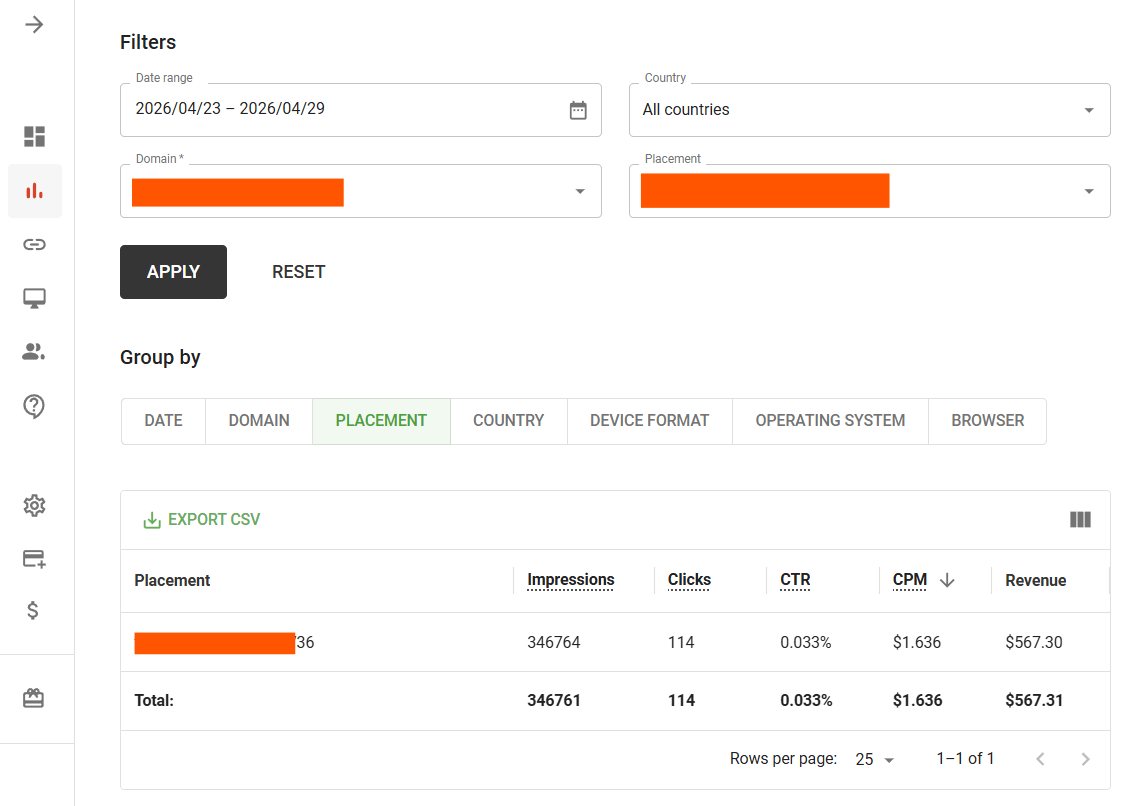
My current test doesn’t include all blog pages. But after 7 days of running, I clearly see an extra money of $567. Even with CTRs lower than I expected, this format definitely deserves further tests!
My final advice to publishers
While it’s easy to say “believe in yourself and work hard.” You already know about this. I would suggest you cultivate the moneyflow-mindset of “where will my skills be appreciated?” Track CPM per source of traffic (countries, devices, browsers) and not an average of money flow. Include traffic from TikTok or Facebook if you can; there is always high demand for social views. Make tests, tests, and more tests.