The digital banner advertising market is soaring worldwide, and one of the strategic metrics here is ad fill rate. It’s especially useful for publishers, and it naturally connects with viewability, demand quality, ad inventory, and long-term revenue optimization.
But what if you don’t have to calculate ad fill rate for your traffic monetization activities and spend months optimizing it? What if you can have a 100% ad fill rate by default? That means you have ad space filled in with quality ads shown on your website continuously. In its turn, it most profitably influences your ad revenue.
Today, we put together the missing pieces for the ad fill rate puzzle and plunge into all you need to know, including the generally accepted formula, examples, and best practices.
For those who do not want to wait to try the 100% ad network fill rate with Adsterra, go through quick moderation of your website right now 🤗. It takes under 10 min, and you can start monetizing with the highest fill rate today 😊.
What is fill rate in advertising?
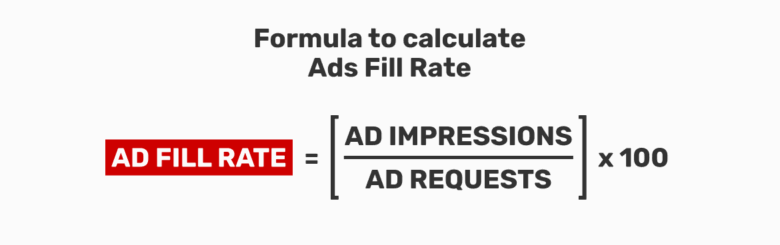
Ad fill rate is a metric that highlights the ratio of ad requests with the end number of ads displayed on the publisher’s website. A fill rate in digital advertising is an important metric alongside CPM (cost per 1000 impressions), RPM (revenue per mille), viewability of your ads, and click-through rate (CTR).
How to calculate ad fill rate? Formula and example
If you want to calculate ad fill rate, you can resort to the standard fill rate formula for advertising:
Let’s assume that you own an iGaming blog, posting fresh updates and hot news in the niche. There is 100 percent of the total number of ad inventory posted at various places on your site. Maybe even an ad combo. Your fill rate will refer to the percent of ads that you actually showed to your iGaming audience out of all those inventories. So, if you succeed in showing ads in only 70 of ad inventories, then the fill rate is 70%.
Your Ad Fill Rate = (70 : 100) x 100% = 70%
What’s a good fill rate?
You can find a few interpretations in the advertising community of what a good ad fill rate is. For instance, ad fill rate revenue impacts advertising monetization, and it is more profitable for a publisher to have a higher fill rate. Or, that a fill rate is a more complex substance with a few moving parts that you need to constantly optimize. However, one thing is clear — 100% fill rate with quality ads gives you an advantageous monetization kick-off at the start by all means.
If your ad network is capable of providing a 100 percent fill rate for ads served, it indicates there is only one thing you need to worry about now — growing and nurturing your audience and maintaining your traffic. If you want to go a little further, you can choose which available ad space to use on your website, for what particular ad format, and when. You compare the performance of ad units and types of ads that work for your audience best and optimize ad placements for more revenue.
Adsterra delivers a 100% ad network fill rate for its publishers and has no minimum impression threshold requirement for a publisher’s website. Adsterra partners with over 16,000 advertisers and solid businesses that are eager to invest to show ads. You can register now to see how it works from your personal account.
Common reasons for low ad fill rates
It’s still useful to understand what can cause a low ad fill rate percentage. Let’s imagine you are a news site publisher, and you partner with an advertising platform, an ad exchange, or advertisers directly. Then, it may be technical issues, limited advertiser demand, or publisher-side settings that reduce the ad fill rate or eligible bids for your ads.
For convenience, we’ll break it down into categories:
| Cause | Common Issues | How to Improve |
|---|---|---|
| Technical Errors | Slow page speed, ad server errors, incorrect ad tags, auction timeouts, unsupported creatives. | Optimize page performance, fix ad tags, monitor server health, and reduce latency. |
| Limited Advertiser Demand | Insufficient-demand geographies, niche audiences, seasonal fluctuations, limited competition. | Add more ad demand partners, partner with ad networks, diversify traffic sources, and prepare for seasonal demand peaks. |
| Publisher Settings & Strategies | Blocked advertiser categories, limited ad formats, restrictive placement rules. | Test new ad formats, expand demand sources, and optimize ad placements. |
Technical issues
Sometimes technical issues can make it difficult for the advertisements to be shown even in the case of existing demand for them. Some of these technical issues include slow loading time, ad server errors, bad code, latency issues, and unsupported formats of advertisements.
Limited advertiser demand
There is a difference in ad demands due to several reasons, including geography, time of year, type of the target audience and even niche of the website itself. This means that traffic coming from locations with less number of advertisers or off-season for advertisement campaigns will probably have lower fill rates.
Publisher settings and strategies
There are several strategies and actions by which publishers can end up decreasing their fill rate unintentionally. For instance:
- Setting prices higher can lead to low bids by advertisers if you work with an ad exchange or programmatic advertising.
- Limiting the demand sources, say, mainstream or niche ads, can result in fewer impressions for your ads.
Expanding demand partners and optimizing ad placements can improve inventory application without sacrificing user experience or long-term revenue.
Ad fill rate vs. eCPM
Although ad fill rate and eCPM are equally important publisher metrics, they are different ways to measure the effectiveness of the ads. The ad fill rate shows what percentage of ad requests is successfully filled with ads, thus showing how good you monetize your inventory.
On the other hand, eCPM shows the average revenue that you make for one thousand impressions independently of the pricing model, comprising clicks, conversions, and impressions for revenue calculations.
High fill rate does not necessarily mean high revenues. For instance, filling all the ad requests with less valuable ads will boost your fill rate but decrease the overall eCPM. The opposite approach, when you accept fewer, but more valuable bids / placed ads on your site, may lower your fill rate but increase revenues dramatically.
Best practices for publishers. Ad formats, targeting, and technical setup
Maximizing ad revenue isn’t just about increasing your ad fill rate, it also requires creating a positive user experience, being ready for quality demand, and continually optimizing your setup.
Here are some proven key takeaway practices to help publishers get the most from their ad inventory.
1. Recover revenue with anti-adblock solutions
Blocking of ads causes loss of fill rates and earning potentials. The use of anti-adblock solutions will make sure that you get back the lost ad opportunities and lost ad revenue. Some ad networks have anti-adblock solutions that will make sure that publishers can increase their revenue by around 35%.
Expert tip: You can learn more about the robust solution and how to apply it to your website for more revenue in the guide Ad Blocker Detection: Tools and Techniques for Publishers.
2. Prioritize user experience (UX)
More advertisements do not necessarily equate to increased earnings. Too many popups, autoplay video ads, or overlapping ads could irritate the website visitors and drive up bounce rates and disengagement. Therefore, rather than cramming too many ads together, the emphasis should be on effective ad placement and workable ad combos. For instance, Popunder, Social Bar, and Smartlink.
Example: When you see high bounce rates and low session times on your website, as shown in analytics tools such as Google Analytics, you may try to reduce ads or substitute ads for less intrusive units.
3. Test different ad format combinations
And it’s never too many times to mention. Every website has its own audience, so there is no universal advertising strategy for all. Try various options for ad format combinations (combos), which can help achieve the best balance between earning money and creating an acceptable experience for the site’s users. Select formats that complement your content rather than interrupt it. Above-the-fold placements, in-content native ads, Smartlinks, Social Bar units, and Popunders, needing no ad space at all, perform excellent.
Case study example: An Indonesian publisher applied and tested a combo of Native Banner and Popunder for the most profitable approach for the specific audience in the entertainment niche, bringing $8,700 in monthly payouts.
4. Optimize for seasonal demand
Advertiser demand changes with the season, where important shopping and holidays cause high demands. Make sure that your website is ready ahead of time when there are important events like Black Friday, Cyber Monday, Christmas, or other holidays and sports events.
Example: Make sure that you are capable of handling increased traffic, coming to your website before the launch of seasonal ad campaigns.
5. Use frequency capping to prevent ad fatigue
Frequency capping simply means that the same advertisement is not seen by the same user more than planned. It improves both user experience and the efficiency of the campaign as well. Showing the same ad creative repeatedly decreases the CTR.
Case study example: A Vietnamese recipe blog generates over $15,000 in monthly ad revenue using primarily Popunder ads, with 5.43 million ad impressions at a blended $2.81 CPM. The secret of such a success is the non-aggressive use of the ad format. To maintain a positive user experience, the blog owner utilizes the following capping: Popunder exposure is limited to three ads per user session, users won’t see one ad twice per session.
6. Focus on high-quality traffic
Advertisers require authenticity from the audience. Quality traffic generated through SEO & GEO techniques, high-value content and loyal readership tends to attract more advertisers, and hence increased fill rate and CPM.
Example: A technology blog targeting its readers would earn more CPM than a website without a focused niche and consequently generic-interest traffic.
7. Continuously test and optimize
You can test your ad placement, types of ads, and frequency caps regularly in order to find out what will provide you with the most benefit.
Case study example: Setiawan, a publisher from Indonesia, owns a visual search + long-tail image aggregation engine. As most of his traffic comes from image discovery and quick search, without high click rates, but users can visit numerous pages and are likely to convert from these views and rare clicks, he asked Adsterra to optimize ads for CPA/CPM campaigns 70%/30%. This strategy generated $4,000–5,000 per month, proving that matching ad optimization to user behavior can significantly improve monetization even with relatively low click-through rates.
8. Partner with reliable ad networks
The advantage of working with a reputable ad network includes premium advertiser demand, optimization technology, anti-fraud protection, and a professional support team. The right partner could assist in improving the fill rate and ensuring maximum efficiency of ad impressions.
Looking forward to maximizing your ad fill rate to 100% and earning money from your website? Join Adsterra and enjoy from day one: high CPM, Anti-AdBlocker, variety of ad formats, and a timely and caring support team with 24/7 live chat support.
FAQ
What is the average ad fill rate?
The best average fill rate results in digital advertising are usually between 80 and 95%. If you partner with Adsterra, it ensures a 100% fill rate with quality ads for your website. If you are a team of one, it’s better to balance your ad fill rate with increased eCPM that calculates all revenue generation from clicks, ad impressions, and other targeted actions set by the advertisers.
What is considered a good ad fill rate benchmark?
A good ad fill rate should range anywhere between 80%-95% even though the ideal benchmark for ad fill rates varies depending on your market niche, audience type, traffic sources, and geographic location. Some premium publishers with high advertiser demand will easily hit a 95% fill rate and beyond. On the other hand, some ad networks, like Adsterra, can offer a 100% ad fill rate benchmark without needing you to work on the metric yourself.
Which types of ads typically have the highest fill rates?
Ad formats like standard displaying ads and native ads usually have high ad fill rates because of historically higher advertisers’ demand for these placements. That said, formats like Popunder ads in the iGaming, Sports, and Sweepstakes niches are conventionally successful, and Social Bar ads across a variety of niches also show great results due to their interactive, non-intrusive nature.