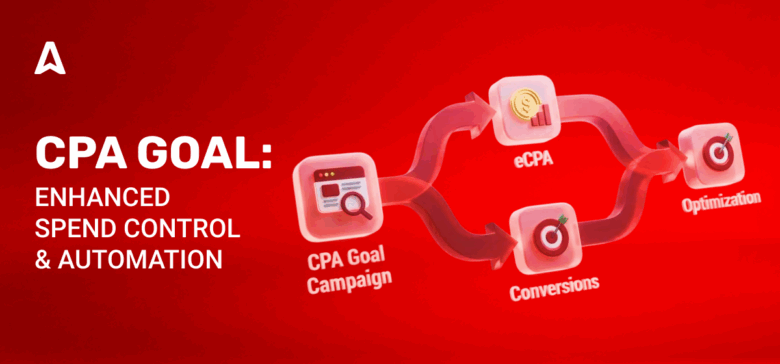
CPA Goal is an advanced algorithm for maximizing ad spending. Performance marketers can auto-optimize CPM/CPC traffic for conversions and limit expenses using smart rules. CPA Goal addresses the main challenge of large-scale use acquisition—converting traffic volume into value. This guide details the benefits of using CPA Goal and provides a clear, step-by-step setup process.
Important updates:
- Two rules in one: Add two CPA Goal rules per campaign, combining filters by conversions and by eCPA.
- Protection period: Set the period during which placements are protected from unlinking.
These settings become active right after you set them live, so you can fine-tune traffic more accurately and achieve the ideal balance between cost and performance.
CPA Goal’s benefits for advertisers
- Quality over quantity: Move beyond bulk impression buying. Our system optimizes your campaign based on critical marketing performance metrics: spending, eCPA, and conversions.
- Cost-efficiency with targeted traffic: Secure top-performing traffic while removing unwanted placements by simply setting clear unlinking rules.
- Tailored performance with flexible controls: Create template rules, add combinations of rules, and change placement protection settings.
- Automation for performance management: If an ad placement meets your KPIs despite hitting the spend threshold, we keep it. We recheck it 9 days later to confirm KPI adherence, protecting you from overpayment or false unlinking.
*You can change the protection period and return unlinked placements. We’ll get these topics covered later on.
Why do you need CPA Goal?
This feature is vitally important for advertisers who put user actions (CPA) as their KPI but acquire traffic using CPM or CPC pricing models.
Formerly, you had to manually blacklist placements that spent too much and delivered poor results. Now, you possess a game-changing tool to save CPM/CPC budgets and continue getting the best traffic.
CPA Goal automatically unlinks placements that get flagged by the criteria you set, either eCPA or the number of conversions. No more jumping between your tracker and Adsterra to create a blacklist: our intelligent algorithm will do all the jobs and keep an eye on your ad spend.
eCPA stands for “effective cost of conversion.” The eCPA formula will be = Spending / Number of conversions.
How CPA Goal works: Learn and apply
You maximize ad spend and enhance performance when buying CPM or CPC traffic. Three parameters are needed here:
- Spending limit (when the algorithm must review an ad placement)
- Conversions (the minimum number you expect to have within a placement)
- eCPA (or the average cost of one conversion)
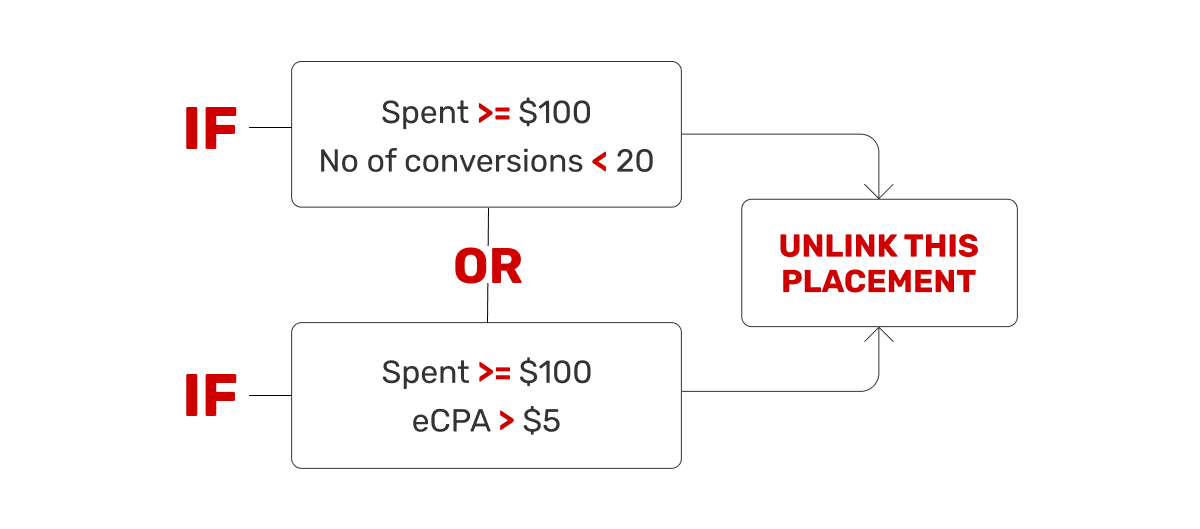
Let’s see how a rule works. First, you enter a critical spending amount. Upon reaching this spending, our algorithm will check if an ad placement complies with the next vital parameters:
- conversions
- eCPA (or the average conversion cost)
Case study: eCPA twice lower with CPA goal
Here is how CPA Goal helped our direct advertiser, a local online store. A Brazilian e-mall was launching a promotion aiming to embrace new audiences. Thanks to smart rules, our advertiser managed to reduce eCPA almost by half, while growing the number of shopping orders and ROI.
Background:
- Vertical: E-commerce
- Conversion flow: first order
- Geo: Brazil
1st campaign
- 14 days
- CPM pricing (no auto-optimization)
- eCPA = $12
- 2327 conversions
2nd campaign – with optimization
- 14 days
- CPM pricing with CPA Goal added
- Rule: If eCPA is >$7, then unlink the placement
- eCPA = $6–7
- 2619 conversions
Smart rules allow for managing huge traffic volumes and achieve your desirable KPIs (conversion price or volume) much faster.
How to use CPA Goal optimization by Adsterra?
Before you start
You need an Advertiser’s account. Please remember to confirm your email while registering. Your next step after the registration (if you plan to acquire traffic) is putting funds, but we will now skip this part. With Adsterra, you can access any feature without topping up the account.
S2S tracking is a must for any conversion-based activities, so please ensure you have set it up.
Step 1. Create a campaign
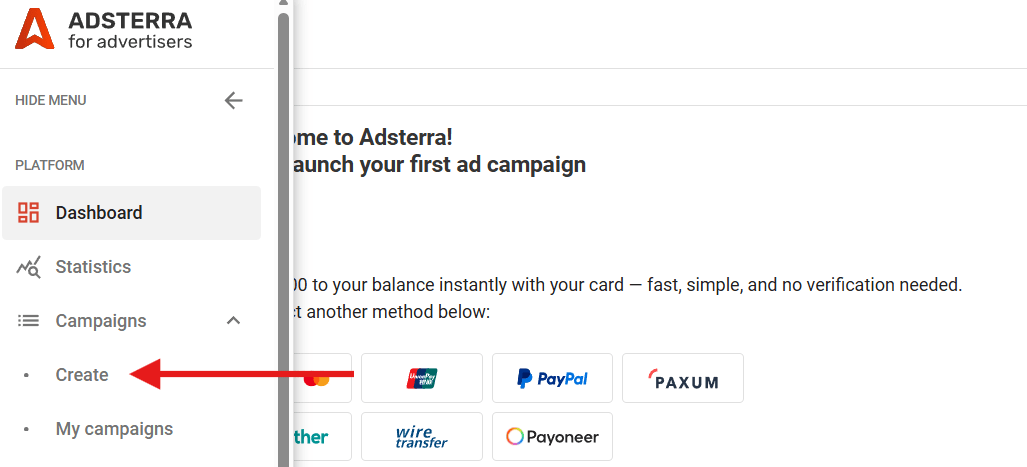
From the vertical menu, hit Campaigns > Create.
To go live, you’ll need to enter all the Required Settings. Please add your campaign name, pick the ad unit (e.g., In-Page Push), choose traffic and connection type, decide on the device type, and add your landing page’s URL.
Remember to include the ##SUB_ID_SHORT(action)## token to the URL and match it with your tracker’s “clickID”.
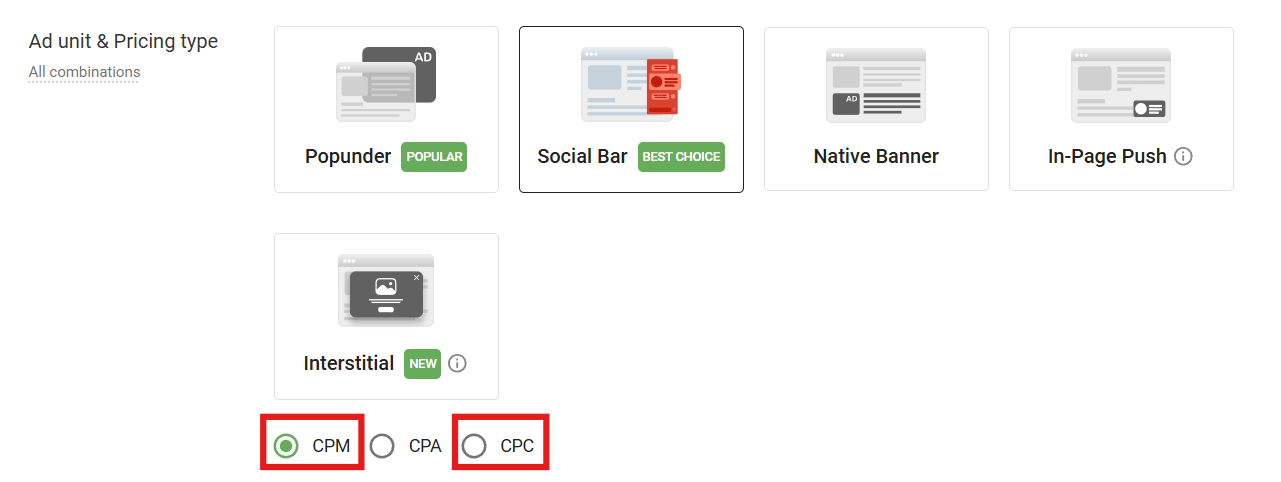
To enable further optimization, pick CPM or CPC pricing type. Then, choose a country and add a payout (bid). You can use the Traffic Estimator’s clues and enter the recommended bid.
Please note that if you select a CPA campaign, the CPA Goal option will not appear on the page.
One more thing left to enable CPA Goal: jump to Step 4 – Advanced settings. Scroll to the CPA Goal section. Let’s now add a new rule.
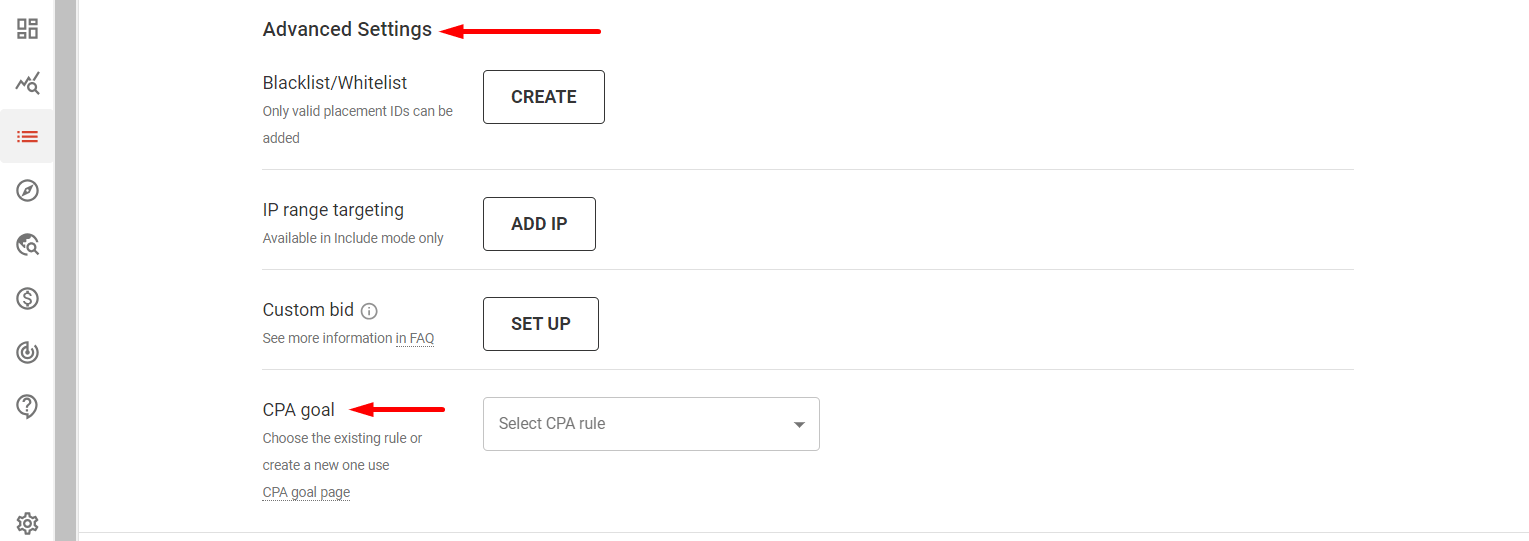
Step 2. Create a rule
Ok, you’re about to add a new rule. Use any of the following 2 methods. From the drop-down list ‘Select CPA rule’ select Custom to add a unique rule per campaign. Or, click on the CPA Goal page link to add a rule you will then apply as many times as needed.

Let’s now select Custom. First, enter the critical spending amount (the money limit per placement). By hitting it, you command Adsterra’s intelligent algorithms to check all ad placements. Please enter this amount in the Spent field ($).
Next, add optimization parameters that signal our system to unlink a placement when it reaches this mark. These can be either eCPA or the number of conversions.
Let’s now draft a compound rule. It will unlink a placement if it reaches the $1 spending floor while delivering fewer than 1 conversion. The same rule checks whether the placement’s eCPA exceeds $1 when spending $10. Both rules will operate under the “OR” logic. See the example below.
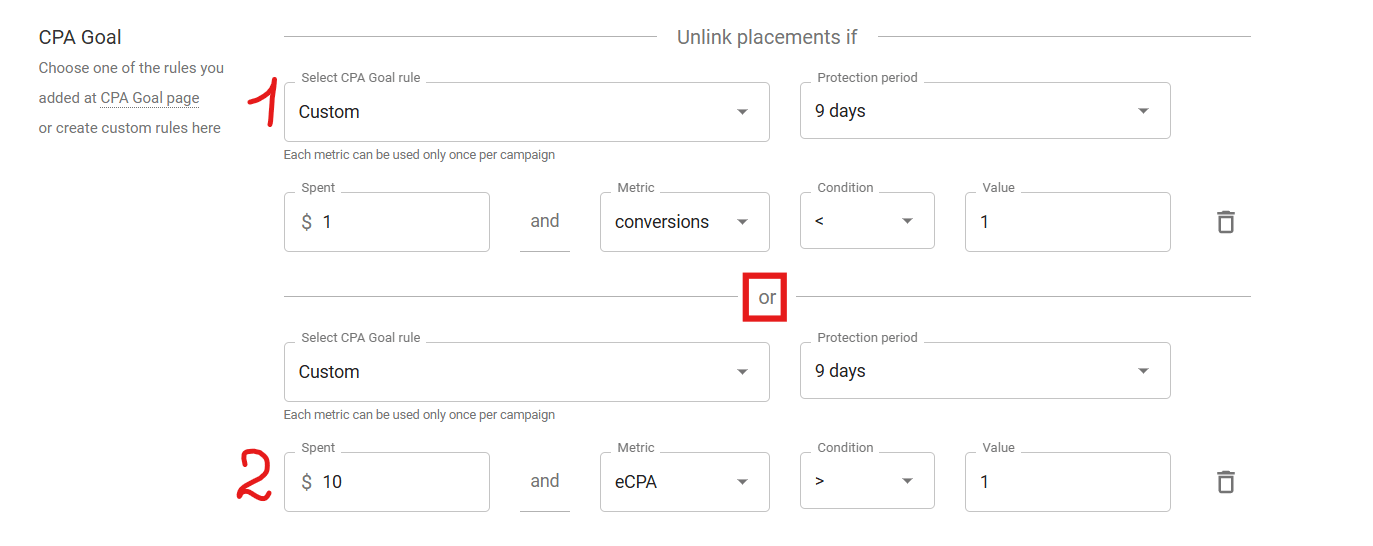
Keep the default protection period (9 days). For further performance optimization, you can adjust the protection period.
The protection period plays a critical role in traffic optimization. When a placement reaches the spend floor, CPA Goal verifies if it falls under the rule’s conditions. If yes (eCPA is high / few conversions), the placement is unlinked regardless of the protection period. But if the placement hasn’t triggered the conditions, CPA Goal can protect it for a desired time.
Please note: Changing of the rule conditions (eCPA/conversions) clears placement protection and restarts placement evaluation with the initial settings. If it’s only the rule name you want to change, all settings remain as is, including the protection period.
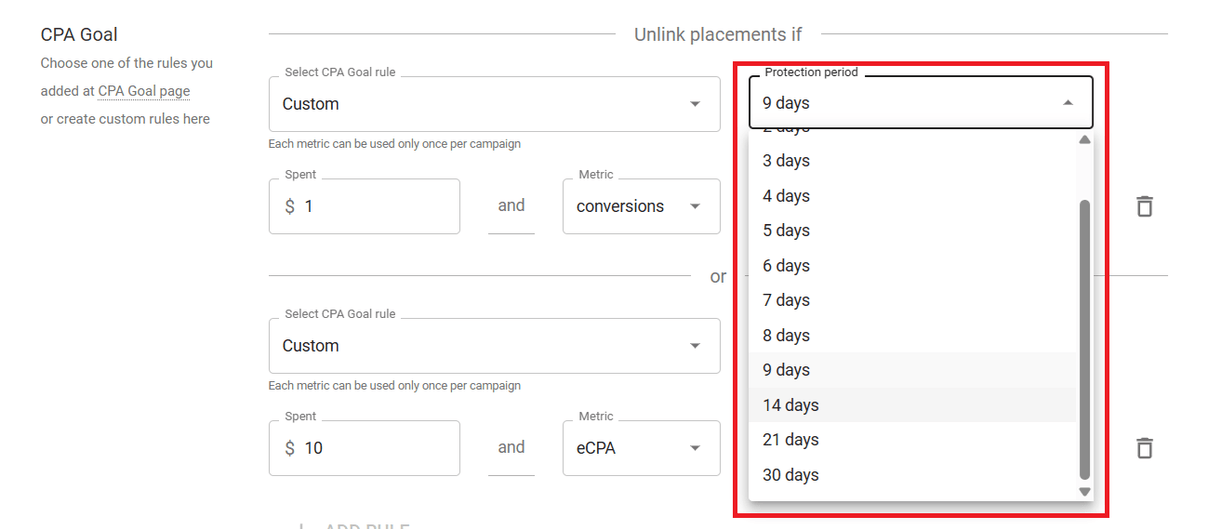
Click ADD RULE when finished with the settings. And let’s wrap up the setup process!
Step 3. Submit the campaign for review
As soon as you add the rule, enter all the required settings, click the PROCEED TO REVIEW button and recheck all critical parameters. Finally, click the CREATE CAMPAIGN button, and your campaign will enter a verification stage and go live as you scheduled. The smart algorithm will be applied immediately to all CPM/CPC traffic sources.
Reusing and adjusting CPA Goal rules
There is a more convenient way to create, adjust, and update the rules for smart optimization. From the vertical navigation bar, hit Campaigns > CPA Goal rules. On a new page, you can create rules to easily apply them to any campaign.
Below is the list of all optimization rules added. By clicking the Edit icon, you can correct the parameters, and the changes will be applied immediately.
Please note that you can’t create a compound rule (containing both eCPA and conversion parameters) on this page. But you can add two rules to any campaign, as outlined above.
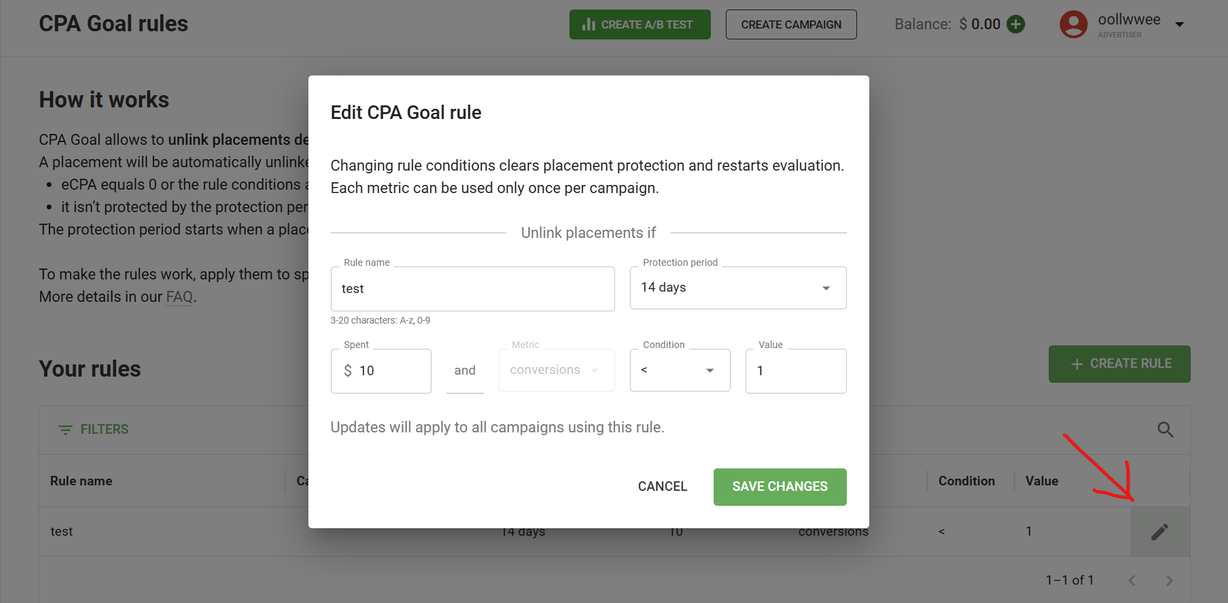
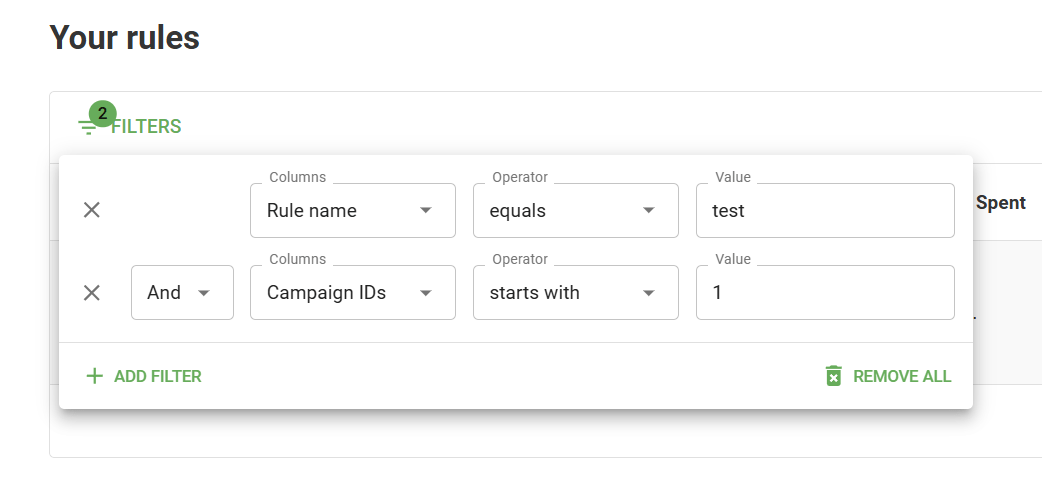
You can quickly check which campaigns a particular rule is applied to by using the Campaigns ID column or the available filters.
Strategies for CPA Goal optimization
We’ve made sure it’s an advanced optimization strategy powered by intelligent algorithms. It allows advertisers and affiliate marketers to reach the target payout for a conversion (CPA) while purchasing CPM or CPC traffic.
You pay less for traffic since they pay for ad impressions or clicks but achieve better results by optimizing this traffic by conversions or eCPA.
- Embrace huge amounts of traffic while testing and scaling your digital marketing campaigns
- Manage the number of conversions you can get with your targeting settings
- Control your spending and virtuously allocate budgets for the long-run campaigns
- Set up global-reach advertising campaigns without risks of overspending
If you’re an advertiser or affiliate marketer, you need to try it out. It’s an updated optimization tool that uses real data to deliver you both target actions and acceptable conversion cost.
Frequently asked questions (FAQs) about CPA Goal:
Target CPA vs CPA Goal: What’s the difference?
Both CPA Goal and Target CPA (or CPA Target) use smart algorithms to adjust spending based on performance metrics. But there is a difference in how they work. Target CPA bidding analyzes and optimizes bids using historical data and competitor signals from the same auction. With Target CPA, you maintain the average cost per conversion (target cost) you’re aiming at. On the contrary, CPA Goal asks you to enter critical parameters to filter out ad placements unlikely to drive enough high-quality conversions.
Is CPA Goal based on machine learning?
Yes, our system implements advanced machine learning algorithms to optimize CPM/CPC traffic for conversions and eCPA. These algorithms carry out complex data analysis to identify and select ad placements that align with your KPIs.
Is CPA Goal a bidding model?
Adsterra’s CPA Goal is not a bidding model or an automated bidding algorithm (like on Google or Apple Ads). Instead, it is an optimization algorithm that can be applied to CPM or CPC traffic. It enables you to automatically remove ad placements and exclude those that produce fewer conversions or cost too much.
Can I use the tool in any digital marketing campaign?
The tool may not be suitable for all campaigns. It requires a substantial number of impressions within your targeting, and it may not be the ideal tool for complex, expensive conversions like purchases and orders. If your campaign involves such conversions and you’re new to Adsterra, it is better to run a classic CPM campaign and manually optimize traffic slice by slice. Previously, we published a guide to running E-commerce ads where we listed several pro tips from our experts.
Why not buy CPA traffic from the start?
With some offers and products, it is much cheaper to buy impressions or clicks. In E-commerce marketing, for instance, every user action costs pretty much. But when you purchase CPM/CPC traffic, you can try all targets and embrace more impressions while keeping your KPIs safe thanks to smart optimization.
Can I edit CPA Goal rules?
Sure! From the CPA Goal Rules page, you can select a rule needed and make changes. They will be automatically applied to ad campaigns when they’ve been included. If you created a Custom rule per campaign, you’ll be able to edit it when editing this campaign. the recommended bid.
Where can I check all unlinked ad placements?
Open your current campaign with an active rule and scroll down to the Advanced settings section. All unlinked placements will be listed in a table.
In this table, you get all IDs excluded from your current campaign and the date when they were unlinked. You can look for a specific placement ID using the search field, select and copy IDs, download all unlinked placements as .CSV to save it as a blacklist for your further campaigns.
And the most important move: you can remove the placement or a group from this list returning them to your campaign. To do so, select one or several placements and hit Remove selected IDs.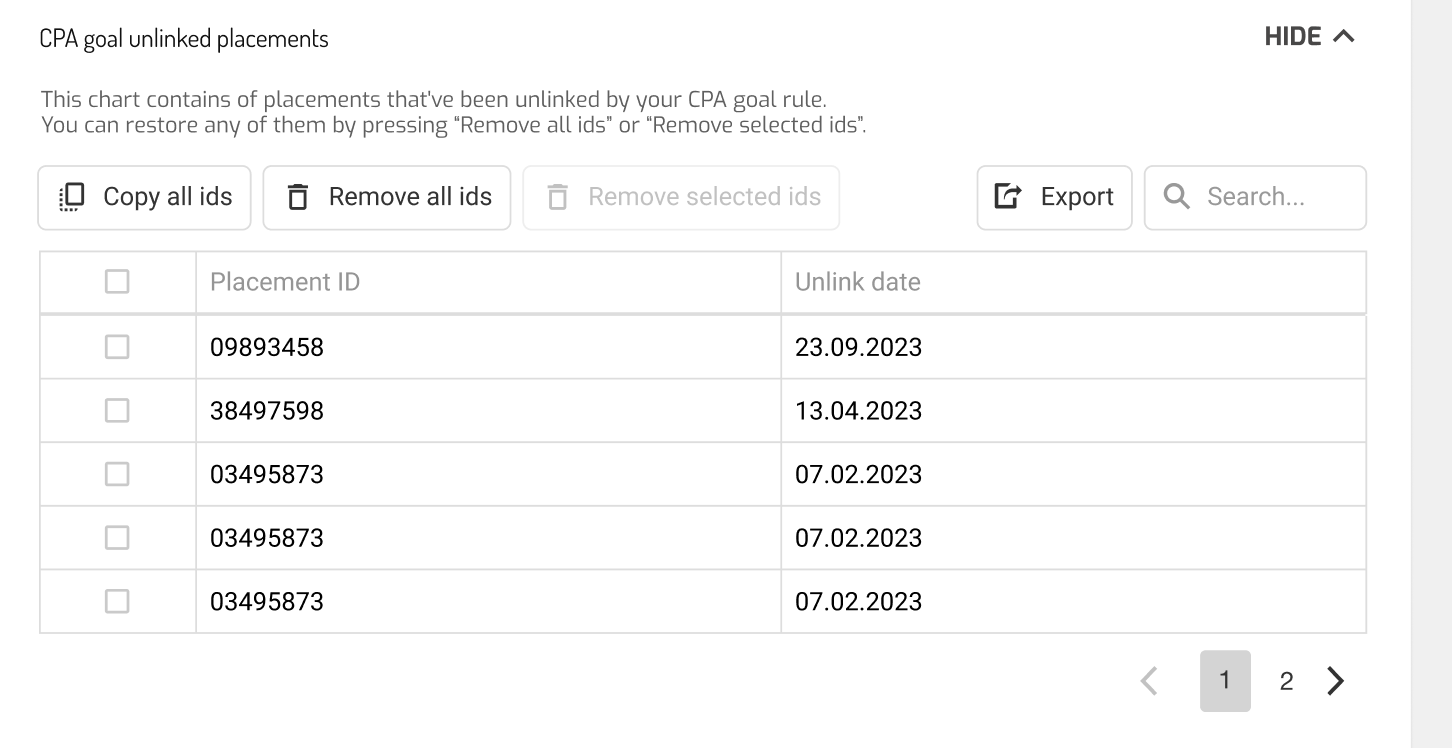
Can I save my rules?
Of course. You can create, edit and save as many rules as needed and apply them to any of your campaigns from the CPA Goal rules page.
When should I change CPA Goal?
It depends on many factors, such as your strategy, your vertical, your targeting, and more. If you notice you don’t get enough traffic, it is better to recheck the current amount of traffic available for your geo (you can do it using Traffic Chart) and the recommended bid.
Is CPA Goal enough to increase campaign effectiveness?
Optimizing for CPA requires refining targeting settings, improving landing pages, rethinking bidding strategies, and refreshing ad creatives. Use in-platform stats reports or data from your tracker to analyze historical data of campaign results; this helps set competitive CPA goals. Also, you can try automated bidding strategies like Smart CPM to reduce spending, but this will not be a conversion-based approach.
Can I save my rules?
Of course. You can create, edit, and save as many rules as needed and apply them to any of your campaigns from the CPA Goal rules page.
Does CPA Goal fit only new campaigns?
You can add a rule to any of your current ad groups. The tool analyzes statistics for the current month. This means that it will analyze all placements for the current month, as well, and next, unlink those that don’t meet your criteria.